

12.9 Periodic Structures
479
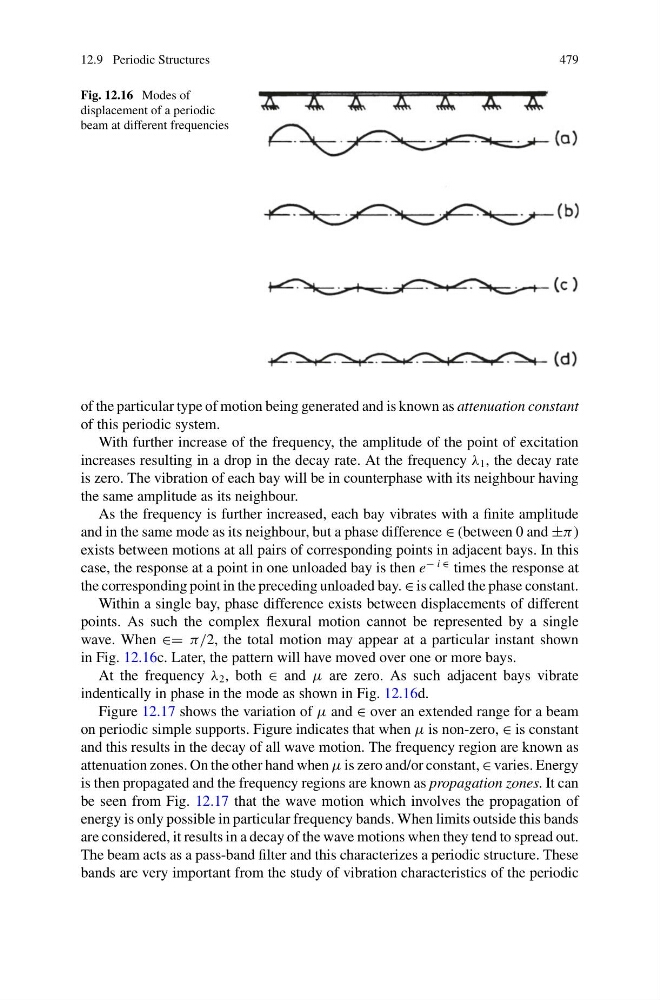
Fig. 12.16 Modes of
displacement of a periodic
beam at different frequencies
of the particular type of motion being generated and is known as attenuation constant
of this periodic system.
With further increase of the frequency, the amplitude of the point of excitation
increases resulting in a drop in the decay rate. At the frequency λ 1 , the decay rate
is zero. The vibration of each bay will be in counterphase with its neighbour having
the same amplitude as its neighbour.
As the frequency is further increased, each bay vibrates with a finite amplitude
and in the same mode as its neighbour, but a phase difference ∈ (between 0 and ±π )
exists between motions at all pairs of corresponding points in adjacent bays. In this
case, the response at a point in one unloaded bay is then e
− i ∈ times the response at
the corresponding point in the preceding unloaded bay. ∈ is called the phase constant.
Within a single bay, phase difference exists between displacements of different
points. As such the complex flexural motion cannot be represented by a single
wave. When ∈= π/2, the total motion may appear at a particular instant shown
in Fig. 12.16c. Later, the pattern will have moved over one or more bays.
At the frequency λ 2 , both ∈ and μ are zero. As such adjacent bays vibrate
indentically in phase in the mode as shown in Fig. 12.16d.
Figure 12.17 shows the variation of μ and ∈ over an extended range for a beam
on periodic simple supports. Figure indicates that when μ is non-zero, ∈ is constant
and this results in the decay of all wave motion. The frequency region are known as
attenuation zones. On the other hand when μ is zero and/or constant, ∈ varies. Energy
is then propagated and the frequency regions are known as propagation zones. It can
be seen from Fig. 12.17 that the wave motion which involves the propagation of
energy is only possible in particular frequency bands. When limits outside this bands
are considered, it results in a decay of the wave motions when they tend to spread out.
The beam acts as a pass-band filter and this characterizes a periodic structure. These
bands are very important from the study of vibration characteristics of the periodic
479
Fig. 12.16 Modes of
displacement of a periodic
beam at different frequencies
of the particular type of motion being generated and is known as attenuation constant
of this periodic system.
With further increase of the frequency, the amplitude of the point of excitation
increases resulting in a drop in the decay rate. At the frequency λ 1 , the decay rate
is zero. The vibration of each bay will be in counterphase with its neighbour having
the same amplitude as its neighbour.
As the frequency is further increased, each bay vibrates with a finite amplitude
and in the same mode as its neighbour, but a phase difference ∈ (between 0 and ±π )
exists between motions at all pairs of corresponding points in adjacent bays. In this
case, the response at a point in one unloaded bay is then e
− i ∈ times the response at
the corresponding point in the preceding unloaded bay. ∈ is called the phase constant.
Within a single bay, phase difference exists between displacements of different
points. As such the complex flexural motion cannot be represented by a single
wave. When ∈= π/2, the total motion may appear at a particular instant shown
in Fig. 12.16c. Later, the pattern will have moved over one or more bays.
At the frequency λ 2 , both ∈ and μ are zero. As such adjacent bays vibrate
indentically in phase in the mode as shown in Fig. 12.16d.
Figure 12.17 shows the variation of μ and ∈ over an extended range for a beam
on periodic simple supports. Figure indicates that when μ is non-zero, ∈ is constant
and this results in the decay of all wave motion. The frequency region are known as
attenuation zones. On the other hand when μ is zero and/or constant, ∈ varies. Energy
is then propagated and the frequency regions are known as propagation zones. It can
be seen from Fig. 12.17 that the wave motion which involves the propagation of
energy is only possible in particular frequency bands. When limits outside this bands
are considered, it results in a decay of the wave motions when they tend to spread out.
The beam acts as a pass-band filter and this characterizes a periodic structure. These
bands are very important from the study of vibration characteristics of the periodic