

480
12 Finite Element Method in Vibration Analysis
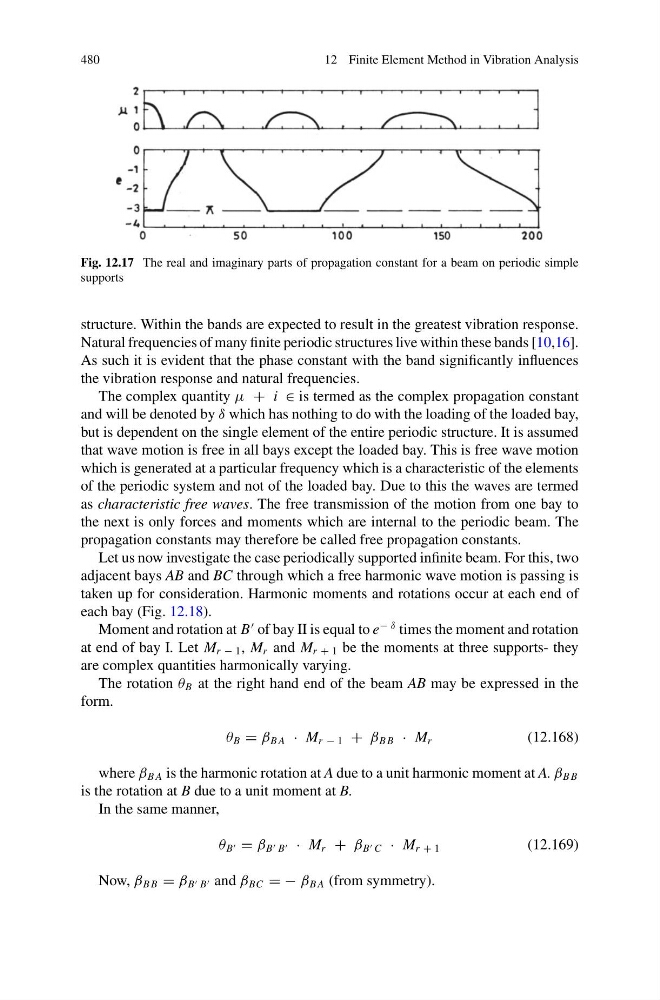
Fig. 12.17 The real and imaginary parts of propagation constant for a beam on periodic simple
supports
structure. Within the bands are expected to result in the greatest vibration response.
Natural frequencies of many finite periodic structures live within these bands [10,16].
As such it is evident that the phase constant with the band significantly influences
the vibration response and natural frequencies.
The complex quantity μ + i ∈ is termed as the complex propagation constant
and will be denoted by δ which has nothing to do with the loading of the loaded bay,
but is dependent on the single element of the entire periodic structure. It is assumed
that wave motion is free in all bays except the loaded bay. This is free wave motion
which is generated at a particular frequency which is a characteristic of the elements
of the periodic system and not of the loaded bay. Due to this the waves are termed
as characteristic free waves. The free transmission of the motion from one bay to
the next is only forces and moments which are internal to the periodic beam. The
propagation constants may therefore be called free propagation constants.
Let us now investigate the case periodically supported infinite beam. For this, two
adjacent bays AB and BC through which a free harmonic wave motion is passing is
taken up for consideration. Harmonic moments and rotations occur at each end of
each bay (Fig. 12.18).
Moment and rotation at B
of bay II is equal to e
− δ times the moment and rotation
at end of bay I. Let M r − 1 , M r and M r + 1 be the moments at three supports- they
are complex quantities harmonically varying.
The rotation θ B at the right hand end of the beam AB may be expressed in the
form.
θ B = β B A · M r − 1 + β B B · M r
(12.168)
where β B A is the harmonic rotation at A due to a unit harmonic moment at A. β B B
is the rotation at B due to a unit moment at B.
In the same manner,
θ B = β B B · M r + β B C · M r + 1
(12.169)
Now, β B B = β B B and β BC = − β B A (from symmetry).
12 Finite Element Method in Vibration Analysis
Fig. 12.17 The real and imaginary parts of propagation constant for a beam on periodic simple
supports
structure. Within the bands are expected to result in the greatest vibration response.
Natural frequencies of many finite periodic structures live within these bands [10,16].
As such it is evident that the phase constant with the band significantly influences
the vibration response and natural frequencies.
The complex quantity μ + i ∈ is termed as the complex propagation constant
and will be denoted by δ which has nothing to do with the loading of the loaded bay,
but is dependent on the single element of the entire periodic structure. It is assumed
that wave motion is free in all bays except the loaded bay. This is free wave motion
which is generated at a particular frequency which is a characteristic of the elements
of the periodic system and not of the loaded bay. Due to this the waves are termed
as characteristic free waves. The free transmission of the motion from one bay to
the next is only forces and moments which are internal to the periodic beam. The
propagation constants may therefore be called free propagation constants.
Let us now investigate the case periodically supported infinite beam. For this, two
adjacent bays AB and BC through which a free harmonic wave motion is passing is
taken up for consideration. Harmonic moments and rotations occur at each end of
each bay (Fig. 12.18).
Moment and rotation at B
of bay II is equal to e
− δ times the moment and rotation
at end of bay I. Let M r − 1 , M r and M r + 1 be the moments at three supports- they
are complex quantities harmonically varying.
The rotation θ B at the right hand end of the beam AB may be expressed in the
form.
θ B = β B A · M r − 1 + β B B · M r
(12.168)
where β B A is the harmonic rotation at A due to a unit harmonic moment at A. β B B
is the rotation at B due to a unit moment at B.
In the same manner,
θ B = β B B · M r + β B C · M r + 1
(12.169)
Now, β B B = β B B and β BC = − β B A (from symmetry).