

478
12 Finite Element Method in Vibration Analysis
examples are a jack-up-rig used for oil drilling in the ocean bed and multi-storey
building in modular construction.
12.9.2 Free Harmonic Wave Motion Through
a Mono-coupled Periodic Beam
A beam extending to infinity and having equally spaced simple supports is considered.
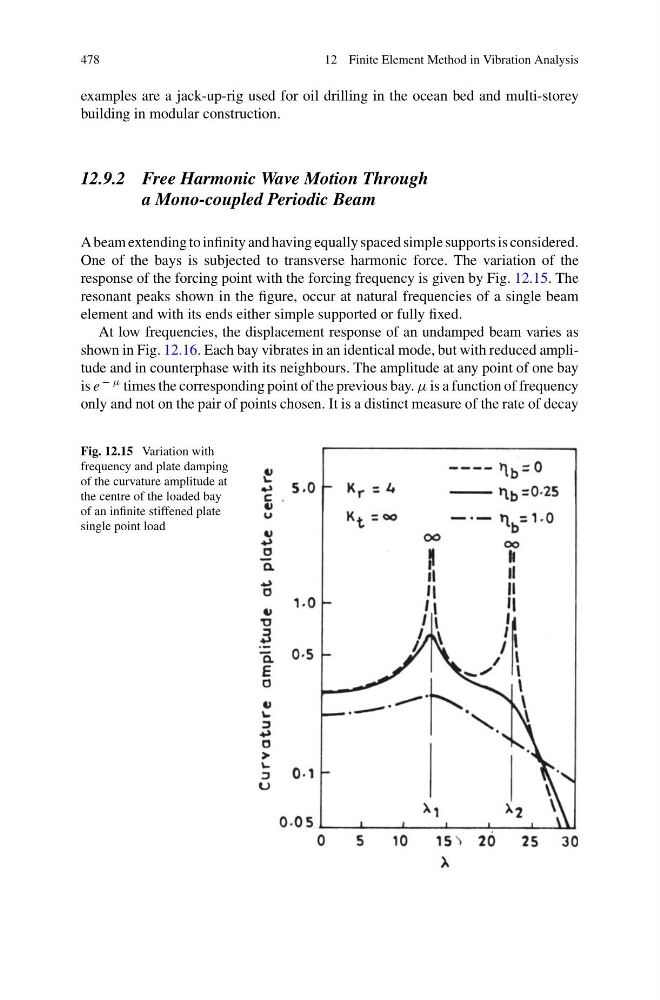
One of the bays is subjected to transverse harmonic force. The variation of the
response of the forcing point with the forcing frequency is given by Fig. 12.15. The
resonant peaks shown in the figure, occur at natural frequencies of a single beam
element and with its ends either simple supported or fully fixed.
At low frequencies, the displacement response of an undamped beam varies as
shown in Fig. 12.16. Each bay vibrates in an identical mode, but with reduced amplitude and in counterphase with its neighbours. The amplitude at any point of one bay
is e
− μ times the corresponding point of the previous bay. μ is a function of frequency
only and not on the pair of points chosen. It is a distinct measure of the rate of decay
Fig. 12.15 Variation with
frequency and plate damping
of the curvature amplitude at
the centre of the loaded bay
of an infinite stiffened plate
single point load
12 Finite Element Method in Vibration Analysis
examples are a jack-up-rig used for oil drilling in the ocean bed and multi-storey
building in modular construction.
12.9.2 Free Harmonic Wave Motion Through
a Mono-coupled Periodic Beam
A beam extending to infinity and having equally spaced simple supports is considered.
One of the bays is subjected to transverse harmonic force. The variation of the
response of the forcing point with the forcing frequency is given by Fig. 12.15. The
resonant peaks shown in the figure, occur at natural frequencies of a single beam
element and with its ends either simple supported or fully fixed.
At low frequencies, the displacement response of an undamped beam varies as
shown in Fig. 12.16. Each bay vibrates in an identical mode, but with reduced amplitude and in counterphase with its neighbours. The amplitude at any point of one bay
is e
− μ times the corresponding point of the previous bay. μ is a function of frequency
only and not on the pair of points chosen. It is a distinct measure of the rate of decay
Fig. 12.15 Variation with
frequency and plate damping
of the curvature amplitude at
the centre of the loaded bay
of an infinite stiffened plate
single point load