

474
12 Finite Element Method in Vibration Analysis
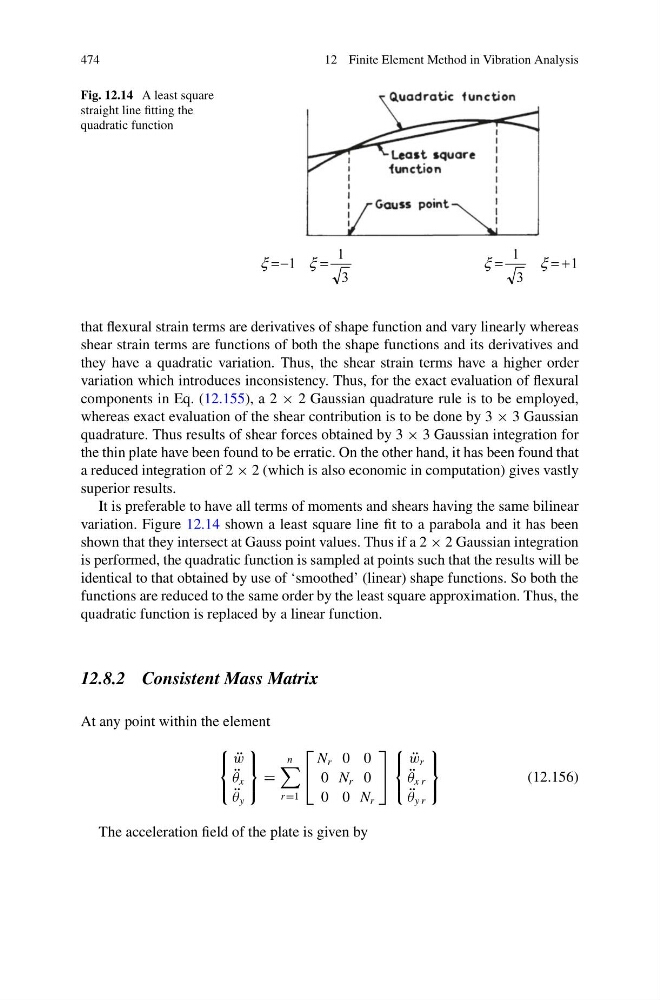
Fig. 12.14 A least square
straight line fitting the
quadratic function
1
−
=
ξ
3
1
=
ξ
3
1
=
ξ
1
+
=
ξ
that flexural strain terms are derivatives of shape function and vary linearly whereas
shear strain terms are functions of both the shape functions and its derivatives and
they have a quadratic variation. Thus, the shear strain terms have a higher order
variation which introduces inconsistency. Thus, for the exact evaluation of flexural
components in Eq. (12.155), a 2 × 2 Gaussian quadrature rule is to be employed,
whereas exact evaluation of the shear contribution is to be done by 3 × 3 Gaussian
quadrature. Thus results of shear forces obtained by 3 × 3 Gaussian integration for
the thin plate have been found to be erratic. On the other hand, it has been found that
a reduced integration of 2 × 2 (which is also economic in computation) gives vastly
superior results.
It is preferable to have all terms of moments and shears having the same bilinear
variation. Figure 12.14 shown a least square line fit to a parabola and it has been
shown that they intersect at Gauss point values. Thus if a 2 × 2 Gaussian integration
is performed, the quadratic function is sampled at points such that the results will be
identical to that obtained by use of ‘smoothed’ (linear) shape functions. So both the
functions are reduced to the same order by the least square approximation. Thus, the
quadratic function is replaced by a linear function.
12.8.2 Consistent Mass Matrix
At any point within the element
⎧
⎨
⎩
¨
w
¨
θ x
¨
θ y
⎫
⎬
⎭
=
n
r =1
⎡
⎣
N r 0 0
0 N r 0
0 0 N r
⎤
⎦
⎧
⎨
⎩
¨
w r
¨
θ x r
¨
θ y r
⎫
⎬
⎭
(12.156)
The acceleration field of the plate is given by
12 Finite Element Method in Vibration Analysis
Fig. 12.14 A least square
straight line fitting the
quadratic function
1
−
=
ξ
3
1
=
ξ
3
1
=
ξ
1
+
=
ξ
that flexural strain terms are derivatives of shape function and vary linearly whereas
shear strain terms are functions of both the shape functions and its derivatives and
they have a quadratic variation. Thus, the shear strain terms have a higher order
variation which introduces inconsistency. Thus, for the exact evaluation of flexural
components in Eq. (12.155), a 2 × 2 Gaussian quadrature rule is to be employed,
whereas exact evaluation of the shear contribution is to be done by 3 × 3 Gaussian
quadrature. Thus results of shear forces obtained by 3 × 3 Gaussian integration for
the thin plate have been found to be erratic. On the other hand, it has been found that
a reduced integration of 2 × 2 (which is also economic in computation) gives vastly
superior results.
It is preferable to have all terms of moments and shears having the same bilinear
variation. Figure 12.14 shown a least square line fit to a parabola and it has been
shown that they intersect at Gauss point values. Thus if a 2 × 2 Gaussian integration
is performed, the quadratic function is sampled at points such that the results will be
identical to that obtained by use of ‘smoothed’ (linear) shape functions. So both the
functions are reduced to the same order by the least square approximation. Thus, the
quadratic function is replaced by a linear function.
12.8.2 Consistent Mass Matrix
At any point within the element
⎧
⎨
⎩
¨
w
¨
θ x
¨
θ y
⎫
⎬
⎭
=
n
r =1
⎡
⎣
N r 0 0
0 N r 0
0 0 N r
⎤
⎦
⎧
⎨
⎩
¨
w r
¨
θ x r
¨
θ y r
⎫
⎬
⎭
(12.156)
The acceleration field of the plate is given by