

12.8 Flexural Vibrations of Plates Using Isoparametric Elements
473
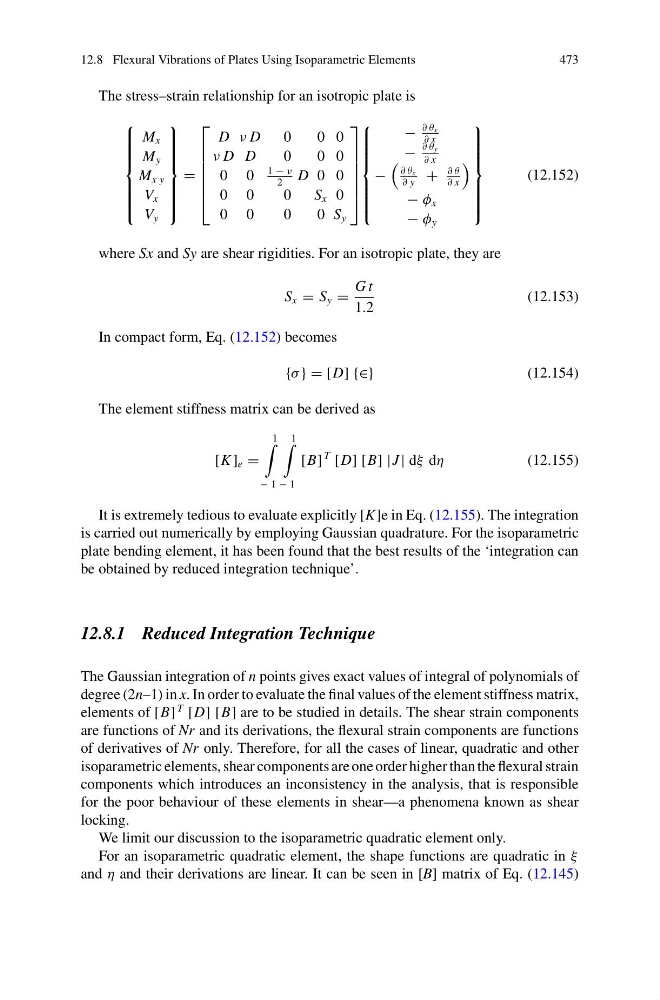
The stress–strain relationship for an isotropic plate is
⎧
⎪ ⎪ ⎪ ⎪ ⎪ ⎨
⎪ ⎪ ⎪ ⎪ ⎪ ⎩
M x
M y
M x y
V x
V y
⎫
⎪ ⎪ ⎪ ⎪ ⎪ ⎬
⎪ ⎪ ⎪ ⎪ ⎪ ⎭
=
⎡
⎢
⎢
⎢
⎢
⎢
⎣
D ν D
0
0 0
ν D D
0
0 0
0 0
1 − ν
2
D 0 0
0 0
0
S x 0
0 0
0
0 S y
⎤
⎥
⎥
⎥
⎥
⎥
⎦
⎧
⎪ ⎪ ⎪ ⎪ ⎪ ⎨
⎪ ⎪ ⎪ ⎪ ⎪ ⎩
−
∂ θ x
∂ x
−
∂ θ y
∂ x
−
∂ θ x
∂ y
+
∂ θ
∂ x
− φ x
− φ y
⎫
⎪ ⎪ ⎪ ⎪ ⎪ ⎬
⎪ ⎪ ⎪ ⎪ ⎪ ⎭
(12.152)
where Sx and Sy are shear rigidities. For an isotropic plate, they are
S x = S y =
G t
1.2
(12.153)
In compact form, Eq. (12.152) becomes
{σ } = [D] {∈}
(12.154)
The element stiffness matrix can be derived as
[K ] e =
1
− 1
1
− 1
[B]
T
[D] [B] |J | dξ dη
(12.155)
It is extremely tedious to evaluate explicitly [K]e in Eq. (12.155). The integration
is carried out numerically by employing Gaussian quadrature. For the isoparametric
plate bending element, it has been found that the best results of the ‘integration can
be obtained by reduced integration technique’.
12.8.1 Reduced Integration Technique
The Gaussian integration of n points gives exact values of integral of polynomials of
degree (2n–1) in x. In order to evaluate the final values of the element stiffness matrix,
elements of [B]
T
[D] [B] are to be studied in details. The shear strain components
are functions of Nr and its derivations, the flexural strain components are functions
of derivatives of Nr only. Therefore, for all the cases of linear, quadratic and other
isoparametric elements, shear components are one order higher than the flexural strain
components which introduces an inconsistency in the analysis, that is responsible
for the poor behaviour of these elements in shear—a phenomena known as shear
locking.
We limit our discussion to the isoparametric quadratic element only.
For an isoparametric quadratic element, the shape functions are quadratic in ξ
and η and their derivations are linear. It can be seen in [B] matrix of Eq. (12.145)
473
The stress–strain relationship for an isotropic plate is
⎧
⎪ ⎪ ⎪ ⎪ ⎪ ⎨
⎪ ⎪ ⎪ ⎪ ⎪ ⎩
M x
M y
M x y
V x
V y
⎫
⎪ ⎪ ⎪ ⎪ ⎪ ⎬
⎪ ⎪ ⎪ ⎪ ⎪ ⎭
=
⎡
⎢
⎢
⎢
⎢
⎢
⎣
D ν D
0
0 0
ν D D
0
0 0
0 0
1 − ν
2
D 0 0
0 0
0
S x 0
0 0
0
0 S y
⎤
⎥
⎥
⎥
⎥
⎥
⎦
⎧
⎪ ⎪ ⎪ ⎪ ⎪ ⎨
⎪ ⎪ ⎪ ⎪ ⎪ ⎩
−
∂ θ x
∂ x
−
∂ θ y
∂ x
−
∂ θ x
∂ y
+
∂ θ
∂ x
− φ x
− φ y
⎫
⎪ ⎪ ⎪ ⎪ ⎪ ⎬
⎪ ⎪ ⎪ ⎪ ⎪ ⎭
(12.152)
where Sx and Sy are shear rigidities. For an isotropic plate, they are
S x = S y =
G t
1.2
(12.153)
In compact form, Eq. (12.152) becomes
{σ } = [D] {∈}
(12.154)
The element stiffness matrix can be derived as
[K ] e =
1
− 1
1
− 1
[B]
T
[D] [B] |J | dξ dη
(12.155)
It is extremely tedious to evaluate explicitly [K]e in Eq. (12.155). The integration
is carried out numerically by employing Gaussian quadrature. For the isoparametric
plate bending element, it has been found that the best results of the ‘integration can
be obtained by reduced integration technique’.
12.8.1 Reduced Integration Technique
The Gaussian integration of n points gives exact values of integral of polynomials of
degree (2n–1) in x. In order to evaluate the final values of the element stiffness matrix,
elements of [B]
T
[D] [B] are to be studied in details. The shear strain components
are functions of Nr and its derivations, the flexural strain components are functions
of derivatives of Nr only. Therefore, for all the cases of linear, quadratic and other
isoparametric elements, shear components are one order higher than the flexural strain
components which introduces an inconsistency in the analysis, that is responsible
for the poor behaviour of these elements in shear—a phenomena known as shear
locking.
We limit our discussion to the isoparametric quadratic element only.
For an isoparametric quadratic element, the shape functions are quadratic in ξ
and η and their derivations are linear. It can be seen in [B] matrix of Eq. (12.145)