

12.8 Flexural Vibrations of Plates Using Isoparametric Elements
475
{ f } =
⎧
⎨
⎩
¨
U
¨
V
¨
W
⎫
⎬
⎭
=
⎧
⎨
⎩
− z ¨
θ x
− z ¨
θ y
¨
w
⎫
⎬
⎭
(12.157)
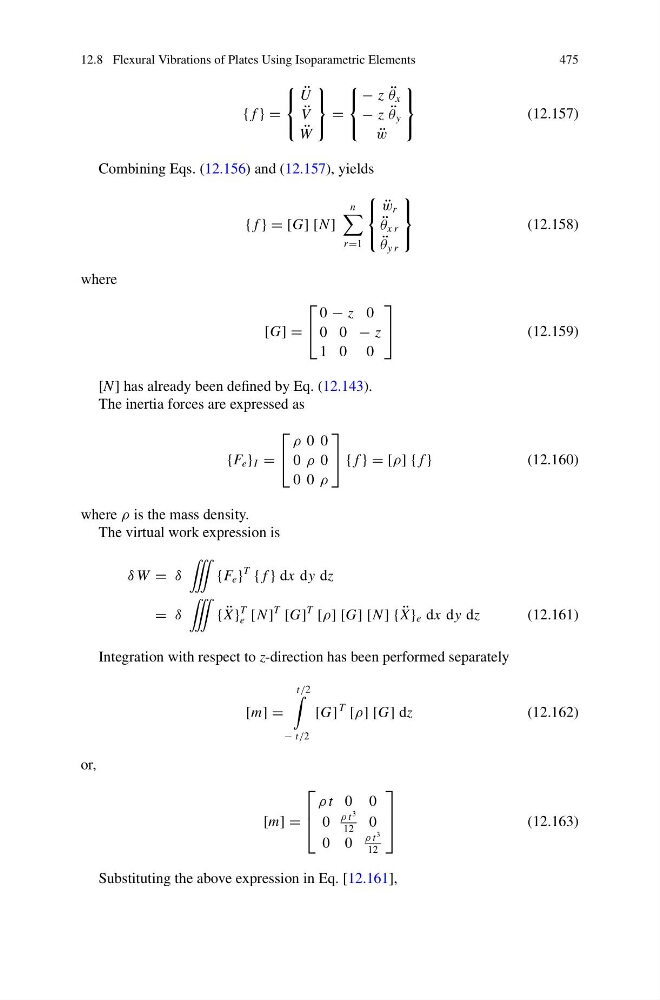
Combining Eqs. (12.156) and (12.157), yields
{ f } = [G] [N ]
n
r =1
⎧
⎨
⎩
¨
w r
¨
θ x r
¨
θ y r
⎫
⎬
⎭
(12.158)
where
[G] =
⎡
⎣
0 − z 0
0 0 − z
1 0 0
⎤
⎦
(12.159)
[N] has already been defined by Eq. (12.143).
The inertia forces are expressed as
{F e } I =
⎡
⎣
ρ 0 0
0 ρ 0
0 0 ρ
⎤
⎦ { f } = [ρ] { f }
(12.160)
where ρ is the mass density.
The virtual work expression is
δ W = δ
˚
{F e }
T
{ f } dx dy dz
= δ
˚
{ ¨
X }
T
e [N ]
T
[G]
T
[ρ] [G] [N ] { ¨
X } e dx dy dz
(12.161)
Integration with respect to z-direction has been performed separately
[m] =
t/2
− t/2
[G]
T
[ρ] [G] dz
(12.162)
or,
[m] =
⎡
⎢
⎣
ρ t 0 0
0
ρ t
3
12
0
0 0
ρ t
3
12
⎤
⎥
⎦
(12.163)
Substituting the above expression in Eq. [12.161],
475
{ f } =
⎧
⎨
⎩
¨
U
¨
V
¨
W
⎫
⎬
⎭
=
⎧
⎨
⎩
− z ¨
θ x
− z ¨
θ y
¨
w
⎫
⎬
⎭
(12.157)
Combining Eqs. (12.156) and (12.157), yields
{ f } = [G] [N ]
n
r =1
⎧
⎨
⎩
¨
w r
¨
θ x r
¨
θ y r
⎫
⎬
⎭
(12.158)
where
[G] =
⎡
⎣
0 − z 0
0 0 − z
1 0 0
⎤
⎦
(12.159)
[N] has already been defined by Eq. (12.143).
The inertia forces are expressed as
{F e } I =
⎡
⎣
ρ 0 0
0 ρ 0
0 0 ρ
⎤
⎦ { f } = [ρ] { f }
(12.160)
where ρ is the mass density.
The virtual work expression is
δ W = δ
˚
{F e }
T
{ f } dx dy dz
= δ
˚
{ ¨
X }
T
e [N ]
T
[G]
T
[ρ] [G] [N ] { ¨
X } e dx dy dz
(12.161)
Integration with respect to z-direction has been performed separately
[m] =
t/2
− t/2
[G]
T
[ρ] [G] dz
(12.162)
or,
[m] =
⎡
⎢
⎣
ρ t 0 0
0
ρ t
3
12
0
0 0
ρ t
3
12
⎤
⎥
⎦
(12.163)
Substituting the above expression in Eq. [12.161],