

468
12 Finite Element Method in Vibration Analysis
By performing the necessary differentiation in Eq. (12.124), the resulting equation
can be written as
{∈} = [B] {X } e
(12.127)
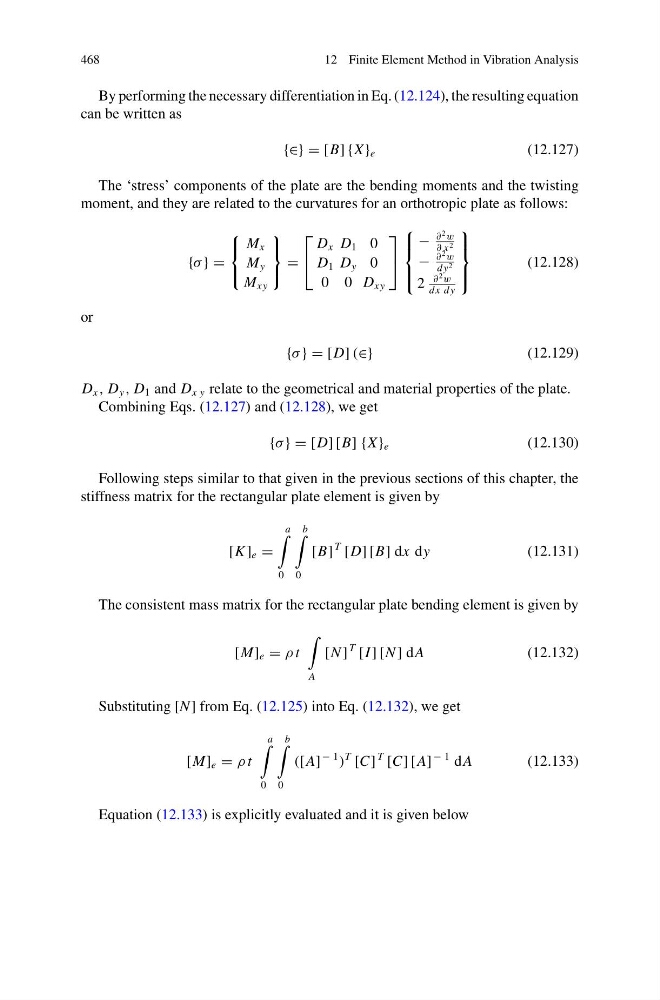
The ‘stress’ components of the plate are the bending moments and the twisting
moment, and they are related to the curvatures for an orthotropic plate as follows:
{σ } =
⎧
⎨
⎩
M x
M y
M xy
⎫
⎬
⎭
=
⎡
⎣
D x D 1 0
D 1 D y 0
0 0 D xy
⎤
⎦
⎧
⎪ ⎨
⎪ ⎩
−
∂
2 w
∂ x 2
−
∂
2 w
dy 2
2
∂
2 w
dx dy
⎫
⎪ ⎬
⎪ ⎭
(12.128)
or
{σ } = [D] (∈}
(12.129)
D x , D y , D 1 and D x y relate to the geometrical and material properties of the plate.
Combining Eqs. (12.127) and (12.128), we get
{σ } = [D] [B] {X } e
(12.130)
Following steps similar to that given in the previous sections of this chapter, the
stiffness matrix for the rectangular plate element is given by
[K ] e =
a
0
b
0
[B]
T
[D] [B] dx dy
(12.131)
The consistent mass matrix for the rectangular plate bending element is given by
[M] e = ρ t
A
[N ]
T
[I ] [N ] dA
(12.132)
Substituting [N] from Eq. (12.125) into Eq. (12.132), we get
[M] e = ρ t
a
0
b
0
([A]
− 1
)
T
[C]
T
[C] [A]
− 1 dA
(12.133)
Equation (12.133) is explicitly evaluated and it is given below
12 Finite Element Method in Vibration Analysis
By performing the necessary differentiation in Eq. (12.124), the resulting equation
can be written as
{∈} = [B] {X } e
(12.127)
The ‘stress’ components of the plate are the bending moments and the twisting
moment, and they are related to the curvatures for an orthotropic plate as follows:
{σ } =
⎧
⎨
⎩
M x
M y
M xy
⎫
⎬
⎭
=
⎡
⎣
D x D 1 0
D 1 D y 0
0 0 D xy
⎤
⎦
⎧
⎪ ⎨
⎪ ⎩
−
∂
2 w
∂ x 2
−
∂
2 w
dy 2
2
∂
2 w
dx dy
⎫
⎪ ⎬
⎪ ⎭
(12.128)
or
{σ } = [D] (∈}
(12.129)
D x , D y , D 1 and D x y relate to the geometrical and material properties of the plate.
Combining Eqs. (12.127) and (12.128), we get
{σ } = [D] [B] {X } e
(12.130)
Following steps similar to that given in the previous sections of this chapter, the
stiffness matrix for the rectangular plate element is given by
[K ] e =
a
0
b
0
[B]
T
[D] [B] dx dy
(12.131)
The consistent mass matrix for the rectangular plate bending element is given by
[M] e = ρ t
A
[N ]
T
[I ] [N ] dA
(12.132)
Substituting [N] from Eq. (12.125) into Eq. (12.132), we get
[M] e = ρ t
a
0
b
0
([A]
− 1
)
T
[C]
T
[C] [A]
− 1 dA
(12.133)
Equation (12.133) is explicitly evaluated and it is given below