

12.7 Flexural Vibration of Plates
469
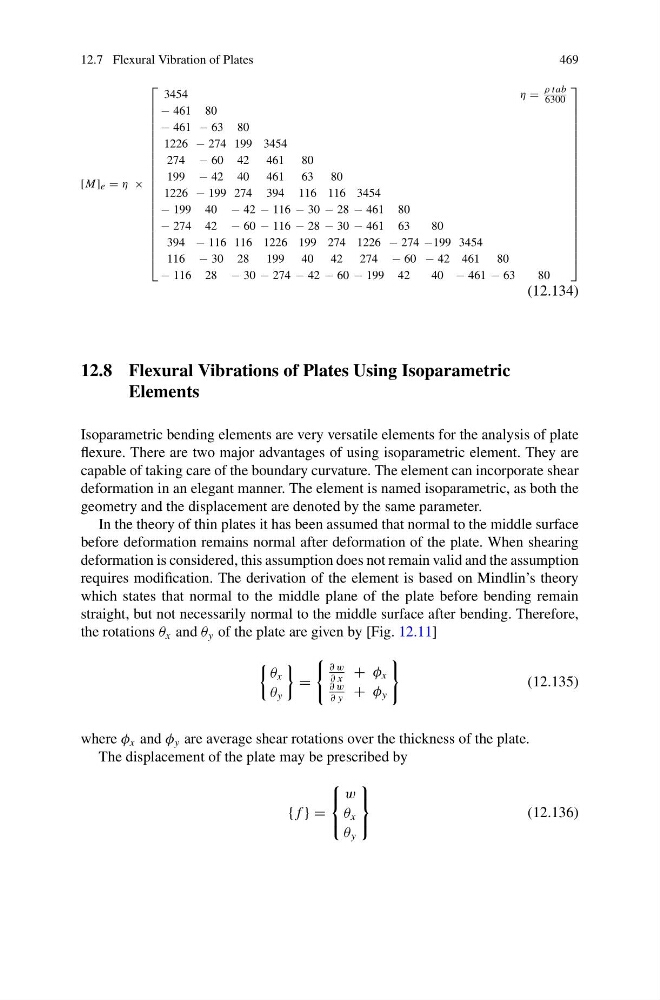
[M] e = η ×
⎡
⎢
⎢
⎢
⎢
⎢
⎢
⎢
⎢
⎢
⎢
⎢
⎢
⎢
⎢
⎢
⎢
⎢
⎢
⎢
⎢
⎢
⎣
3454
η =
ρ tab
6300
− 461 80
− 461 − 63 80
1226 − 274 199 3454
274 − 60 42 461 80
199 − 42 40 461 63 80
1226 − 199 274 394 116 116 3454
− 199 40 − 42 − 116 − 30 − 28 − 461 80
− 274 42 − 60 − 116 − 28 − 30 − 461 63
80
394 − 116 116 1226 199 274 1226 − 274 −199 3454
116 − 30 28 199 40 42 274 − 60 − 42 461 80
− 116 28 − 30 − 274 − 42 − 60 − 199 42
40 − 461 − 63
80
⎤
⎥
⎥
⎥
⎥
⎥
⎥
⎥
⎥
⎥
⎥
⎥
⎥
⎥
⎥
⎥
⎥
⎥
⎥
⎥
⎥
⎥
⎦
(12.134)
12.8 Flexural Vibrations of Plates Using Isoparametric
Elements
Isoparametric bending elements are very versatile elements for the analysis of plate
flexure. There are two major advantages of using isoparametric element. They are
capable of taking care of the boundary curvature. The element can incorporate shear
deformation in an elegant manner. The element is named isoparametric, as both the
geometry and the displacement are denoted by the same parameter.
In the theory of thin plates it has been assumed that normal to the middle surface
before deformation remains normal after deformation of the plate. When shearing
deformation is considered, this assumption does not remain valid and the assumption
requires modification. The derivation of the element is based on Mindlin’s theory
which states that normal to the middle plane of the plate before bending remain
straight, but not necessarily normal to the middle surface after bending. Therefore,
the rotations θ x and θ y of the plate are given by [Fig. 12.11]
θ x
θ y
=
∂ w
∂ x
+ φ x
∂ w
∂ y
+ φ y
(12.135)
where φ x and φ y are average shear rotations over the thickness of the plate.
The displacement of the plate may be prescribed by
{ f } =
⎧
⎨
⎩
w
θ x
θ y
⎫
⎬
⎭
(12.136)
469
[M] e = η ×
⎡
⎢
⎢
⎢
⎢
⎢
⎢
⎢
⎢
⎢
⎢
⎢
⎢
⎢
⎢
⎢
⎢
⎢
⎢
⎢
⎢
⎢
⎣
3454
η =
ρ tab
6300
− 461 80
− 461 − 63 80
1226 − 274 199 3454
274 − 60 42 461 80
199 − 42 40 461 63 80
1226 − 199 274 394 116 116 3454
− 199 40 − 42 − 116 − 30 − 28 − 461 80
− 274 42 − 60 − 116 − 28 − 30 − 461 63
80
394 − 116 116 1226 199 274 1226 − 274 −199 3454
116 − 30 28 199 40 42 274 − 60 − 42 461 80
− 116 28 − 30 − 274 − 42 − 60 − 199 42
40 − 461 − 63
80
⎤
⎥
⎥
⎥
⎥
⎥
⎥
⎥
⎥
⎥
⎥
⎥
⎥
⎥
⎥
⎥
⎥
⎥
⎥
⎥
⎥
⎥
⎦
(12.134)
12.8 Flexural Vibrations of Plates Using Isoparametric
Elements
Isoparametric bending elements are very versatile elements for the analysis of plate
flexure. There are two major advantages of using isoparametric element. They are
capable of taking care of the boundary curvature. The element can incorporate shear
deformation in an elegant manner. The element is named isoparametric, as both the
geometry and the displacement are denoted by the same parameter.
In the theory of thin plates it has been assumed that normal to the middle surface
before deformation remains normal after deformation of the plate. When shearing
deformation is considered, this assumption does not remain valid and the assumption
requires modification. The derivation of the element is based on Mindlin’s theory
which states that normal to the middle plane of the plate before bending remain
straight, but not necessarily normal to the middle surface after bending. Therefore,
the rotations θ x and θ y of the plate are given by [Fig. 12.11]
θ x
θ y
=
∂ w
∂ x
+ φ x
∂ w
∂ y
+ φ y
(12.135)
where φ x and φ y are average shear rotations over the thickness of the plate.
The displacement of the plate may be prescribed by
{ f } =
⎧
⎨
⎩
w
θ x
θ y
⎫
⎬
⎭
(12.136)