

462
12 Finite Element Method in Vibration Analysis
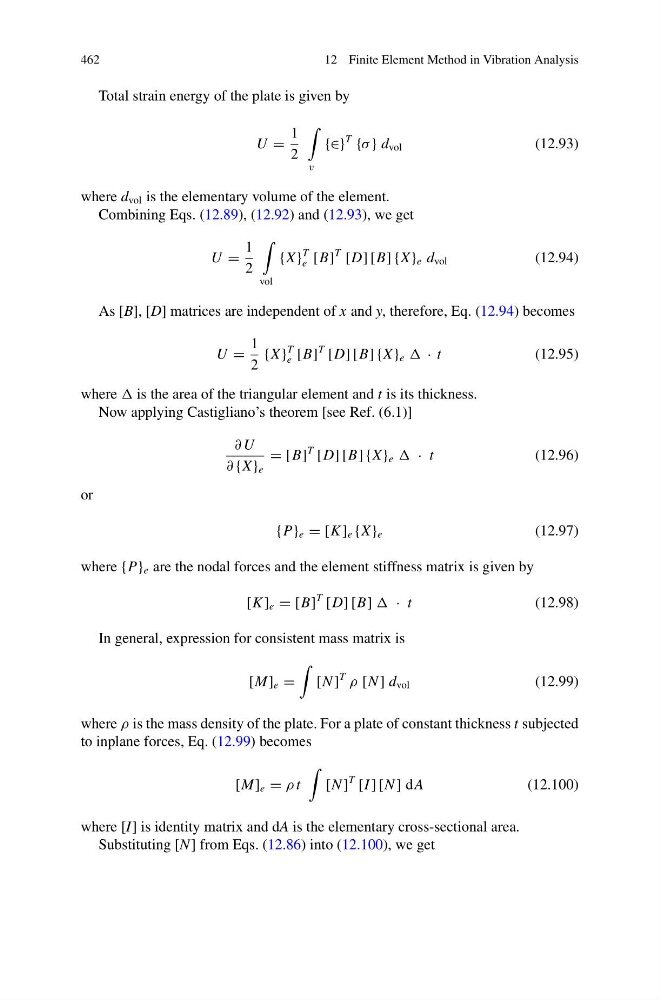
Total strain energy of the plate is given by
U =
1
2
v
{∈}
T
{σ } d vol
(12.93)
where d vol is the elementary volume of the element.
Combining Eqs. (12.89), (12.92) and (12.93), we get
U =
1
2
vol
{X }
T
e [B]
T
[D] [B] {X } e d vol
(12.94)
As [B], [D] matrices are independent of x and y, therefore, Eq. (12.94) becomes
U =
1
2
{X }
T
e [B]
T
[D] [B] {X } e · t
(12.95)
where is the area of the triangular element and t is its thickness.
Now applying Castigliano’s theorem [see Ref. (6.1)]
∂ U
∂ {X } e
= [B]
T
[D] [B] {X } e · t
(12.96)
or
{P} e = [K ] e {X } e
(12.97)
where {P} e are the nodal forces and the element stiffness matrix is given by
[K ] e = [B]
T
[D] [B] · t
(12.98)
In general, expression for consistent mass matrix is
[M] e =
[N ]
T
ρ [N ] d vol
(12.99)
where ρ is the mass density of the plate. For a plate of constant thickness t subjected
to inplane forces, Eq. (12.99) becomes
[M] e = ρ t
[N ]
T
[I ] [N ] dA
(12.100)
where [I] is identity matrix and dA is the elementary cross-sectional area.
Substituting [N] from Eqs. (12.86) into (12.100), we get
12 Finite Element Method in Vibration Analysis
Total strain energy of the plate is given by
U =
1
2
v
{∈}
T
{σ } d vol
(12.93)
where d vol is the elementary volume of the element.
Combining Eqs. (12.89), (12.92) and (12.93), we get
U =
1
2
vol
{X }
T
e [B]
T
[D] [B] {X } e d vol
(12.94)
As [B], [D] matrices are independent of x and y, therefore, Eq. (12.94) becomes
U =
1
2
{X }
T
e [B]
T
[D] [B] {X } e · t
(12.95)
where is the area of the triangular element and t is its thickness.
Now applying Castigliano’s theorem [see Ref. (6.1)]
∂ U
∂ {X } e
= [B]
T
[D] [B] {X } e · t
(12.96)
or
{P} e = [K ] e {X } e
(12.97)
where {P} e are the nodal forces and the element stiffness matrix is given by
[K ] e = [B]
T
[D] [B] · t
(12.98)
In general, expression for consistent mass matrix is
[M] e =
[N ]
T
ρ [N ] d vol
(12.99)
where ρ is the mass density of the plate. For a plate of constant thickness t subjected
to inplane forces, Eq. (12.99) becomes
[M] e = ρ t
[N ]
T
[I ] [N ] dA
(12.100)
where [I] is identity matrix and dA is the elementary cross-sectional area.
Substituting [N] from Eqs. (12.86) into (12.100), we get