

12.6 Inplane Vibration of Plates
461
{X } e = [A] {α}
(12.84)
Combining Eqs. (12.82) and (12.84), we get
{ f } = [N ] {X } e
(12.85)
where
[N ] = [C] [A]
− 1
(12.86)
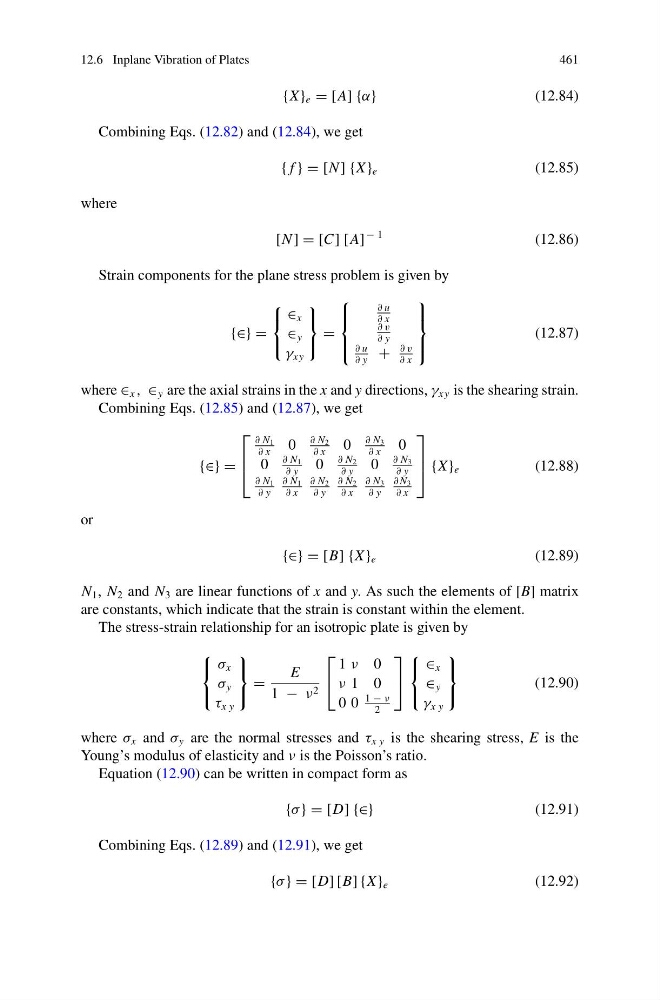
Strain components for the plane stress problem is given by
{∈} =
⎧
⎨
⎩
∈ x
∈ y
γ xy
⎫
⎬
⎭
=
⎧
⎪ ⎨
⎪ ⎩
∂ u
∂ x
∂ v
∂ y
∂ u
∂ y
+
∂ v
∂ x
⎫
⎪ ⎬
⎪ ⎭
(12.87)
where ∈ x , ∈ y are the axial strains in the x and y directions, γ xy is the shearing strain.
Combining Eqs. (12.85) and (12.87), we get
{∈} =
⎡
⎢
⎣
∂ N 1
∂ x
0
∂ N 2
∂ x
0
∂ N 3
∂ x
0
0
∂ N 1
∂ y
0
∂ N 2
∂ y
0
∂ N 3
∂ y
∂ N 1
∂ y
∂ N 1
∂ x
∂ N 2
∂ y
∂ N 2
∂ x
∂ N 3
∂ y
∂ N 3
∂ x
⎤
⎥
⎦ {X } e
(12.88)
or
{∈} = [B] {X } e
(12.89)
N 1 , N 2 and N 3 are linear functions of x and y. As such the elements of [B] matrix
are constants, which indicate that the strain is constant within the element.
The stress-strain relationship for an isotropic plate is given by
⎧
⎨
⎩
σ x
σ y
τ x y
⎫
⎬
⎭
=
E
1 − ν 2
⎡
⎣
1 ν 0
ν 1 0
0 0
1 − ν
2
⎤
⎦
⎧
⎨
⎩
∈ x
∈ y
γ x y
⎫
⎬
⎭
(12.90)
where σ x and σ y are the normal stresses and τ x y is the shearing stress, E is the
Young’s modulus of elasticity and ν is the Poisson’s ratio.
Equation (12.90) can be written in compact form as
{σ } = [D] {∈}
(12.91)
Combining Eqs. (12.89) and (12.91), we get
{σ } = [D] [B] {X } e
(12.92)
461
{X } e = [A] {α}
(12.84)
Combining Eqs. (12.82) and (12.84), we get
{ f } = [N ] {X } e
(12.85)
where
[N ] = [C] [A]
− 1
(12.86)
Strain components for the plane stress problem is given by
{∈} =
⎧
⎨
⎩
∈ x
∈ y
γ xy
⎫
⎬
⎭
=
⎧
⎪ ⎨
⎪ ⎩
∂ u
∂ x
∂ v
∂ y
∂ u
∂ y
+
∂ v
∂ x
⎫
⎪ ⎬
⎪ ⎭
(12.87)
where ∈ x , ∈ y are the axial strains in the x and y directions, γ xy is the shearing strain.
Combining Eqs. (12.85) and (12.87), we get
{∈} =
⎡
⎢
⎣
∂ N 1
∂ x
0
∂ N 2
∂ x
0
∂ N 3
∂ x
0
0
∂ N 1
∂ y
0
∂ N 2
∂ y
0
∂ N 3
∂ y
∂ N 1
∂ y
∂ N 1
∂ x
∂ N 2
∂ y
∂ N 2
∂ x
∂ N 3
∂ y
∂ N 3
∂ x
⎤
⎥
⎦ {X } e
(12.88)
or
{∈} = [B] {X } e
(12.89)
N 1 , N 2 and N 3 are linear functions of x and y. As such the elements of [B] matrix
are constants, which indicate that the strain is constant within the element.
The stress-strain relationship for an isotropic plate is given by
⎧
⎨
⎩
σ x
σ y
τ x y
⎫
⎬
⎭
=
E
1 − ν 2
⎡
⎣
1 ν 0
ν 1 0
0 0
1 − ν
2
⎤
⎦
⎧
⎨
⎩
∈ x
∈ y
γ x y
⎫
⎬
⎭
(12.90)
where σ x and σ y are the normal stresses and τ x y is the shearing stress, E is the
Young’s modulus of elasticity and ν is the Poisson’s ratio.
Equation (12.90) can be written in compact form as
{σ } = [D] {∈}
(12.91)
Combining Eqs. (12.89) and (12.91), we get
{σ } = [D] [B] {X } e
(12.92)