

12.5 Vibration of Timoshenko Beams
459
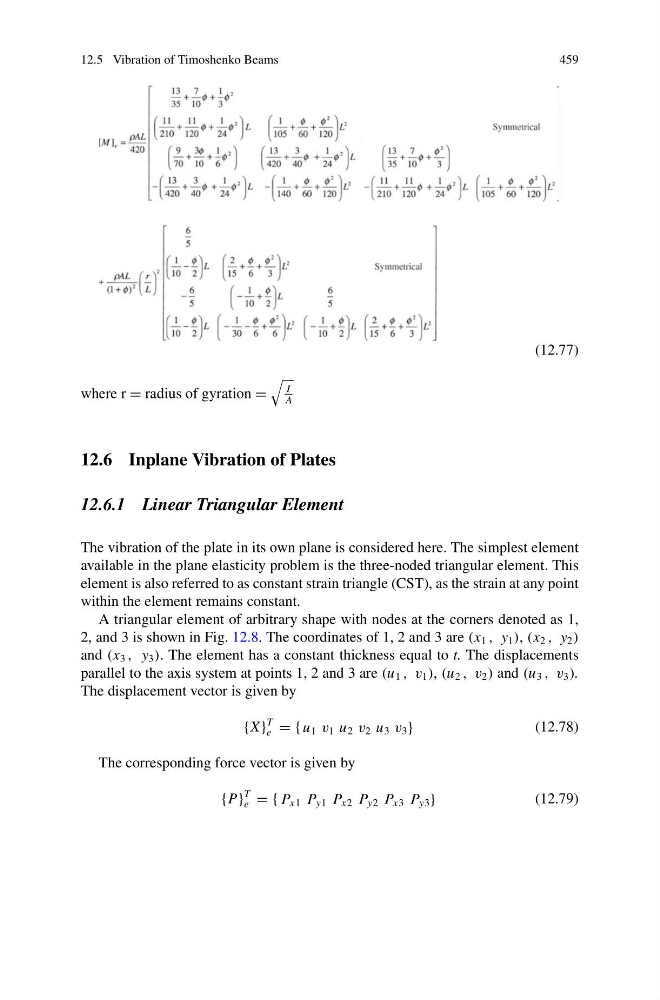
(12.77)
where r = radius of gyration =
I
A
12.6 Inplane Vibration of Plates
12.6.1 Linear Triangular Element
The vibration of the plate in its own plane is considered here. The simplest element
available in the plane elasticity problem is the three-noded triangular element. This
element is also referred to as constant strain triangle (CST), as the strain at any point
within the element remains constant.
A triangular element of arbitrary shape with nodes at the corners denoted as 1,
2, and 3 is shown in Fig. 12.8. The coordinates of 1, 2 and 3 are (x 1 , y 1 ), (x 2 , y 2 )
and (x 3 , y 3 ). The element has a constant thickness equal to t. The displacements
parallel to the axis system at points 1, 2 and 3 are (u 1 , v 1 ), (u 2 , v 2 ) and (u 3 , v 3 ).
The displacement vector is given by
{X }
T
e = { u 1 v 1 u 2 v 2 u 3 v 3 }
(12.78)
The corresponding force vector is given by
{P}
T
e = { P x1 P y1 P x2 P y2 P x3 P y3 }
(12.79)
459
(12.77)
where r = radius of gyration =
I
A
12.6 Inplane Vibration of Plates
12.6.1 Linear Triangular Element
The vibration of the plate in its own plane is considered here. The simplest element
available in the plane elasticity problem is the three-noded triangular element. This
element is also referred to as constant strain triangle (CST), as the strain at any point
within the element remains constant.
A triangular element of arbitrary shape with nodes at the corners denoted as 1,
2, and 3 is shown in Fig. 12.8. The coordinates of 1, 2 and 3 are (x 1 , y 1 ), (x 2 , y 2 )
and (x 3 , y 3 ). The element has a constant thickness equal to t. The displacements
parallel to the axis system at points 1, 2 and 3 are (u 1 , v 1 ), (u 2 , v 2 ) and (u 3 , v 3 ).
The displacement vector is given by
{X }
T
e = { u 1 v 1 u 2 v 2 u 3 v 3 }
(12.78)
The corresponding force vector is given by
{P}
T
e = { P x1 P y1 P x2 P y2 P x3 P y3 }
(12.79)