

458
12 Finite Element Method in Vibration Analysis
{α} = [A]
− 1
{X } e
(12.71)
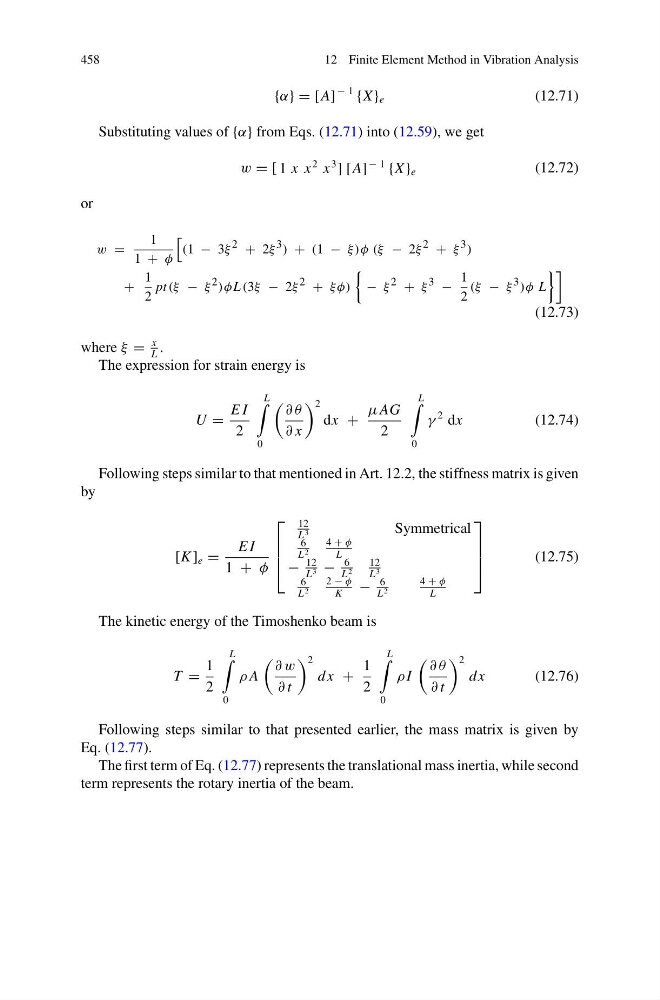
Substituting values of {α} from Eqs. (12.71) into (12.59), we get
w = [ 1 x x
2 x
3
] [A]
− 1
{X } e
(12.72)
or
w =
1
1 + φ
(1 − 3ξ 2 + 2ξ 3 ) + (1 − ξ)φ (ξ − 2ξ 2 + ξ 3 )
+
1
2
pt (ξ − ξ 2 )φ L (3ξ − 2ξ 2 + ξφ)
− ξ 2 + ξ 3 −
1
2
(ξ − ξ 3 )φ L
(12.73)
where ξ =
x
L
.
The expression for strain energy is
U =
E I
2
L
0
∂ θ
∂ x
2
dx +
μAG
2
L
0
γ
2 dx
(12.74)
Following steps similar to that mentioned in Art. 12.2, the stiffness matrix is given
by
[K ] e =
E I
1 + φ
⎡
⎢
⎢
⎣
12
L 3
Symmetrical
6
L 2
4 + φ
L
−
12
L 3 −
6
L 2
12
L 3
6
L 2
2 − φ
K
−
6
L 2
4 + φ
L
⎤
⎥
⎥
⎦
(12.75)
The kinetic energy of the Timoshenko beam is
T =
1
2
L
0
ρ A
∂ w
∂ t
2
dx +
1
2
L
0
ρ I
∂ θ
∂ t
2
dx
(12.76)
Following steps similar to that presented earlier, the mass matrix is given by
Eq. (12.77).
The first term of Eq. (12.77) represents the translational mass inertia, while second
term represents the rotary inertia of the beam.
12 Finite Element Method in Vibration Analysis
{α} = [A]
− 1
{X } e
(12.71)
Substituting values of {α} from Eqs. (12.71) into (12.59), we get
w = [ 1 x x
2 x
3
] [A]
− 1
{X } e
(12.72)
or
w =
1
1 + φ
(1 − 3ξ 2 + 2ξ 3 ) + (1 − ξ)φ (ξ − 2ξ 2 + ξ 3 )
+
1
2
pt (ξ − ξ 2 )φ L (3ξ − 2ξ 2 + ξφ)
− ξ 2 + ξ 3 −
1
2
(ξ − ξ 3 )φ L
(12.73)
where ξ =
x
L
.
The expression for strain energy is
U =
E I
2
L
0
∂ θ
∂ x
2
dx +
μAG
2
L
0
γ
2 dx
(12.74)
Following steps similar to that mentioned in Art. 12.2, the stiffness matrix is given
by
[K ] e =
E I
1 + φ
⎡
⎢
⎢
⎣
12
L 3
Symmetrical
6
L 2
4 + φ
L
−
12
L 3 −
6
L 2
12
L 3
6
L 2
2 − φ
K
−
6
L 2
4 + φ
L
⎤
⎥
⎥
⎦
(12.75)
The kinetic energy of the Timoshenko beam is
T =
1
2
L
0
ρ A
∂ w
∂ t
2
dx +
1
2
L
0
ρ I
∂ θ
∂ t
2
dx
(12.76)
Following steps similar to that presented earlier, the mass matrix is given by
Eq. (12.77).
The first term of Eq. (12.77) represents the translational mass inertia, while second
term represents the rotary inertia of the beam.