

12.3 Axial Vibration of Rods
451
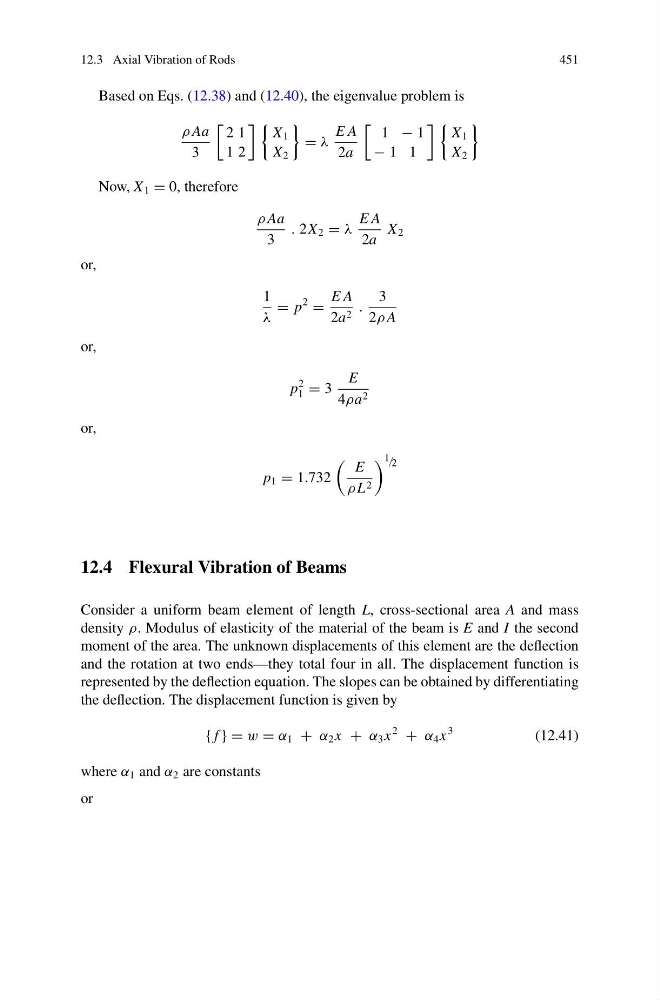
Based on Eqs. (12.38) and (12.40), the eigenvalue problem is
ρ Aa
3
2 1
1 2
X 1
X 2
= λ
E A
2a
1 − 1
− 1 1
X 1
X 2
Now, X 1 = 0, therefore
ρ Aa
3
. 2X 2 = λ
E A
2a
X 2
or,
1
λ
= p
2
=
E A
2a 2 .
3
2ρ A
or,
p
2
1 = 3
E
4ρa 2
or,
p 1 = 1.732
E
ρ L 2
1 / 2
12.4 Flexural Vibration of Beams
Consider a uniform beam element of length L, cross-sectional area A and mass
density ρ. Modulus of elasticity of the material of the beam is E and I the second
moment of the area. The unknown displacements of this element are the deflection
and the rotation at two ends—they total four in all. The displacement function is
represented by the deflection equation. The slopes can be obtained by differentiating
the deflection. The displacement function is given by
{ f } = w = α 1 + α 2 x + α 3 x
2
+ α 4 x
3
(12.41)
where α 1 and α 2 are constants
or
451
Based on Eqs. (12.38) and (12.40), the eigenvalue problem is
ρ Aa
3
2 1
1 2
X 1
X 2
= λ
E A
2a
1 − 1
− 1 1
X 1
X 2
Now, X 1 = 0, therefore
ρ Aa
3
. 2X 2 = λ
E A
2a
X 2
or,
1
λ
= p
2
=
E A
2a 2 .
3
2ρ A
or,
p
2
1 = 3
E
4ρa 2
or,
p 1 = 1.732
E
ρ L 2
1 / 2
12.4 Flexural Vibration of Beams
Consider a uniform beam element of length L, cross-sectional area A and mass
density ρ. Modulus of elasticity of the material of the beam is E and I the second
moment of the area. The unknown displacements of this element are the deflection
and the rotation at two ends—they total four in all. The displacement function is
represented by the deflection equation. The slopes can be obtained by differentiating
the deflection. The displacement function is given by
{ f } = w = α 1 + α 2 x + α 3 x
2
+ α 4 x
3
(12.41)
where α 1 and α 2 are constants
or