

450
12 Finite Element Method in Vibration Analysis
or
T e =
1
2
{ ˙
X }
T
e [M] e { ˙
X } e
(12.36)
where
[M] e = ρ Aa
1
− 1
[N ]
T
[N ] dξ
(12.37)
Combining Eqs. (12.32) and (12.37), yields the explicit value of the consistent
mass matrix [M] e which is
[M] e =
ρ Aa
3
2 1
1 2
(12.38)
Now, let us look into strain energy expression of Eq. (12.34). Combining
Eqs. (12.34) and (12.31), yields
U e =
1
2
1
−1
E A
1
a 2
∂u
∂ξ
2
a dξ
=
1
2
{X }
T
e [K ] e {X } e
(12.39)
where
[K ] e =
E A
a
1
− 1
[N
/
]
T
[N
/
] dξ and [N
/
] =
∂u
∂ξ
[K ] e =
E A
2a
1 − 1
− 1 1
(12.40)
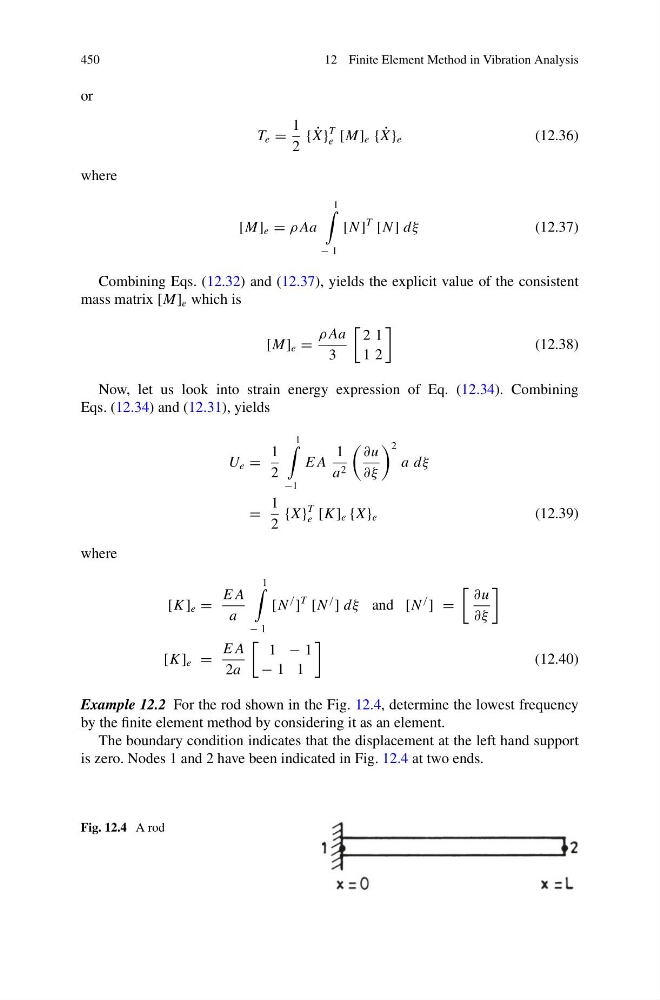
Example 12.2 For the rod shown in the Fig. 12.4, determine the lowest frequency
by the finite element method by considering it as an element.
The boundary condition indicates that the displacement at the left hand support
is zero. Nodes 1 and 2 have been indicated in Fig. 12.4 at two ends.
Fig. 12.4 A rod
12 Finite Element Method in Vibration Analysis
or
T e =
1
2
{ ˙
X }
T
e [M] e { ˙
X } e
(12.36)
where
[M] e = ρ Aa
1
− 1
[N ]
T
[N ] dξ
(12.37)
Combining Eqs. (12.32) and (12.37), yields the explicit value of the consistent
mass matrix [M] e which is
[M] e =
ρ Aa
3
2 1
1 2
(12.38)
Now, let us look into strain energy expression of Eq. (12.34). Combining
Eqs. (12.34) and (12.31), yields
U e =
1
2
1
−1
E A
1
a 2
∂u
∂ξ
2
a dξ
=
1
2
{X }
T
e [K ] e {X } e
(12.39)
where
[K ] e =
E A
a
1
− 1
[N
/
]
T
[N
/
] dξ and [N
/
] =
∂u
∂ξ
[K ] e =
E A
2a
1 − 1
− 1 1
(12.40)
Example 12.2 For the rod shown in the Fig. 12.4, determine the lowest frequency
by the finite element method by considering it as an element.
The boundary condition indicates that the displacement at the left hand support
is zero. Nodes 1 and 2 have been indicated in Fig. 12.4 at two ends.
Fig. 12.4 A rod