

12.3 Axial Vibration of Rods
449
or
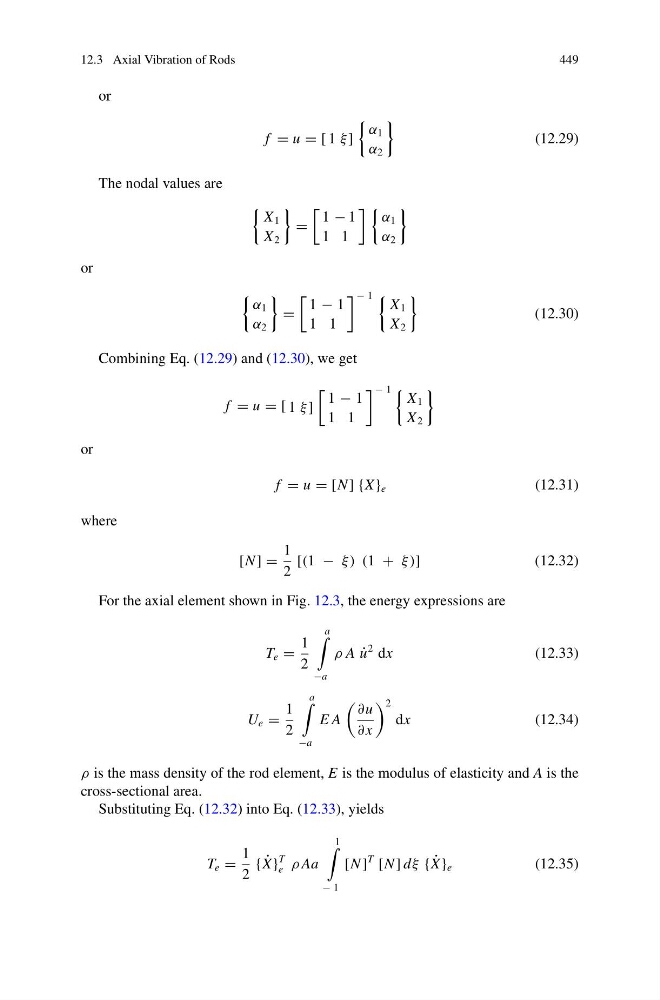
f = u = [ 1 ξ ]
α 1
α 2
(12.29)
The nodal values are
X 1
X 2
=
1 − 1
1 1
α 1
α 2
or
α 1
α 2
=
1 − 1
1 1
− 1
X 1
X 2
(12.30)
Combining Eq. (12.29) and (12.30), we get
f = u = [ 1 ξ ]
1 − 1
1 1
− 1
X 1
X 2
or
f = u = [N ] {X } e
(12.31)
where
[N ] =
1
2
[(1 − ξ) (1 + ξ)]
(12.32)
For the axial element shown in Fig. 12.3, the energy expressions are
T e =
1
2
a
−a
ρ A ˙
u
2 dx
(12.33)
U e =
1
2
a
−a
E A
∂u
∂ x
2
dx
(12.34)
ρ is the mass density of the rod element, E is the modulus of elasticity and A is the
cross-sectional area.
Substituting Eq. (12.32) into Eq. (12.33), yields
T e =
1
2
{ ˙
X }
T
e ρ Aa
1
− 1
[N ]
T
[N ] dξ { ˙
X } e
(12.35)
449
or
f = u = [ 1 ξ ]
α 1
α 2
(12.29)
The nodal values are
X 1
X 2
=
1 − 1
1 1
α 1
α 2
or
α 1
α 2
=
1 − 1
1 1
− 1
X 1
X 2
(12.30)
Combining Eq. (12.29) and (12.30), we get
f = u = [ 1 ξ ]
1 − 1
1 1
− 1
X 1
X 2
or
f = u = [N ] {X } e
(12.31)
where
[N ] =
1
2
[(1 − ξ) (1 + ξ)]
(12.32)
For the axial element shown in Fig. 12.3, the energy expressions are
T e =
1
2
a
−a
ρ A ˙
u
2 dx
(12.33)
U e =
1
2
a
−a
E A
∂u
∂ x
2
dx
(12.34)
ρ is the mass density of the rod element, E is the modulus of elasticity and A is the
cross-sectional area.
Substituting Eq. (12.32) into Eq. (12.33), yields
T e =
1
2
{ ˙
X }
T
e ρ Aa
1
− 1
[N ]
T
[N ] dξ { ˙
X } e
(12.35)