

448
12 Finite Element Method in Vibration Analysis
On solution of the eigenvalue problem, the natural frequency squared are
p
2
= 2.597
G J
I L 2
and 31.687
G J
I L 2
If the system is subjected to forced vibration and damping is included in the
system, Eq. (12.23) is modified as
[M] { ¨
X } + [C] { ˙
X } + [K ] {X } = {P}
(12.26)
If the system has viscous damping, then the damping matrix of an element will
be
[C] e =
L
0
[N ]
T
μ [N ] dx
(12.27)
where μ, is some numerical value of viscous damping.
Equation (12.27) is identical to Eq. (7.20). As such when the structure stiffness,
damping and mass matrices, as also the dynamic loading matrix have been formed, the
procedure of analysis is same as that presented in Chap. 7. In the following, we limit
ourselves to the derivation of element stiffness matrix and element consistent mass
matrix, for different types of structural elements. The assembly of these elements
can be done in the same manner as given in Appendix A and the necessary analysis
can be performed as per Chaps. 6 or 7, depending on the problem.
12.3 Axial Vibration of Rods
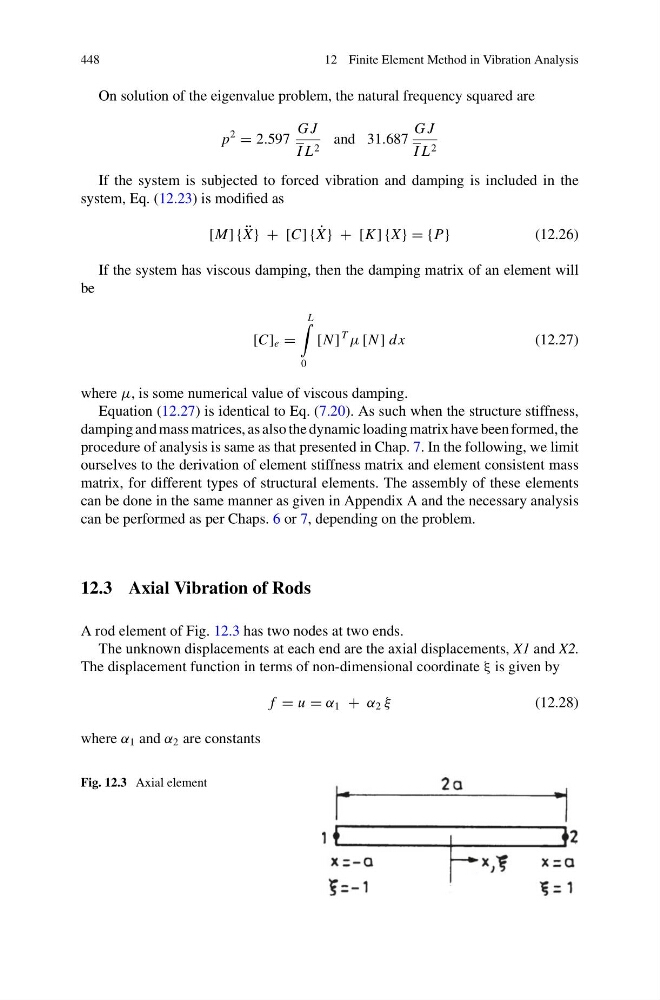
A rod element of Fig. 12.3 has two nodes at two ends.
The unknown displacements at each end are the axial displacements, X1 and X2.
The displacement function in terms of non-dimensional coordinate ξ is given by
f = u = α 1 + α 2 ξ
(12.28)
where α 1 and α 2 are constants
Fig. 12.3 Axial element
12 Finite Element Method in Vibration Analysis
On solution of the eigenvalue problem, the natural frequency squared are
p
2
= 2.597
G J
I L 2
and 31.687
G J
I L 2
If the system is subjected to forced vibration and damping is included in the
system, Eq. (12.23) is modified as
[M] { ¨
X } + [C] { ˙
X } + [K ] {X } = {P}
(12.26)
If the system has viscous damping, then the damping matrix of an element will
be
[C] e =
L
0
[N ]
T
μ [N ] dx
(12.27)
where μ, is some numerical value of viscous damping.
Equation (12.27) is identical to Eq. (7.20). As such when the structure stiffness,
damping and mass matrices, as also the dynamic loading matrix have been formed, the
procedure of analysis is same as that presented in Chap. 7. In the following, we limit
ourselves to the derivation of element stiffness matrix and element consistent mass
matrix, for different types of structural elements. The assembly of these elements
can be done in the same manner as given in Appendix A and the necessary analysis
can be performed as per Chaps. 6 or 7, depending on the problem.
12.3 Axial Vibration of Rods
A rod element of Fig. 12.3 has two nodes at two ends.
The unknown displacements at each end are the axial displacements, X1 and X2.
The displacement function in terms of non-dimensional coordinate ξ is given by
f = u = α 1 + α 2 ξ
(12.28)
where α 1 and α 2 are constants
Fig. 12.3 Axial element