

432
11 Vibration of Ship and Aircraft as a Beam
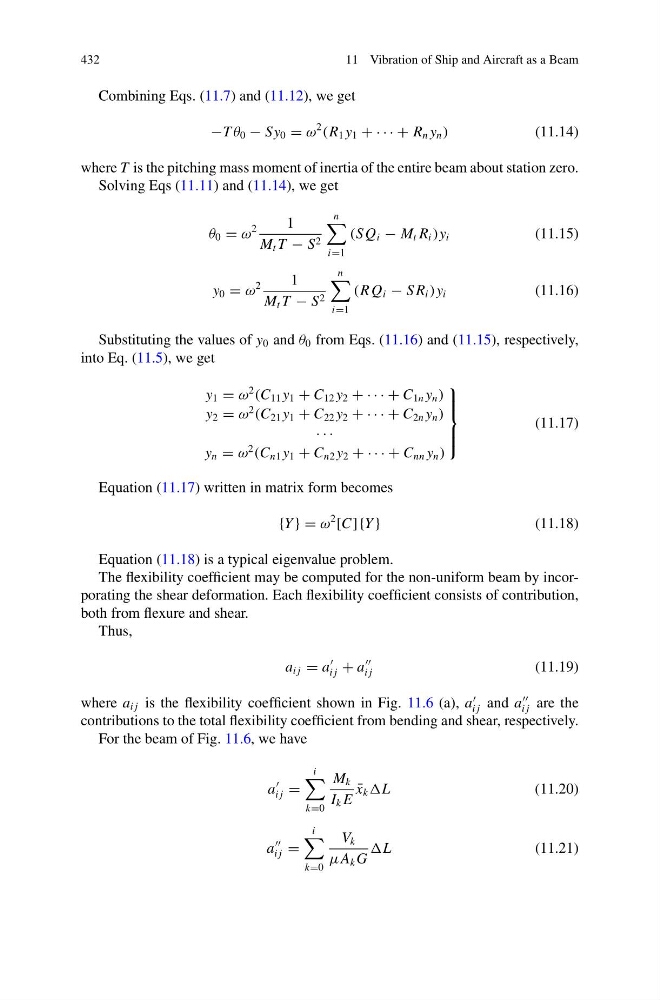
Combining Eqs. (11.7) and (11.12), we get
−T θ 0 − Sy 0 = ω
2
(R 1 y 1 + · · · + R n y n )
(11.14)
where T is the pitching mass moment of inertia of the entire beam about station zero.
Solving Eqs (11.11) and (11.14), we get
θ 0 = ω
2
1
M t T − S 2
n
i=1
(S Q i − M t R i )y i
(11.15)
y 0 = ω
2
1
M t T − S 2
n
i=1
(R Q i − S R i )y i
(11.16)
Substituting the values of y 0 and θ 0 from Eqs. (11.16) and (11.15), respectively,
into Eq. (11.5), we get
y 1 = ω
2
(C 11 y 1 + C 12 y 2 + · · · + C 1n y n )
y 2 = ω
2
(C 21 y 1 + C 22 y 2 + · · · + C 2n y n )
· · ·
y n = ω
2
(C n1 y 1 + C n2 y 2 + · · · + C nn y n )
⎫
⎪ ⎪ ⎬
⎪ ⎪ ⎭
(11.17)
Equation (11.17) written in matrix form becomes
{Y } = ω
2 [C]{Y }
(11.18)
Equation (11.18) is a typical eigenvalue problem.
The flexibility coefficient may be computed for the non-uniform beam by incorporating the shear deformation. Each flexibility coefficient consists of contribution,
both from flexure and shear.
Thus,
a i j = a
i j + a
i j
(11.19)
where a i j is the flexibility coefficient shown in Fig. 11.6 (a), a
i j and a
i j are the
contributions to the total flexibility coefficient from bending and shear, respectively.
For the beam of Fig. 11.6, we have
a
i j =
i
k=0
M k
I k E
¯
x k L
(11.20)
a
i j =
i
k=0
V k
μA k G
L
(11.21)
11 Vibration of Ship and Aircraft as a Beam
Combining Eqs. (11.7) and (11.12), we get
−T θ 0 − Sy 0 = ω
2
(R 1 y 1 + · · · + R n y n )
(11.14)
where T is the pitching mass moment of inertia of the entire beam about station zero.
Solving Eqs (11.11) and (11.14), we get
θ 0 = ω
2
1
M t T − S 2
n
i=1
(S Q i − M t R i )y i
(11.15)
y 0 = ω
2
1
M t T − S 2
n
i=1
(R Q i − S R i )y i
(11.16)
Substituting the values of y 0 and θ 0 from Eqs. (11.16) and (11.15), respectively,
into Eq. (11.5), we get
y 1 = ω
2
(C 11 y 1 + C 12 y 2 + · · · + C 1n y n )
y 2 = ω
2
(C 21 y 1 + C 22 y 2 + · · · + C 2n y n )
· · ·
y n = ω
2
(C n1 y 1 + C n2 y 2 + · · · + C nn y n )
⎫
⎪ ⎪ ⎬
⎪ ⎪ ⎭
(11.17)
Equation (11.17) written in matrix form becomes
{Y } = ω
2 [C]{Y }
(11.18)
Equation (11.18) is a typical eigenvalue problem.
The flexibility coefficient may be computed for the non-uniform beam by incorporating the shear deformation. Each flexibility coefficient consists of contribution,
both from flexure and shear.
Thus,
a i j = a
i j + a
i j
(11.19)
where a i j is the flexibility coefficient shown in Fig. 11.6 (a), a
i j and a
i j are the
contributions to the total flexibility coefficient from bending and shear, respectively.
For the beam of Fig. 11.6, we have
a
i j =
i
k=0
M k
I k E
¯
x k L
(11.20)
a
i j =
i
k=0
V k
μA k G
L
(11.21)