

11.4 The Flexibility Matrix Method for Determining Natural …
431
n
i=0
m i x i y i + I 0 θ 0 = 0
(11.7)
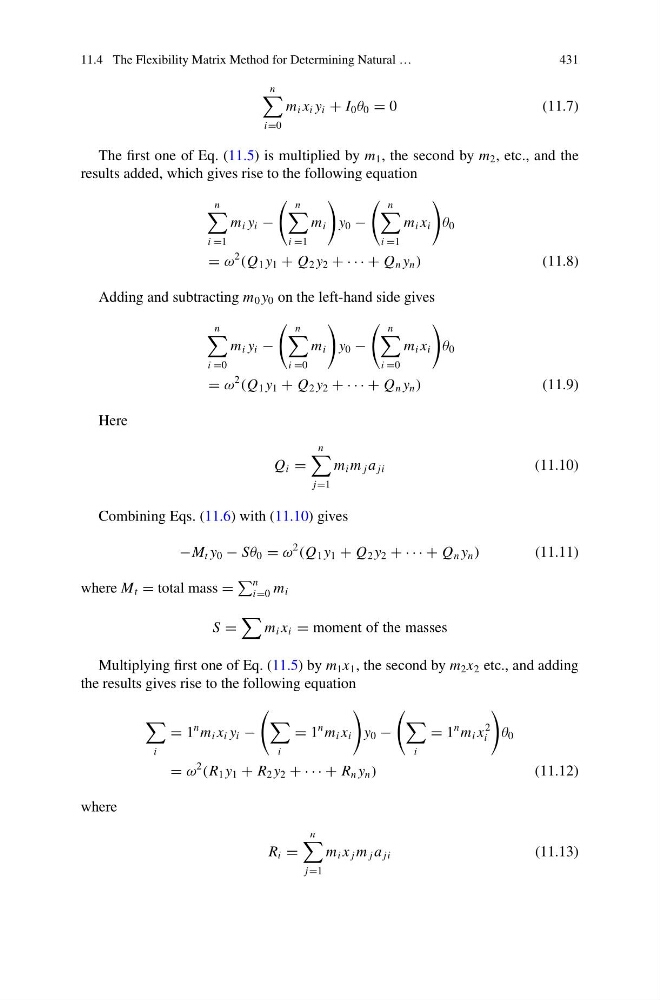
The first one of Eq. (11.5) is multiplied by m 1 , the second by m 2 , etc., and the
results added, which gives rise to the following equation
n
i =1
m i y i −
n
i =1
m i
y 0 −
n
i =1
m i x i
θ 0
= ω
2
(Q 1 y 1 + Q 2 y 2 + · · · + Q n y n )
(11.8)
Adding and subtracting m 0 y 0 on the left-hand side gives
n
i =0
m i y i −
n
i =0
m i
y 0 −
n
i =0
m i x i
θ 0
= ω
2
(Q 1 y 1 + Q 2 y 2 + · · · + Q n y n )
(11.9)
Here
Q i =
n
j=1
m i m j a ji
(11.10)
Combining Eqs. (11.6) with (11.10) gives
−M t y 0 − Sθ 0 = ω
2
(Q 1 y 1 + Q 2 y 2 + · · · + Q n y n )
(11.11)
where M t = total mass =
n
i=0 m i
S =
m i x i = moment of the masses
Multiplying first one of Eq. (11.5) by m 1 x 1 , the second by m 2 x 2 etc., and adding
the results gives rise to the following equation
i
= 1
n m i x i y i −
i
= 1
n m i x i
y 0 −
i
= 1
n m i x
2
i
θ 0
= ω
2
(R 1 y 1 + R 2 y 2 + · · · + R n y n )
(11.12)
where
R i =
n
j=1
m i x j m j a ji
(11.13)
431
n
i=0
m i x i y i + I 0 θ 0 = 0
(11.7)
The first one of Eq. (11.5) is multiplied by m 1 , the second by m 2 , etc., and the
results added, which gives rise to the following equation
n
i =1
m i y i −
n
i =1
m i
y 0 −
n
i =1
m i x i
θ 0
= ω
2
(Q 1 y 1 + Q 2 y 2 + · · · + Q n y n )
(11.8)
Adding and subtracting m 0 y 0 on the left-hand side gives
n
i =0
m i y i −
n
i =0
m i
y 0 −
n
i =0
m i x i
θ 0
= ω
2
(Q 1 y 1 + Q 2 y 2 + · · · + Q n y n )
(11.9)
Here
Q i =
n
j=1
m i m j a ji
(11.10)
Combining Eqs. (11.6) with (11.10) gives
−M t y 0 − Sθ 0 = ω
2
(Q 1 y 1 + Q 2 y 2 + · · · + Q n y n )
(11.11)
where M t = total mass =
n
i=0 m i
S =
m i x i = moment of the masses
Multiplying first one of Eq. (11.5) by m 1 x 1 , the second by m 2 x 2 etc., and adding
the results gives rise to the following equation
i
= 1
n m i x i y i −
i
= 1
n m i x i
y 0 −
i
= 1
n m i x
2
i
θ 0
= ω
2
(R 1 y 1 + R 2 y 2 + · · · + R n y n )
(11.12)
where
R i =
n
j=1
m i x j m j a ji
(11.13)