

430
11 Vibration of Ship and Aircraft as a Beam
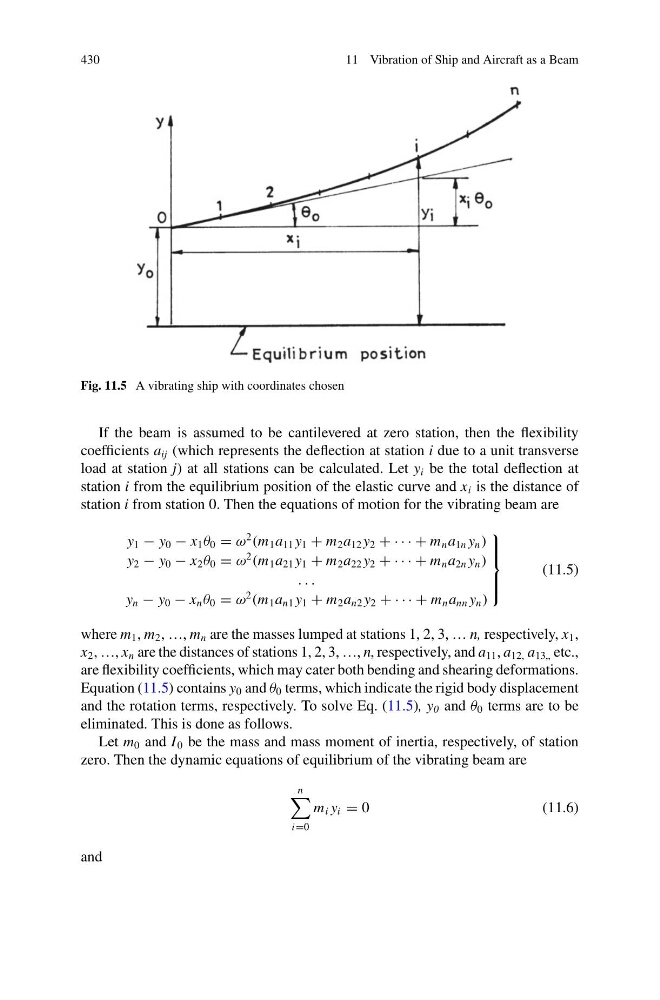
Fig. 11.5 A vibrating ship with coordinates chosen
If the beam is assumed to be cantilevered at zero station, then the flexibility
coefficients a ij (which represents the deflection at station i due to a unit transverse
load at station j) at all stations can be calculated. Let y i be the total deflection at
station i from the equilibrium position of the elastic curve and x i is the distance of
station i from station 0. Then the equations of motion for the vibrating beam are
y 1 − y 0 − x 1 θ 0 = ω
2
(m 1 a 11 y 1 + m 2 a 12 y 2 + · · · + m n a 1n y n )
y 2 − y 0 − x 2 θ 0 = ω
2
(m 1 a 21 y 1 + m 2 a 22 y 2 + · · · + m n a 2n y n )
. . .
y n − y 0 − x n θ 0 = ω
2
(m 1 a n1 y 1 + m 2 a n2 y 2 + · · · + m n a nn y n )
⎫
⎪ ⎪ ⎬
⎪ ⎪ ⎭
(11.5)
where m 1 , m 2 , …, m n are the masses lumped at stations 1, 2, 3, … n, respectively, x 1 ,
x 2 , …, x n are the distances of stations 1, 2, 3, …, n, respectively, and a 11 , a 12, a 13„ etc.,
are flexibility coefficients, which may cater both bending and shearing deformations.
Equation (11.5) contains y 0 and θ 0 terms, which indicate the rigid body displacement
and the rotation terms, respectively. To solve Eq. (11.5), y 0 and θ 0 terms are to be
eliminated. This is done as follows.
Let m 0 and I 0 be the mass and mass moment of inertia, respectively, of station
zero. Then the dynamic equations of equilibrium of the vibrating beam are
n
i=0
m i y i = 0
(11.6)
and
11 Vibration of Ship and Aircraft as a Beam
Fig. 11.5 A vibrating ship with coordinates chosen
If the beam is assumed to be cantilevered at zero station, then the flexibility
coefficients a ij (which represents the deflection at station i due to a unit transverse
load at station j) at all stations can be calculated. Let y i be the total deflection at
station i from the equilibrium position of the elastic curve and x i is the distance of
station i from station 0. Then the equations of motion for the vibrating beam are
y 1 − y 0 − x 1 θ 0 = ω
2
(m 1 a 11 y 1 + m 2 a 12 y 2 + · · · + m n a 1n y n )
y 2 − y 0 − x 2 θ 0 = ω
2
(m 1 a 21 y 1 + m 2 a 22 y 2 + · · · + m n a 2n y n )
. . .
y n − y 0 − x n θ 0 = ω
2
(m 1 a n1 y 1 + m 2 a n2 y 2 + · · · + m n a nn y n )
⎫
⎪ ⎪ ⎬
⎪ ⎪ ⎭
(11.5)
where m 1 , m 2 , …, m n are the masses lumped at stations 1, 2, 3, … n, respectively, x 1 ,
x 2 , …, x n are the distances of stations 1, 2, 3, …, n, respectively, and a 11 , a 12, a 13„ etc.,
are flexibility coefficients, which may cater both bending and shearing deformations.
Equation (11.5) contains y 0 and θ 0 terms, which indicate the rigid body displacement
and the rotation terms, respectively. To solve Eq. (11.5), y 0 and θ 0 terms are to be
eliminated. This is done as follows.
Let m 0 and I 0 be the mass and mass moment of inertia, respectively, of station
zero. Then the dynamic equations of equilibrium of the vibrating beam are
n
i=0
m i y i = 0
(11.6)
and