

378
9 Forced Vibration of Continuous Systems
9.4 Forced Vibration of Flexural Member
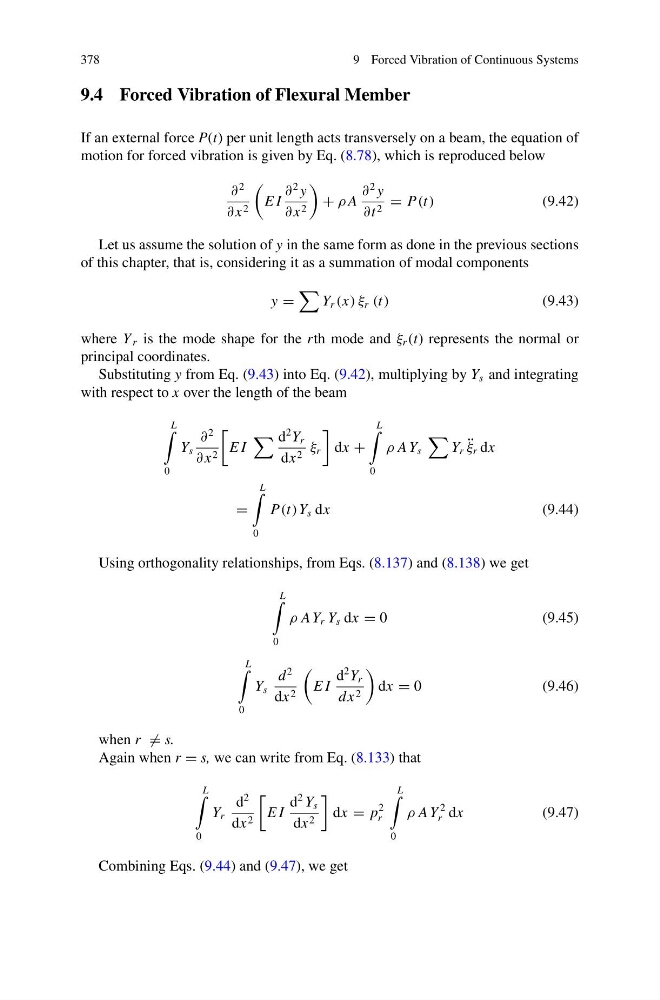
If an external force P(t) per unit length acts transversely on a beam, the equation of
motion for forced vibration is given by Eq. (8.78), which is reproduced below
∂
2
∂ x 2
E I
∂
2 y
∂ x 2
+ ρ A
∂
2 y
∂t 2 = P(t)
(9.42)
Let us assume the solution of y in the same form as done in the previous sections
of this chapter, that is, considering it as a summation of modal components
y =
Y r (x) ξ r (t)
(9.43)
where Y r is the mode shape for the rth mode and ξ r (t) represents the normal or
principal coordinates.
Substituting y from Eq. (9.43) into Eq. (9.42), multiplying by Y s and integrating
with respect to x over the length of the beam
L
0
Y s
∂
2
∂ x 2
E I
d
2 Y r
dx 2 ξ r
dx +
L
0
ρ A Y s
Y r ¨
ξ r dx
=
L
0
P(t) Y s dx
(9.44)
Using orthogonality relationships, from Eqs. (8.137) and (8.138) we get
L
0
ρ A Y r Y s dx = 0
(9.45)
L
0
Y s
d
2
dx 2
E I
d
2 Y r
dx 2
dx = 0
(9.46)
when r = s.
Again when r = s, we can write from Eq. (8.133) that
L
0
Y r
d
2
dx 2
E I
d
2 Y s
dx 2
dx = p
2
r
L
0
ρ A Y
2
r dx
(9.47)
Combining Eqs. (9.44) and (9.47), we get
9 Forced Vibration of Continuous Systems
9.4 Forced Vibration of Flexural Member
If an external force P(t) per unit length acts transversely on a beam, the equation of
motion for forced vibration is given by Eq. (8.78), which is reproduced below
∂
2
∂ x 2
E I
∂
2 y
∂ x 2
+ ρ A
∂
2 y
∂t 2 = P(t)
(9.42)
Let us assume the solution of y in the same form as done in the previous sections
of this chapter, that is, considering it as a summation of modal components
y =
Y r (x) ξ r (t)
(9.43)
where Y r is the mode shape for the rth mode and ξ r (t) represents the normal or
principal coordinates.
Substituting y from Eq. (9.43) into Eq. (9.42), multiplying by Y s and integrating
with respect to x over the length of the beam
L
0
Y s
∂
2
∂ x 2
E I
d
2 Y r
dx 2 ξ r
dx +
L
0
ρ A Y s
Y r ¨
ξ r dx
=
L
0
P(t) Y s dx
(9.44)
Using orthogonality relationships, from Eqs. (8.137) and (8.138) we get
L
0
ρ A Y r Y s dx = 0
(9.45)
L
0
Y s
d
2
dx 2
E I
d
2 Y r
dx 2
dx = 0
(9.46)
when r = s.
Again when r = s, we can write from Eq. (8.133) that
L
0
Y r
d
2
dx 2
E I
d
2 Y s
dx 2
dx = p
2
r
L
0
ρ A Y
2
r dx
(9.47)
Combining Eqs. (9.44) and (9.47), we get