

9.4 Forced Vibration of Flexural Member
379
L
0
ρ AY
2
r
¨
ξ r + p
2
r ξ r
dx =
L
0
P (t) Y r dx
(9.48)
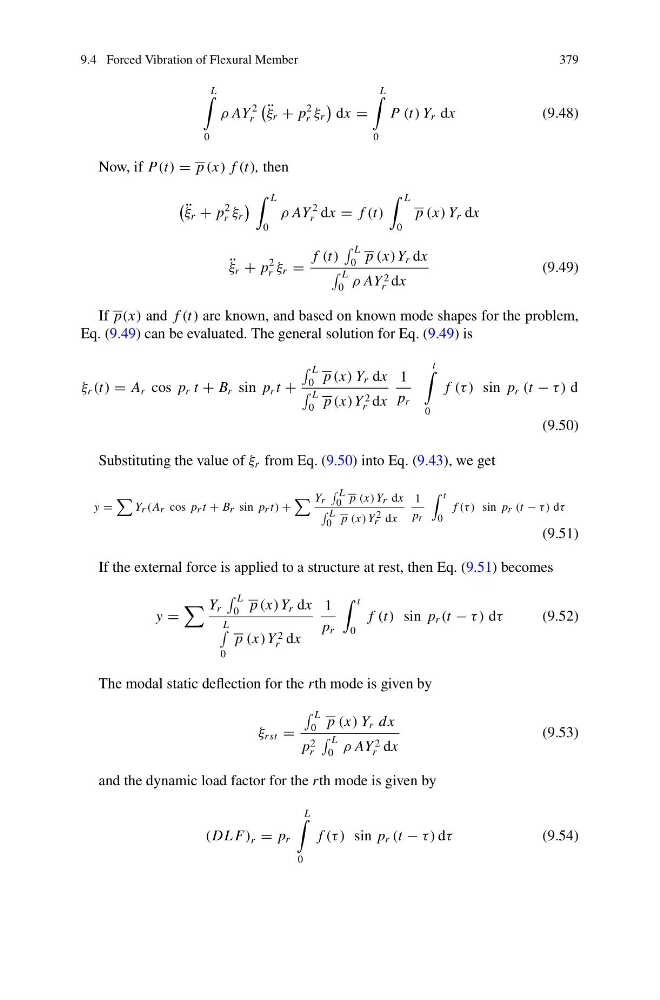
Now, if P(t) = p (x) f (t), then
¨
ξ r + p
2
r ξ r
L
0
ρ AY
2
r dx = f (t)
L
0
p (x) Y r dx
¨
ξ r + p
2
r ξ r =
f (t)
L
0 p (x) Y r dx
L
0 ρ AY 2
r dx
(9.49)
If p(x) and f (t) are known, and based on known mode shapes for the problem,
Eq. (9.49) can be evaluated. The general solution for Eq. (9.49) is
ξ r (t) = A r cos p r t + B r sin p r t +
L
0 p (x) Y r dx
L
0 p (x) Y 2
r dx
1
p r
t
0
f (τ ) sin p r (t − τ ) d
(9.50)
Substituting the value of ξ r from Eq. (9.50) into Eq. (9.43), we get
y =
Y r ( A r cos p r t + B r sin p r t) +
Y r
L
0 p (x) Y r dx
L
0 p (x) Y 2
r dx
1
p r
t
0
f (τ ) sin p r (t − τ ) dτ
(9.51)
If the external force is applied to a structure at rest, then Eq. (9.51) becomes
y =
Y r
L
0 p (x) Y r dx
L
0
p (x) Y 2
r dx
1
p r
t
0
f (t) sin p r (t − τ ) dτ
(9.52)
The modal static deflection for the rth mode is given by
ξ rst =
L
0 p (x) Y r dx
p 2
r
L
0 ρ AY 2
r dx
(9.53)
and the dynamic load factor for the rth mode is given by
(DL F) r = p r
L
0
f (τ ) sin p r (t − τ ) dτ
(9.54)
379
L
0
ρ AY
2
r
¨
ξ r + p
2
r ξ r
dx =
L
0
P (t) Y r dx
(9.48)
Now, if P(t) = p (x) f (t), then
¨
ξ r + p
2
r ξ r
L
0
ρ AY
2
r dx = f (t)
L
0
p (x) Y r dx
¨
ξ r + p
2
r ξ r =
f (t)
L
0 p (x) Y r dx
L
0 ρ AY 2
r dx
(9.49)
If p(x) and f (t) are known, and based on known mode shapes for the problem,
Eq. (9.49) can be evaluated. The general solution for Eq. (9.49) is
ξ r (t) = A r cos p r t + B r sin p r t +
L
0 p (x) Y r dx
L
0 p (x) Y 2
r dx
1
p r
t
0
f (τ ) sin p r (t − τ ) d
(9.50)
Substituting the value of ξ r from Eq. (9.50) into Eq. (9.43), we get
y =
Y r ( A r cos p r t + B r sin p r t) +
Y r
L
0 p (x) Y r dx
L
0 p (x) Y 2
r dx
1
p r
t
0
f (τ ) sin p r (t − τ ) dτ
(9.51)
If the external force is applied to a structure at rest, then Eq. (9.51) becomes
y =
Y r
L
0 p (x) Y r dx
L
0
p (x) Y 2
r dx
1
p r
t
0
f (t) sin p r (t − τ ) dτ
(9.52)
The modal static deflection for the rth mode is given by
ξ rst =
L
0 p (x) Y r dx
p 2
r
L
0 ρ AY 2
r dx
(9.53)
and the dynamic load factor for the rth mode is given by
(DL F) r = p r
L
0
f (τ ) sin p r (t − τ ) dτ
(9.54)