

368
8 Free Vibration Analysis of Continuous Systems
Exercise 8
8.1. Determine the velocity of wave propagation in an underwater cable of mass
m = 10 kg/m and the applied tension T = 6000 N.
8.2. The cord of a musical instrument is fixed at both ends and has a length of
1 m, diameter d = 0.5 mm and density 7800 kg/m
3 . Determine the tension
needed in the cord so as to have a fundamental frequency of transverse
vibration 200 Hz.
8.3. A flexible string of mass m per unit length is stretched under tension T
between two fixed points placed at a distance L. Determine the natural
frequencies of the string.
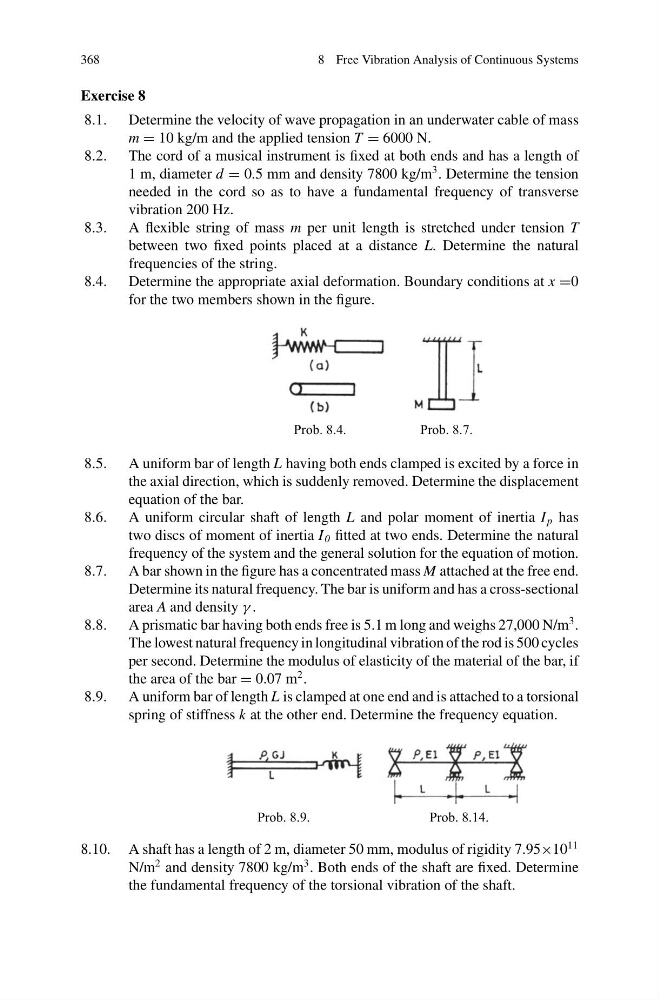
8.4. Determine the appropriate axial deformation. Boundary conditions at x =0
for the two members shown in the figure.
Prob. 8.4.
Prob. 8.7.
8.5. A uniform bar of length L having both ends clamped is excited by a force in
the axial direction, which is suddenly removed. Determine the displacement
equation of the bar.
8.6. A uniform circular shaft of length L and polar moment of inertia I p has
two discs of moment of inertia I 0 fitted at two ends. Determine the natural
frequency of the system and the general solution for the equation of motion.
8.7. A bar shown in the figure has a concentrated mass M attached at the free end.
Determine its natural frequency. The bar is uniform and has a cross-sectional
area A and density γ .
8.8. A prismatic bar having both ends free is 5.1 m long and weighs 27,000 N/m
3 .
The lowest natural frequency in longitudinal vibration of the rod is 500 cycles
per second. Determine the modulus of elasticity of the material of the bar, if
the area of the bar = 0.07 m
2 .
8.9. A uniform bar of length L is clamped at one end and is attached to a torsional
spring of stiffness k at the other end. Determine the frequency equation.
8.10. A shaft has a length of 2 m, diameter 50 mm, modulus of rigidity 7.95×10
11
N/m
2 and density 7800 kg/m
3 . Both ends of the shaft are fixed. Determine
the fundamental frequency of the torsional vibration of the shaft.
8 Free Vibration Analysis of Continuous Systems
Exercise 8
8.1. Determine the velocity of wave propagation in an underwater cable of mass
m = 10 kg/m and the applied tension T = 6000 N.
8.2. The cord of a musical instrument is fixed at both ends and has a length of
1 m, diameter d = 0.5 mm and density 7800 kg/m
3 . Determine the tension
needed in the cord so as to have a fundamental frequency of transverse
vibration 200 Hz.
8.3. A flexible string of mass m per unit length is stretched under tension T
between two fixed points placed at a distance L. Determine the natural
frequencies of the string.
8.4. Determine the appropriate axial deformation. Boundary conditions at x =0
for the two members shown in the figure.
Prob. 8.4.
Prob. 8.7.
8.5. A uniform bar of length L having both ends clamped is excited by a force in
the axial direction, which is suddenly removed. Determine the displacement
equation of the bar.
8.6. A uniform circular shaft of length L and polar moment of inertia I p has
two discs of moment of inertia I 0 fitted at two ends. Determine the natural
frequency of the system and the general solution for the equation of motion.
8.7. A bar shown in the figure has a concentrated mass M attached at the free end.
Determine its natural frequency. The bar is uniform and has a cross-sectional
area A and density γ .
8.8. A prismatic bar having both ends free is 5.1 m long and weighs 27,000 N/m
3 .
The lowest natural frequency in longitudinal vibration of the rod is 500 cycles
per second. Determine the modulus of elasticity of the material of the bar, if
the area of the bar = 0.07 m
2 .
8.9. A uniform bar of length L is clamped at one end and is attached to a torsional
spring of stiffness k at the other end. Determine the frequency equation.
8.10. A shaft has a length of 2 m, diameter 50 mm, modulus of rigidity 7.95×10
11
N/m
2 and density 7800 kg/m
3 . Both ends of the shaft are fixed. Determine
the fundamental frequency of the torsional vibration of the shaft.