

8.18 Transverse Vibration of Rectangular Thin Plates
369
8.11. For the transverse vibration of a simply supported uniform beam, solve for
free response if the initial conditions are given by
y(x, 0) = B
x
L
− 3
x
2
L 2 + 2
x
3
L 3
, y(x, 0) = 0
8.12 Derive an expression for natural frequencies of transverse vibration of a
uniform fixed-fixed beam.
8.13 Determine the natural frequencies of flexural vibration of a cantilever beam.
8.14 Determine the natural frequencies of the flexural vibration of a two-span
beam shown in the figure. Both the spans are identical.
8.15 Determine the solution of the free inplane vibrations of a rectangular
membrane, having sides a and b. Assume the edges of the membrane to
be clamped.
8.16 A beam of a particular material is supported at the left-hand end and at a
distance of 0.264L from the right-hand end. The dimensions of beam in mm
are 50 × 50 × 300, its fundamental frequency is 1160 cps, and its density is
2450 kg/m
3 . Determine the modulus of elasticity of the beam.
8.17 Determine the frequency equation of a uniform beam pinned at one end and
elastically supported at the other.
8.18 For the mode shape function given by Eq. (8.105), show that the mode shapes
are orthogonal.
8.19 A uniform bar of length L and axial rigidity EA is undergoing axial vibrations.
Determine the fundamental frequency of the bar by the method of collocation.
8.20 For a uniform beam simply supported at both ends, having span L and flexural
rigidity EI, determine the natural frequencies of flexural vibrations due to its
own mass.
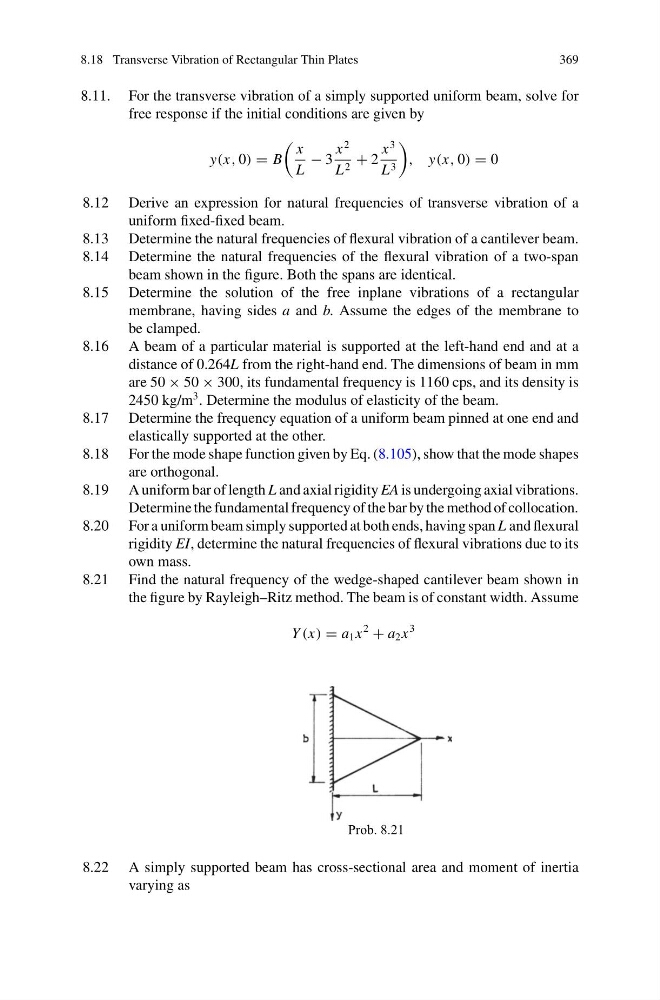
8.21 Find the natural frequency of the wedge-shaped cantilever beam shown in
the figure by Rayleigh–Ritz method. The beam is of constant width. Assume
Y (x) = a 1 x
2
+ a 2 x
3
Prob. 8.21
8.22 A simply supported beam has cross-sectional area and moment of inertia
varying as
369
8.11. For the transverse vibration of a simply supported uniform beam, solve for
free response if the initial conditions are given by
y(x, 0) = B
x
L
− 3
x
2
L 2 + 2
x
3
L 3
, y(x, 0) = 0
8.12 Derive an expression for natural frequencies of transverse vibration of a
uniform fixed-fixed beam.
8.13 Determine the natural frequencies of flexural vibration of a cantilever beam.
8.14 Determine the natural frequencies of the flexural vibration of a two-span
beam shown in the figure. Both the spans are identical.
8.15 Determine the solution of the free inplane vibrations of a rectangular
membrane, having sides a and b. Assume the edges of the membrane to
be clamped.
8.16 A beam of a particular material is supported at the left-hand end and at a
distance of 0.264L from the right-hand end. The dimensions of beam in mm
are 50 × 50 × 300, its fundamental frequency is 1160 cps, and its density is
2450 kg/m
3 . Determine the modulus of elasticity of the beam.
8.17 Determine the frequency equation of a uniform beam pinned at one end and
elastically supported at the other.
8.18 For the mode shape function given by Eq. (8.105), show that the mode shapes
are orthogonal.
8.19 A uniform bar of length L and axial rigidity EA is undergoing axial vibrations.
Determine the fundamental frequency of the bar by the method of collocation.
8.20 For a uniform beam simply supported at both ends, having span L and flexural
rigidity EI, determine the natural frequencies of flexural vibrations due to its
own mass.
8.21 Find the natural frequency of the wedge-shaped cantilever beam shown in
the figure by Rayleigh–Ritz method. The beam is of constant width. Assume
Y (x) = a 1 x
2
+ a 2 x
3
Prob. 8.21
8.22 A simply supported beam has cross-sectional area and moment of inertia
varying as