

8.18 Transverse Vibration of Rectangular Thin Plates
367
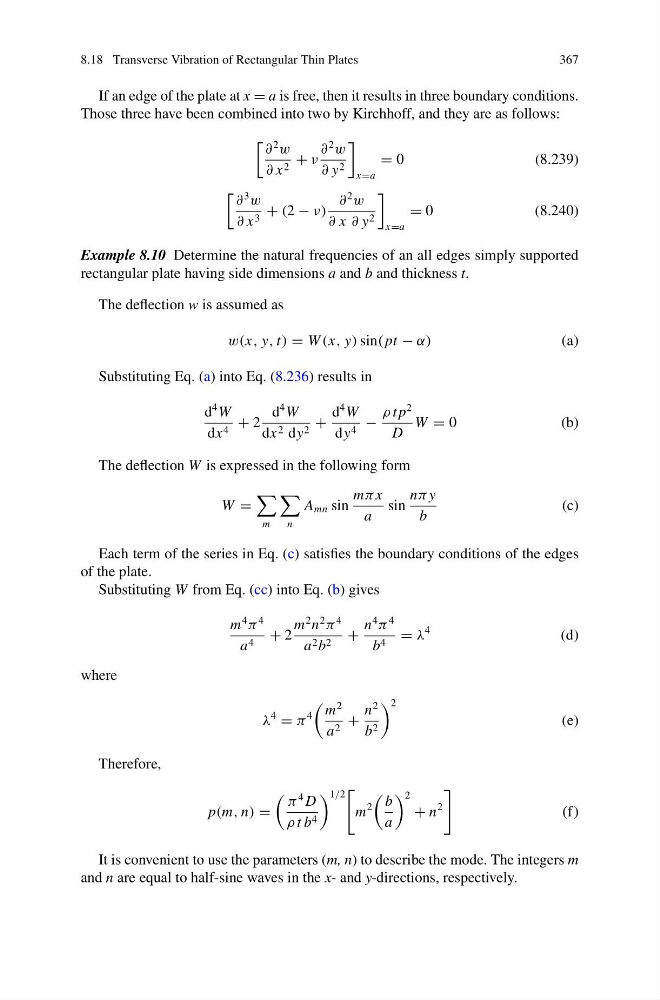
If an edge of the plate at x = a is free, then it results in three boundary conditions.
Those three have been combined into two by Kirchhoff, and they are as follows:
∂
2
w
∂ x 2 + ν
∂
2
w
∂ y 2
x=a
= 0
(8.239)
∂
3
w
∂ x 3 + (2 − ν)
∂
2
w
∂ x ∂ y 2
x=a
= 0
(8.240)
Example 8.10 Determine the natural frequencies of an all edges simply supported
rectangular plate having side dimensions a and b and thickness t.
The deflection w is assumed as
w(x, y, t) = W (x, y) sin( pt − α)
(a)
Substituting Eq. (a) into Eq. (8.236) results in
d
4 W
dx 4 + 2
d
4 W
dx 2 dy 2 +
d
4 W
dy 4 −
ρ t p
2
D
W = 0
( b )
The deflection W is expressed in the following form
W =
m
n
A mn sin
mπ x
a
sin
nπ y
b
(c)
Each term of the series in Eq. (c) satisfies the boundary conditions of the edges
of the plate.
Substituting W from Eq. (cc) into Eq. (b) gives
m
4
π
4
a 4 + 2
m
2 n
2
π
4
a 2 b 2 +
n
4
π
4
b 4 = λ
4
(d)
where
λ
4
= π
4
m
2
a 2 +
n
2
b 2
2
(e)
Therefore,
p(m, n) =
π
4 D
ρ t b 4
1/2
m
2
b
a
2
+ n
2
(f)
It is convenient to use the parameters (m, n) to describe the mode. The integers m
and n are equal to half-sine waves in the x- and y-directions, respectively.
367
If an edge of the plate at x = a is free, then it results in three boundary conditions.
Those three have been combined into two by Kirchhoff, and they are as follows:
∂
2
w
∂ x 2 + ν
∂
2
w
∂ y 2
x=a
= 0
(8.239)
∂
3
w
∂ x 3 + (2 − ν)
∂
2
w
∂ x ∂ y 2
x=a
= 0
(8.240)
Example 8.10 Determine the natural frequencies of an all edges simply supported
rectangular plate having side dimensions a and b and thickness t.
The deflection w is assumed as
w(x, y, t) = W (x, y) sin( pt − α)
(a)
Substituting Eq. (a) into Eq. (8.236) results in
d
4 W
dx 4 + 2
d
4 W
dx 2 dy 2 +
d
4 W
dy 4 −
ρ t p
2
D
W = 0
( b )
The deflection W is expressed in the following form
W =
m
n
A mn sin
mπ x
a
sin
nπ y
b
(c)
Each term of the series in Eq. (c) satisfies the boundary conditions of the edges
of the plate.
Substituting W from Eq. (cc) into Eq. (b) gives
m
4
π
4
a 4 + 2
m
2 n
2
π
4
a 2 b 2 +
n
4
π
4
b 4 = λ
4
(d)
where
λ
4
= π
4
m
2
a 2 +
n
2
b 2
2
(e)
Therefore,
p(m, n) =
π
4 D
ρ t b 4
1/2
m
2
b
a
2
+ n
2
(f)
It is convenient to use the parameters (m, n) to describe the mode. The integers m
and n are equal to half-sine waves in the x- and y-directions, respectively.