

366
8 Free Vibration Analysis of Continuous Systems
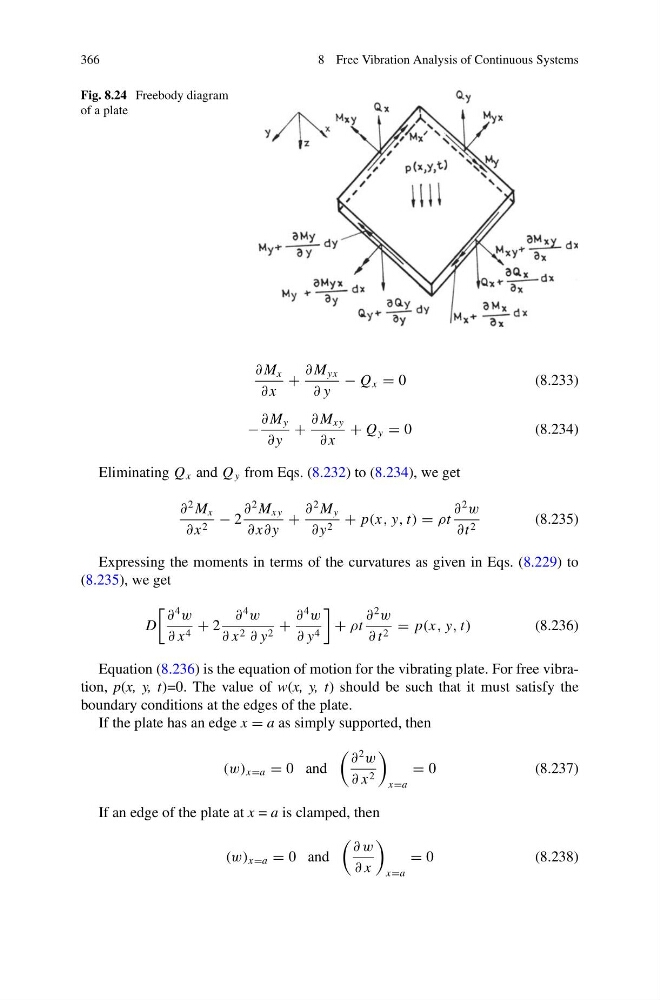
Fig. 8.24 Freebody diagram
of a plate
∂ M x
∂ x
+
∂ M yx
∂ y
− Q x = 0
(8.233)
−
∂ M y
∂ y
+
∂ M xy
∂ x
+ Q y = 0
(8.234)
Eliminating Q x and Q y from Eqs. (8.232) to (8.234), we get
∂
2 M x
∂ x 2 − 2
∂
2 M xy
∂ x∂ y
+
∂
2 M y
∂ y 2 + p(x, y, t) = ρt
∂
2
w
∂t 2
(8.235)
Expressing the moments in terms of the curvatures as given in Eqs. (8.229) to
(8.235), we get
D
∂
4
w
∂ x 4 + 2
∂
4
w
∂ x 2 ∂ y 2 +
∂
4
w
∂ y 4
+ ρt
∂
2
w
∂ t 2 = p(x, y, t)
(8.236)
Equation (8.236) is the equation of motion for the vibrating plate. For free vibration, p(x, y, t)=0. The value of w(x, y, t) should be such that it must satisfy the
boundary conditions at the edges of the plate.
If the plate has an edge x = a as simply supported, then
(w) x=a = 0 and
∂
2
w
∂ x 2
x=a
= 0
(8.237)
If an edge of the plate at x = a is clamped, then
(w) x=a = 0 and
∂ w
∂ x
x=a
= 0
(8.238)
8 Free Vibration Analysis of Continuous Systems
Fig. 8.24 Freebody diagram
of a plate
∂ M x
∂ x
+
∂ M yx
∂ y
− Q x = 0
(8.233)
−
∂ M y
∂ y
+
∂ M xy
∂ x
+ Q y = 0
(8.234)
Eliminating Q x and Q y from Eqs. (8.232) to (8.234), we get
∂
2 M x
∂ x 2 − 2
∂
2 M xy
∂ x∂ y
+
∂
2 M y
∂ y 2 + p(x, y, t) = ρt
∂
2
w
∂t 2
(8.235)
Expressing the moments in terms of the curvatures as given in Eqs. (8.229) to
(8.235), we get
D
∂
4
w
∂ x 4 + 2
∂
4
w
∂ x 2 ∂ y 2 +
∂
4
w
∂ y 4
+ ρt
∂
2
w
∂ t 2 = p(x, y, t)
(8.236)
Equation (8.236) is the equation of motion for the vibrating plate. For free vibration, p(x, y, t)=0. The value of w(x, y, t) should be such that it must satisfy the
boundary conditions at the edges of the plate.
If the plate has an edge x = a as simply supported, then
(w) x=a = 0 and
∂
2
w
∂ x 2
x=a
= 0
(8.237)
If an edge of the plate at x = a is clamped, then
(w) x=a = 0 and
∂ w
∂ x
x=a
= 0
(8.238)