

8.17 Vibration of Membranes
361
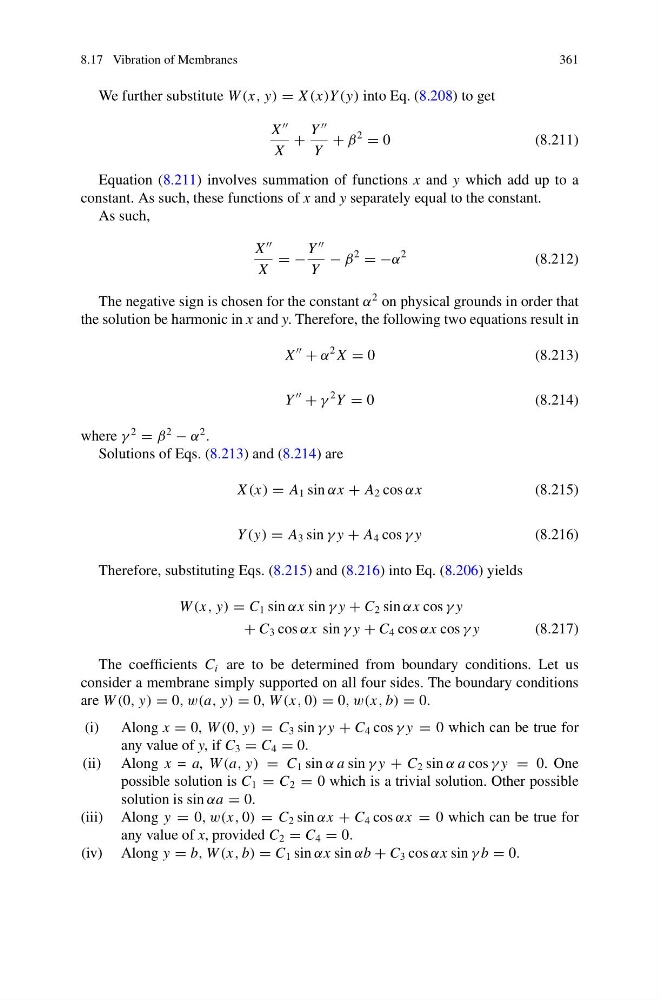
We further substitute W (x, y) = X (x)Y (y) into Eq. (8.208) to get
X
X
+
Y
Y
+ β
2
= 0
(8.211)
Equation (8.211) involves summation of functions x and y which add up to a
constant. As such, these functions of x and y separately equal to the constant.
As such,
X
X
= −
Y
Y
− β
2
= −α
2
(8.212)
The negative sign is chosen for the constant α
2 on physical grounds in order that
the solution be harmonic in x and y. Therefore, the following two equations result in
X
+ α
2 X = 0
(8.213)
Y
+ γ
2 Y = 0
(8.214)
where γ
2
= β
2
− α
2 .
Solutions of Eqs. (8.213) and (8.214) are
X (x) = A 1 sin αx + A 2 cos αx
(8.215)
Y (y) = A 3 sin γ y + A 4 cos γ y
(8.216)
Therefore, substituting Eqs. (8.215) and (8.216) into Eq. (8.206) yields
W (x, y) = C 1 sin αx sin γ y + C 2 sin αx cos γ y
+ C 3 cos αx sin γ y + C 4 cos αx cos γ y
(8.217)
The coefficients C i are to be determined from boundary conditions. Let us
consider a membrane simply supported on all four sides. The boundary conditions
are W (0, y) = 0, w(a, y) = 0, W (x, 0) = 0, w(x, b) = 0.
(i) Along x = 0, W (0, y) = C 3 sin γ y + C 4 cos γ y = 0 which can be true for
any value of y, if C 3 = C 4 = 0.
(ii) Along x = a, W (a, y) = C 1 sin α a sin γ y + C 2 sin α a cos γ y = 0. One
possible solution is C 1 = C 2 = 0 which is a trivial solution. Other possible
solution is sin αa = 0.
(iii) Along y = 0, w(x, 0) = C 2 sin αx + C 4 cos αx = 0 which can be true for
any value of x, provided C 2 = C 4 = 0.
(iv) Along y = b, W (x, b) = C 1 sin αx sin αb + C 3 cos αx sin γ b = 0.
361
We further substitute W (x, y) = X (x)Y (y) into Eq. (8.208) to get
X
X
+
Y
Y
+ β
2
= 0
(8.211)
Equation (8.211) involves summation of functions x and y which add up to a
constant. As such, these functions of x and y separately equal to the constant.
As such,
X
X
= −
Y
Y
− β
2
= −α
2
(8.212)
The negative sign is chosen for the constant α
2 on physical grounds in order that
the solution be harmonic in x and y. Therefore, the following two equations result in
X
+ α
2 X = 0
(8.213)
Y
+ γ
2 Y = 0
(8.214)
where γ
2
= β
2
− α
2 .
Solutions of Eqs. (8.213) and (8.214) are
X (x) = A 1 sin αx + A 2 cos αx
(8.215)
Y (y) = A 3 sin γ y + A 4 cos γ y
(8.216)
Therefore, substituting Eqs. (8.215) and (8.216) into Eq. (8.206) yields
W (x, y) = C 1 sin αx sin γ y + C 2 sin αx cos γ y
+ C 3 cos αx sin γ y + C 4 cos αx cos γ y
(8.217)
The coefficients C i are to be determined from boundary conditions. Let us
consider a membrane simply supported on all four sides. The boundary conditions
are W (0, y) = 0, w(a, y) = 0, W (x, 0) = 0, w(x, b) = 0.
(i) Along x = 0, W (0, y) = C 3 sin γ y + C 4 cos γ y = 0 which can be true for
any value of y, if C 3 = C 4 = 0.
(ii) Along x = a, W (a, y) = C 1 sin α a sin γ y + C 2 sin α a cos γ y = 0. One
possible solution is C 1 = C 2 = 0 which is a trivial solution. Other possible
solution is sin αa = 0.
(iii) Along y = 0, w(x, 0) = C 2 sin αx + C 4 cos αx = 0 which can be true for
any value of x, provided C 2 = C 4 = 0.
(iv) Along y = b, W (x, b) = C 1 sin αx sin αb + C 3 cos αx sin γ b = 0.