

362
8 Free Vibration Analysis of Continuous Systems
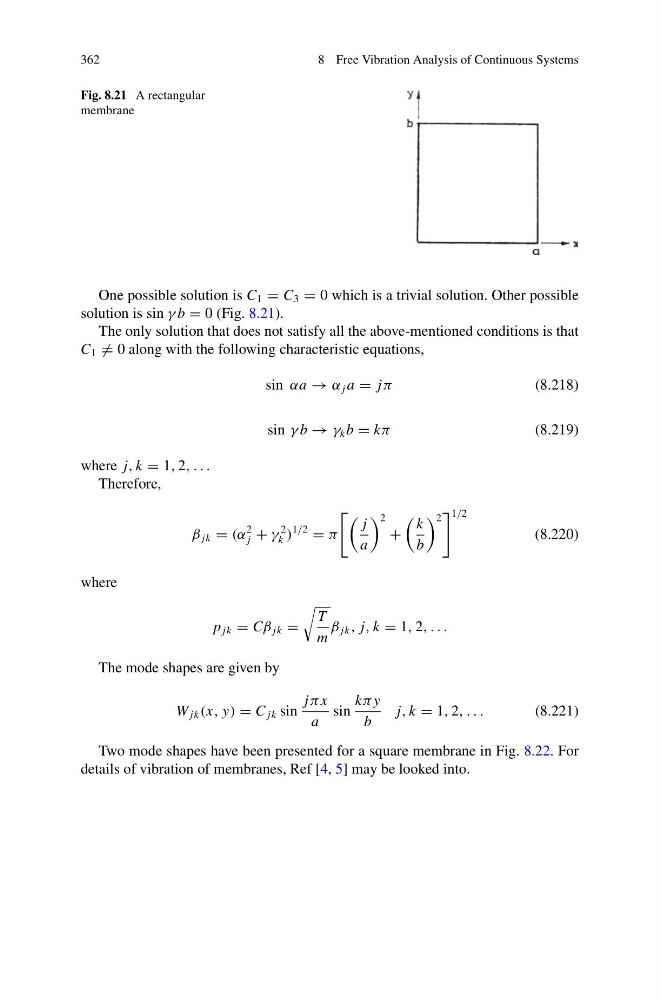
Fig. 8.21 A rectangular
membrane
One possible solution is C 1 = C 3 = 0 which is a trivial solution. Other possible
solution is sin γ b = 0 (Fig. 8.21).
The only solution that does not satisfy all the above-mentioned conditions is that
C 1 = 0 along with the following characteristic equations,
sin αa → α j a = jπ
(8.218)
sin γ b → γ k b = kπ
(8.219)
where j, k = 1, 2, . . .
Therefore,
β jk = (α
2
j + γ
2
k )
1/2
= π
j
a
2
+
k
b
2
1/2
(8.220)
where
p jk = Cβ jk =
T
m
β jk , j, k = 1, 2, . . .
The mode shapes are given by
W jk (x, y) = C jk sin
jπ x
a
sin
kπ y
b
j, k = 1, 2, . . .
(8.221)
Two mode shapes have been presented for a square membrane in Fig. 8.22. For
details of vibration of membranes, Ref [4, 5] may be looked into.
8 Free Vibration Analysis of Continuous Systems
Fig. 8.21 A rectangular
membrane
One possible solution is C 1 = C 3 = 0 which is a trivial solution. Other possible
solution is sin γ b = 0 (Fig. 8.21).
The only solution that does not satisfy all the above-mentioned conditions is that
C 1 = 0 along with the following characteristic equations,
sin αa → α j a = jπ
(8.218)
sin γ b → γ k b = kπ
(8.219)
where j, k = 1, 2, . . .
Therefore,
β jk = (α
2
j + γ
2
k )
1/2
= π
j
a
2
+
k
b
2
1/2
(8.220)
where
p jk = Cβ jk =
T
m
β jk , j, k = 1, 2, . . .
The mode shapes are given by
W jk (x, y) = C jk sin
jπ x
a
sin
kπ y
b
j, k = 1, 2, . . .
(8.221)
Two mode shapes have been presented for a square membrane in Fig. 8.22. For
details of vibration of membranes, Ref [4, 5] may be looked into.