

360
8 Free Vibration Analysis of Continuous Systems
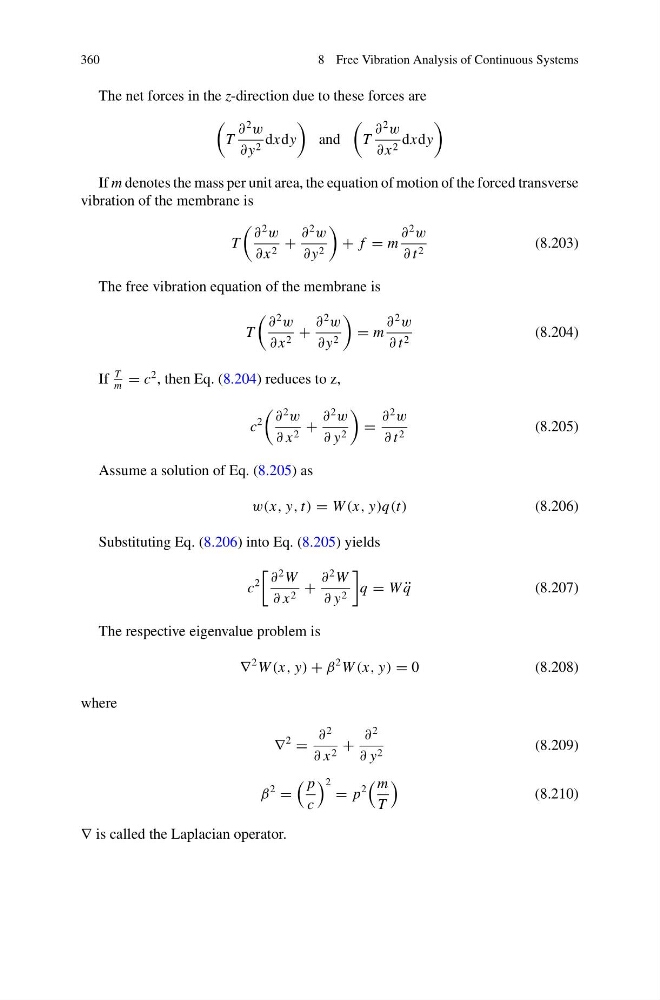
The net forces in the z-direction due to these forces are
T
∂
2
w
∂ y 2 dxdy
and
T
∂
2
w
∂ x 2 dxdy
If m denotes the mass per unit area, the equation of motion of the forced transverse
vibration of the membrane is
T
∂
2
w
∂ x 2 +
∂
2
w
∂ y 2
+ f = m
∂
2
w
∂ t 2
(8.203)
The free vibration equation of the membrane is
T
∂
2
w
∂ x 2 +
∂
2
w
∂ y 2
= m
∂
2
w
∂ t 2
(8.204)
If
T
m
= c
2 , then Eq. (8.204) reduces to z,
c
2
∂
2
w
∂ x 2 +
∂
2
w
∂ y 2
=
∂
2
w
∂ t 2
(8.205)
Assume a solution of Eq. (8.205) as
w(x, y, t) = W (x, y)q(t)
(8.206)
Substituting Eq. (8.206) into Eq. (8.205) yields
c
2
∂
2 W
∂ x 2 +
∂
2 W
∂ y 2
q = W ¨
q
(8.207)
The respective eigenvalue problem is
∇
2 W (x, y) + β
2 W (x, y) = 0
(8.208)
where
∇
2
=
∂
2
∂ x 2 +
∂
2
∂ y 2
(8.209)
β
2
=
p
c
2 = p
2
m
T
(8.210)
∇ is called the Laplacian operator.
8 Free Vibration Analysis of Continuous Systems
The net forces in the z-direction due to these forces are
T
∂
2
w
∂ y 2 dxdy
and
T
∂
2
w
∂ x 2 dxdy
If m denotes the mass per unit area, the equation of motion of the forced transverse
vibration of the membrane is
T
∂
2
w
∂ x 2 +
∂
2
w
∂ y 2
+ f = m
∂
2
w
∂ t 2
(8.203)
The free vibration equation of the membrane is
T
∂
2
w
∂ x 2 +
∂
2
w
∂ y 2
= m
∂
2
w
∂ t 2
(8.204)
If
T
m
= c
2 , then Eq. (8.204) reduces to z,
c
2
∂
2
w
∂ x 2 +
∂
2
w
∂ y 2
=
∂
2
w
∂ t 2
(8.205)
Assume a solution of Eq. (8.205) as
w(x, y, t) = W (x, y)q(t)
(8.206)
Substituting Eq. (8.206) into Eq. (8.205) yields
c
2
∂
2 W
∂ x 2 +
∂
2 W
∂ y 2
q = W ¨
q
(8.207)
The respective eigenvalue problem is
∇
2 W (x, y) + β
2 W (x, y) = 0
(8.208)
where
∇
2
=
∂
2
∂ x 2 +
∂
2
∂ y 2
(8.209)
β
2
=
p
c
2 = p
2
m
T
(8.210)
∇ is called the Laplacian operator.