

8.15 Rayleigh’s Quotient for Fundamental Frequency
355
Therefore,
U E =
1
2
L
0
E I
d
2 Y
d x 2
2
sin
2
( pt − α)dx
(8.193)
and
T E = −
1
2
p
2
L
0
ρ AY
2 sin
2
( pt − α)dx
(8.194)
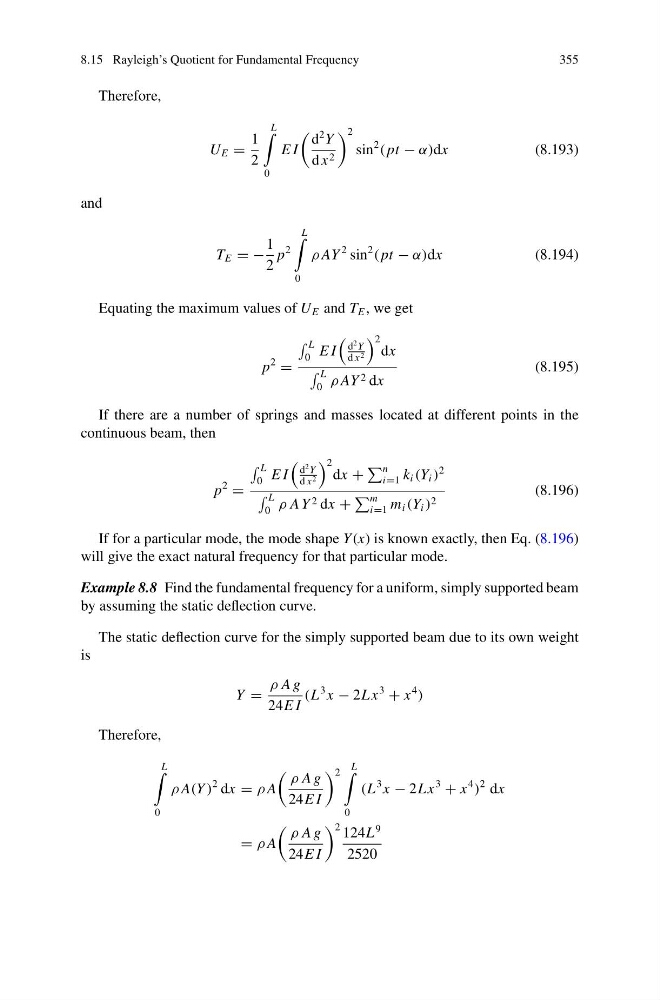
Equating the maximum values of U E and T E , we get
p
2
=
L
0 E I
d
2 Y
d x 2
2
dx
L
0 ρ AY 2 dx
(8.195)
If there are a number of springs and masses located at different points in the
continuous beam, then
p
2
=
L
0 E I
d
2 Y
d x 2
2
dx +
n
i=1 k i (Y i )
2
L
0 ρ A Y 2 dx +
m
i=1 m i (Y i ) 2
(8.196)
If for a particular mode, the mode shape Y (x) is known exactly, then Eq. (8.196)
will give the exact natural frequency for that particular mode.
Example 8.8 Find the fundamental frequency for a uniform, simply supported beam
by assuming the static deflection curve.
The static deflection curve for the simply supported beam due to its own weight
is
Y =
ρ A g
24E I
(L
3 x − 2Lx
3
+ x
4
)
Therefore,
L
0
ρ A(Y )
2 dx = ρ A
ρ A g
24E I
2
L
0
(L
3 x − 2Lx
3
+ x
4
)
2 dx
= ρ A
ρ A g
24E I
2 124L
9
2520
355
Therefore,
U E =
1
2
L
0
E I
d
2 Y
d x 2
2
sin
2
( pt − α)dx
(8.193)
and
T E = −
1
2
p
2
L
0
ρ AY
2 sin
2
( pt − α)dx
(8.194)
Equating the maximum values of U E and T E , we get
p
2
=
L
0 E I
d
2 Y
d x 2
2
dx
L
0 ρ AY 2 dx
(8.195)
If there are a number of springs and masses located at different points in the
continuous beam, then
p
2
=
L
0 E I
d
2 Y
d x 2
2
dx +
n
i=1 k i (Y i )
2
L
0 ρ A Y 2 dx +
m
i=1 m i (Y i ) 2
(8.196)
If for a particular mode, the mode shape Y (x) is known exactly, then Eq. (8.196)
will give the exact natural frequency for that particular mode.
Example 8.8 Find the fundamental frequency for a uniform, simply supported beam
by assuming the static deflection curve.
The static deflection curve for the simply supported beam due to its own weight
is
Y =
ρ A g
24E I
(L
3 x − 2Lx
3
+ x
4
)
Therefore,
L
0
ρ A(Y )
2 dx = ρ A
ρ A g
24E I
2
L
0
(L
3 x − 2Lx
3
+ x
4
)
2 dx
= ρ A
ρ A g
24E I
2 124L
9
2520