

356
8 Free Vibration Analysis of Continuous Systems
d
2 Y
dx 2 =
ρ A g
24E I
(−12Lx + 12x
2
)
L
0
E I
d
2 Y
dx 2
2
dx = E I
ρ Ag
24E I
2
L
0
(−12Lx + 12x
2
)
2 dx
= 144E I
ρ Ag
24E I
2
L
0
(x
2
− Lx)
2 dx
=
144
30
E I
ρ Ag
24E I
2
L
5
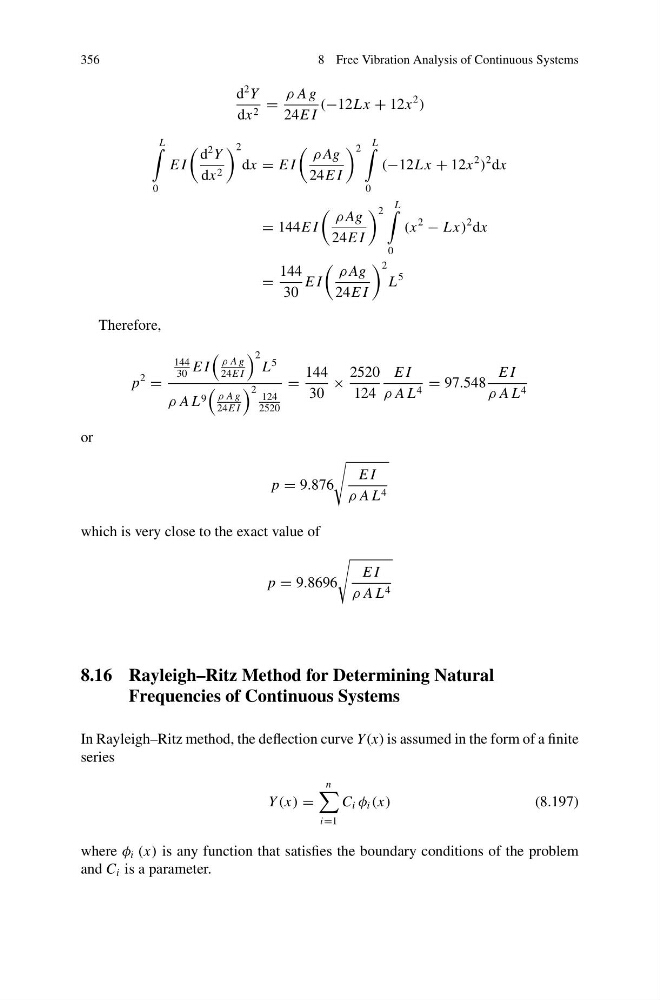
Therefore,
p
2
=
144
30
E I
ρ A g
24E I
2
L
5
ρ A L 9
ρ A g
24E I
2 124
2520
=
144
30
×
2520
124
E I
ρ A L 4 = 97.548
E I
ρ A L 4
or
p = 9.876
E I
ρ A L 4
which is very close to the exact value of
p = 9.8696
E I
ρ A L 4
8.16 Rayleigh–Ritz Method for Determining Natural
Frequencies of Continuous Systems
In Rayleigh–Ritz method, the deflection curve Y (x) is assumed in the form of a finite
series
Y (x) =
n
i=1
C i φ i (x)
(8.197)
where φ i (x) is any function that satisfies the boundary conditions of the problem
and C i is a parameter.
8 Free Vibration Analysis of Continuous Systems
d
2 Y
dx 2 =
ρ A g
24E I
(−12Lx + 12x
2
)
L
0
E I
d
2 Y
dx 2
2
dx = E I
ρ Ag
24E I
2
L
0
(−12Lx + 12x
2
)
2 dx
= 144E I
ρ Ag
24E I
2
L
0
(x
2
− Lx)
2 dx
=
144
30
E I
ρ Ag
24E I
2
L
5
Therefore,
p
2
=
144
30
E I
ρ A g
24E I
2
L
5
ρ A L 9
ρ A g
24E I
2 124
2520
=
144
30
×
2520
124
E I
ρ A L 4 = 97.548
E I
ρ A L 4
or
p = 9.876
E I
ρ A L 4
which is very close to the exact value of
p = 9.8696
E I
ρ A L 4
8.16 Rayleigh–Ritz Method for Determining Natural
Frequencies of Continuous Systems
In Rayleigh–Ritz method, the deflection curve Y (x) is assumed in the form of a finite
series
Y (x) =
n
i=1
C i φ i (x)
(8.197)
where φ i (x) is any function that satisfies the boundary conditions of the problem
and C i is a parameter.