

354
8 Free Vibration Analysis of Continuous Systems
or,
ρ A L
4
486 E I
⎡
⎣
2 5 4
5 16 14
8 28 27
⎤
⎦
⎧
⎨
⎩
1.000
3.334
6.167
⎫
⎬
⎭
=
ρ A L
4
486 E I
⎧
⎨
⎩
43.338
144.682
267.861
⎫
⎬
⎭
=
43.338ρ A L
4
486 E I
⎧
⎨
⎩
1.000
3.338
6.180
⎫
⎬
⎭
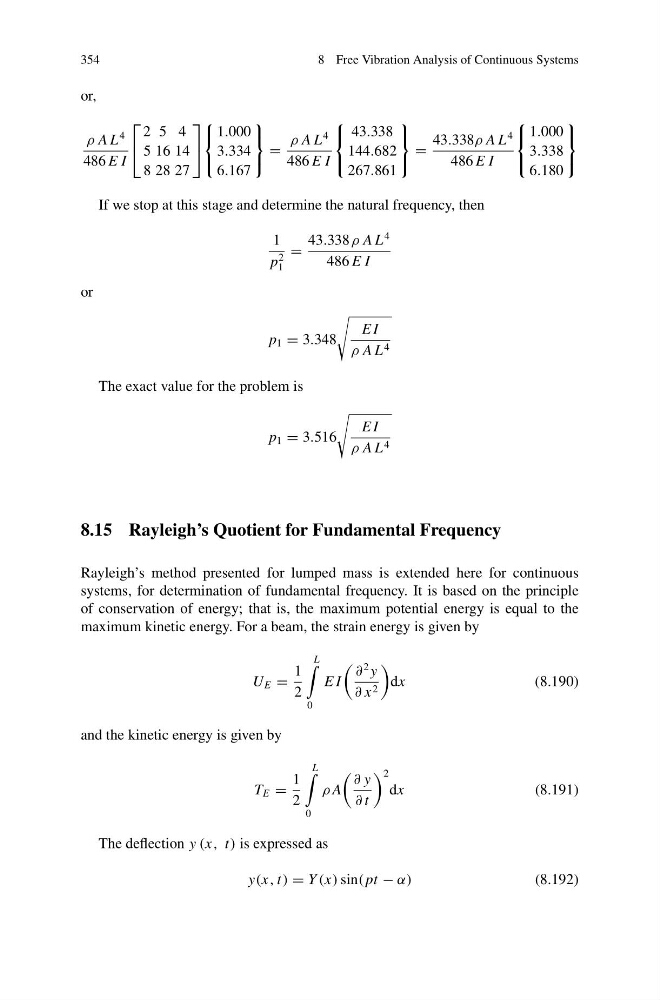
If we stop at this stage and determine the natural frequency, then
1
p
2
1
=
43.338ρ A L
4
486 E I
or
p 1 = 3.348
E I
ρ A L 4
The exact value for the problem is
p 1 = 3.516
E I
ρ A L 4
8.15 Rayleigh’s Quotient for Fundamental Frequency
Rayleigh’s method presented for lumped mass is extended here for continuous
systems, for determination of fundamental frequency. It is based on the principle
of conservation of energy; that is, the maximum potential energy is equal to the
maximum kinetic energy. For a beam, the strain energy is given by
U E =
1
2
L
0
E I
∂
2 y
∂ x 2
dx
(8.190)
and the kinetic energy is given by
T E =
1
2
L
0
ρ A
∂ y
∂ t
2
dx
(8.191)
The deflection y (x, t) is expressed as
y(x, t) = Y (x) sin( pt − α)
(8.192)
8 Free Vibration Analysis of Continuous Systems
or,
ρ A L
4
486 E I
⎡
⎣
2 5 4
5 16 14
8 28 27
⎤
⎦
⎧
⎨
⎩
1.000
3.334
6.167
⎫
⎬
⎭
=
ρ A L
4
486 E I
⎧
⎨
⎩
43.338
144.682
267.861
⎫
⎬
⎭
=
43.338ρ A L
4
486 E I
⎧
⎨
⎩
1.000
3.338
6.180
⎫
⎬
⎭
If we stop at this stage and determine the natural frequency, then
1
p
2
1
=
43.338ρ A L
4
486 E I
or
p 1 = 3.348
E I
ρ A L 4
The exact value for the problem is
p 1 = 3.516
E I
ρ A L 4
8.15 Rayleigh’s Quotient for Fundamental Frequency
Rayleigh’s method presented for lumped mass is extended here for continuous
systems, for determination of fundamental frequency. It is based on the principle
of conservation of energy; that is, the maximum potential energy is equal to the
maximum kinetic energy. For a beam, the strain energy is given by
U E =
1
2
L
0
E I
∂
2 y
∂ x 2
dx
(8.190)
and the kinetic energy is given by
T E =
1
2
L
0
ρ A
∂ y
∂ t
2
dx
(8.191)
The deflection y (x, t) is expressed as
y(x, t) = Y (x) sin( pt − α)
(8.192)