

342
8 Free Vibration Analysis of Continuous Systems
and
at x = L , Y = 0 and
d
2 Y
dx 2 = 0
( b )
Substituting the conditions given by Eq. (a) in Eq. (8.152), we get
C 2 = C 4 = 0
( c )
and on substitution of condition given by Eq. (b) into Eq. (8.152), finally gives the
frequency equation as
sin k L = 0
( d )
which gives
k =
nπ
L
, n = 1, 2, 3, . . . .
(e)
Replacing the value of k from Eq. (e) into the first of Eq. (8.153) gives
λ
4
=
k
4
1 + r 2 k 2
(f)
or
p
2
=
E I
ρ A
k
4
1 + r 2 k 2
(f)
We know that the angular frequencies of an elastic simply supported beam without
rotary inertia effect are [Eq. (8.95)]
¯
p
2
n =
n
4
π
4 E I
ρ AL 4
(g)
Now, combining Eqs. (e), (f) and (g), we get
p
2
= ¯
p
2
n
1 −
n
2 r
2
π
2
L 2 +
n
4 r
4
π
4
L 4 − · · ·
(h)
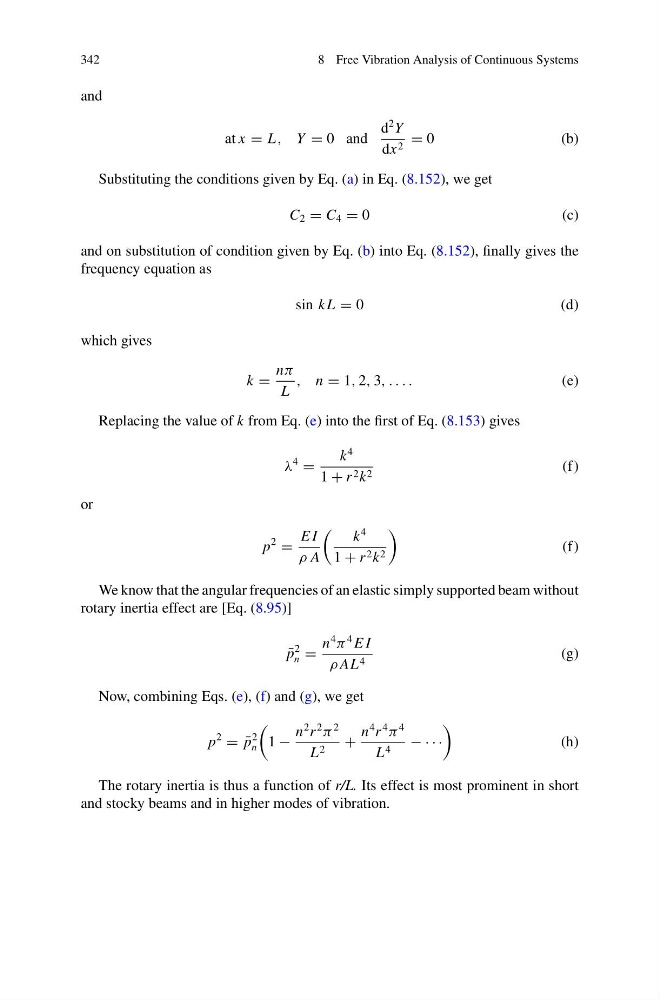
The rotary inertia is thus a function of r/L. Its effect is most prominent in short
and stocky beams and in higher modes of vibration.
8 Free Vibration Analysis of Continuous Systems
and
at x = L , Y = 0 and
d
2 Y
dx 2 = 0
( b )
Substituting the conditions given by Eq. (a) in Eq. (8.152), we get
C 2 = C 4 = 0
( c )
and on substitution of condition given by Eq. (b) into Eq. (8.152), finally gives the
frequency equation as
sin k L = 0
( d )
which gives
k =
nπ
L
, n = 1, 2, 3, . . . .
(e)
Replacing the value of k from Eq. (e) into the first of Eq. (8.153) gives
λ
4
=
k
4
1 + r 2 k 2
(f)
or
p
2
=
E I
ρ A
k
4
1 + r 2 k 2
(f)
We know that the angular frequencies of an elastic simply supported beam without
rotary inertia effect are [Eq. (8.95)]
¯
p
2
n =
n
4
π
4 E I
ρ AL 4
(g)
Now, combining Eqs. (e), (f) and (g), we get
p
2
= ¯
p
2
n
1 −
n
2 r
2
π
2
L 2 +
n
4 r
4
π
4
L 4 − · · ·
(h)
The rotary inertia is thus a function of r/L. Its effect is most prominent in short
and stocky beams and in higher modes of vibration.