

8.10 Effect of Rotary Inertia on the Free Flexural Vibration of Beams
341
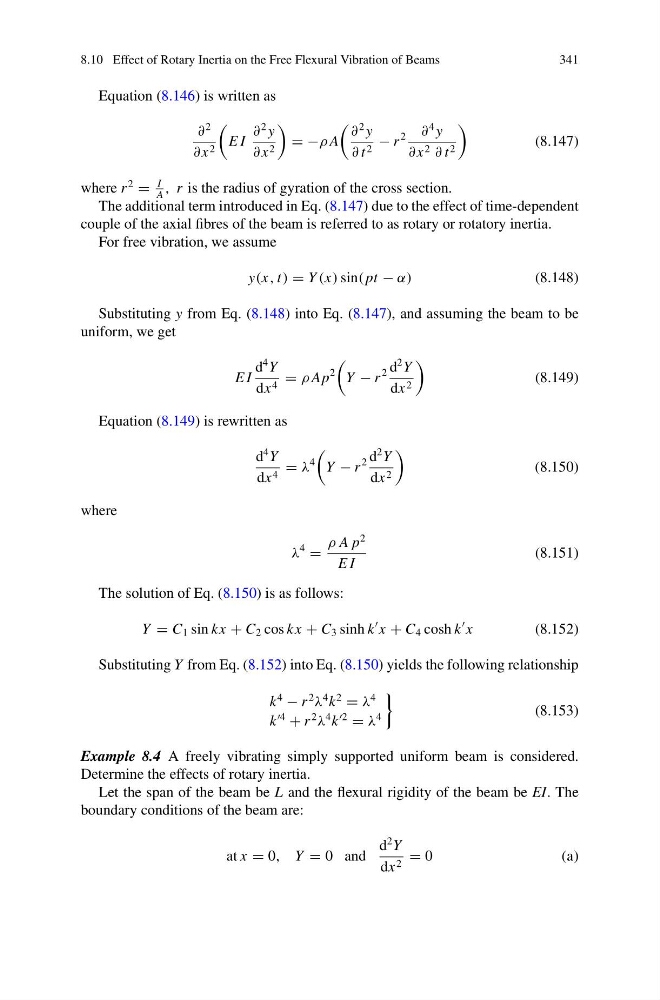
Equation (8.146) is written as
∂
2
∂ x 2
E I
∂
2 y
∂ x 2
= −ρ A
∂
2 y
∂ t 2 − r
2 ∂
4 y
∂ x 2 ∂ t 2
(8.147)
where r
2
=
I
A
, r is the radius of gyration of the cross section.
The additional term introduced in Eq. (8.147) due to the effect of time-dependent
couple of the axial fibres of the beam is referred to as rotary or rotatory inertia.
For free vibration, we assume
y(x, t) = Y (x) sin( pt − α)
(8.148)
Substituting y from Eq. (8.148) into Eq. (8.147), and assuming the beam to be
uniform, we get
E I
d
4 Y
dx 4 = ρ Ap
2
Y − r
2 d
2 Y
dx 2
(8.149)
Equation (8.149) is rewritten as
d
4 Y
dx 4 = λ
4
Y − r
2 d
2 Y
dx 2
(8.150)
where
λ
4
=
ρ A p
2
E I
(8.151)
The solution of Eq. (8.150) is as follows:
Y = C 1 sin kx + C 2 cos kx + C 3 sinh k
x + C 4 cosh k
x
(8.152)
Substituting Y from Eq. (8.152) into Eq. (8.150) yields the following relationship
k
4
− r
2
λ
4 k
2
= λ
4
k
4
+ r
2
λ
4 k
2
= λ
4
(8.153)
Example 8.4 A freely vibrating simply supported uniform beam is considered.
Determine the effects of rotary inertia.
Let the span of the beam be L and the flexural rigidity of the beam be EI. The
boundary conditions of the beam are:
at x = 0, Y = 0 and
d
2 Y
dx 2 = 0
( a )
341
Equation (8.146) is written as
∂
2
∂ x 2
E I
∂
2 y
∂ x 2
= −ρ A
∂
2 y
∂ t 2 − r
2 ∂
4 y
∂ x 2 ∂ t 2
(8.147)
where r
2
=
I
A
, r is the radius of gyration of the cross section.
The additional term introduced in Eq. (8.147) due to the effect of time-dependent
couple of the axial fibres of the beam is referred to as rotary or rotatory inertia.
For free vibration, we assume
y(x, t) = Y (x) sin( pt − α)
(8.148)
Substituting y from Eq. (8.148) into Eq. (8.147), and assuming the beam to be
uniform, we get
E I
d
4 Y
dx 4 = ρ Ap
2
Y − r
2 d
2 Y
dx 2
(8.149)
Equation (8.149) is rewritten as
d
4 Y
dx 4 = λ
4
Y − r
2 d
2 Y
dx 2
(8.150)
where
λ
4
=
ρ A p
2
E I
(8.151)
The solution of Eq. (8.150) is as follows:
Y = C 1 sin kx + C 2 cos kx + C 3 sinh k
x + C 4 cosh k
x
(8.152)
Substituting Y from Eq. (8.152) into Eq. (8.150) yields the following relationship
k
4
− r
2
λ
4 k
2
= λ
4
k
4
+ r
2
λ
4 k
2
= λ
4
(8.153)
Example 8.4 A freely vibrating simply supported uniform beam is considered.
Determine the effects of rotary inertia.
Let the span of the beam be L and the flexural rigidity of the beam be EI. The
boundary conditions of the beam are:
at x = 0, Y = 0 and
d
2 Y
dx 2 = 0
( a )