

340
8 Free Vibration Analysis of Continuous Systems
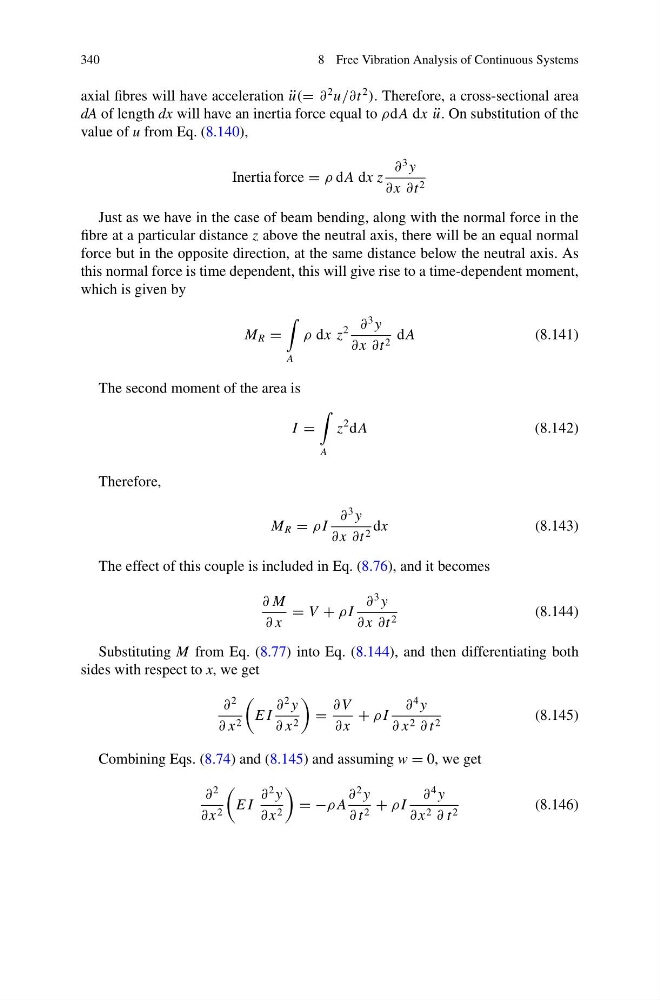
axial fibres will have acceleration ¨
u(= ∂
2 u/∂t
2
). Therefore, a cross-sectional area
dA of length dx will have an inertia force equal to ρdA dx ¨
u. On substitution of the
value of u from Eq. (8.140),
Inertia force = ρ dA dx z
∂
3 y
∂ x ∂t 2
Just as we have in the case of beam bending, along with the normal force in the
fibre at a particular distance z above the neutral axis, there will be an equal normal
force but in the opposite direction, at the same distance below the neutral axis. As
this normal force is time dependent, this will give rise to a time-dependent moment,
which is given by
M R =
A
ρ dx z
2 ∂
3 y
∂ x ∂t 2 dA
(8.141)
The second moment of the area is
I =
A
z
2 dA
(8.142)
Therefore,
M R = ρ I
∂
3 y
∂ x ∂t 2 dx
(8.143)
The effect of this couple is included in Eq. (8.76), and it becomes
∂ M
∂ x
= V + ρ I
∂
3 y
∂ x ∂t 2
(8.144)
Substituting M from Eq. (8.77) into Eq. (8.144), and then differentiating both
sides with respect to x, we get
∂
2
∂ x 2
E I
∂
2 y
∂ x 2
=
∂ V
∂ x
+ ρ I
∂
4 y
∂ x 2 ∂ t 2
(8.145)
Combining Eqs. (8.74) and (8.145) and assuming w = 0, we get
∂
2
∂ x 2
E I
∂
2 y
∂ x 2
= −ρ A
∂
2 y
∂ t 2 + ρ I
∂
4 y
∂ x 2 ∂ t 2
(8.146)
8 Free Vibration Analysis of Continuous Systems
axial fibres will have acceleration ¨
u(= ∂
2 u/∂t
2
). Therefore, a cross-sectional area
dA of length dx will have an inertia force equal to ρdA dx ¨
u. On substitution of the
value of u from Eq. (8.140),
Inertia force = ρ dA dx z
∂
3 y
∂ x ∂t 2
Just as we have in the case of beam bending, along with the normal force in the
fibre at a particular distance z above the neutral axis, there will be an equal normal
force but in the opposite direction, at the same distance below the neutral axis. As
this normal force is time dependent, this will give rise to a time-dependent moment,
which is given by
M R =
A
ρ dx z
2 ∂
3 y
∂ x ∂t 2 dA
(8.141)
The second moment of the area is
I =
A
z
2 dA
(8.142)
Therefore,
M R = ρ I
∂
3 y
∂ x ∂t 2 dx
(8.143)
The effect of this couple is included in Eq. (8.76), and it becomes
∂ M
∂ x
= V + ρ I
∂
3 y
∂ x ∂t 2
(8.144)
Substituting M from Eq. (8.77) into Eq. (8.144), and then differentiating both
sides with respect to x, we get
∂
2
∂ x 2
E I
∂
2 y
∂ x 2
=
∂ V
∂ x
+ ρ I
∂
4 y
∂ x 2 ∂ t 2
(8.145)
Combining Eqs. (8.74) and (8.145) and assuming w = 0, we get
∂
2
∂ x 2
E I
∂
2 y
∂ x 2
= −ρ A
∂
2 y
∂ t 2 + ρ I
∂
4 y
∂ x 2 ∂ t 2
(8.146)