

8.9 Orthogonality Properties of Normal Modes
339
Therefore, the general solution for transverse displacement is
y(x, t) = 4v
∞
m=1,3,5,...
1
mπ p m
sin
mπ x
L
sin p m t
(g)
Now,
p m = (mπ)
2
E I
ρ AL 4
Therefore,
y(x, t) = 4v
ρ AL 4
E I
∞
m=1,3,5,...
1
(mπ) 3 sin
mπ x
L
sin p m t
(h)
8.10 Effect of Rotary Inertia on the Free Flexural
Vibration of Beams
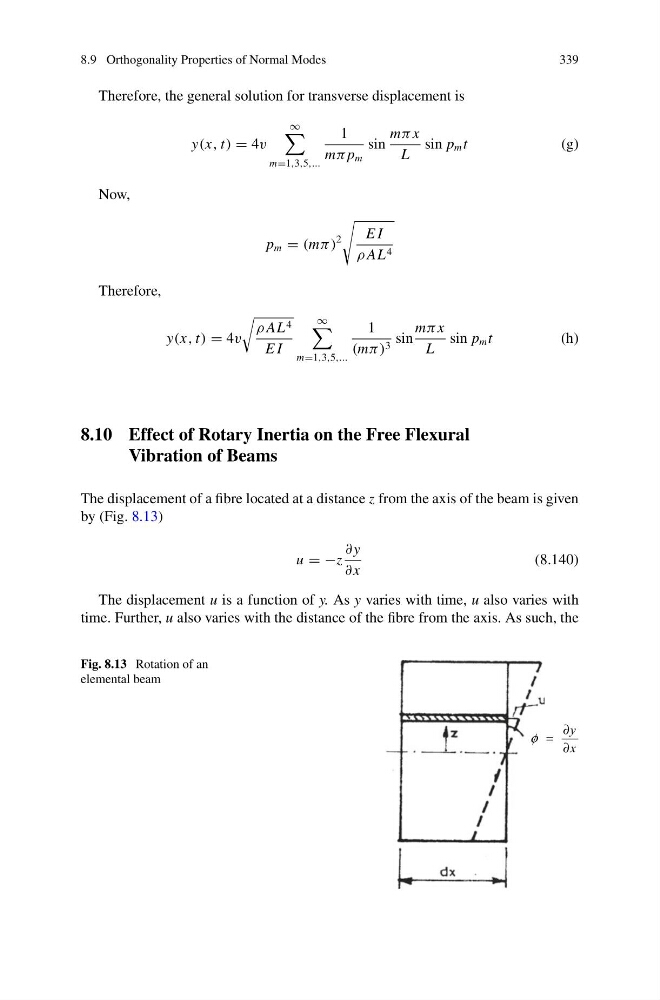
The displacement of a fibre located at a distance z from the axis of the beam is given
by (Fig. 8.13)
u = −z
∂ y
∂ x
(8.140)
The displacement u is a function of y. As y varies with time, u also varies with
time. Further, u also varies with the distance of the fibre from the axis. As such, the
Fig. 8.13 Rotation of an
elemental beam
x
y
∂
∂
=
φ
339
Therefore, the general solution for transverse displacement is
y(x, t) = 4v
∞
m=1,3,5,...
1
mπ p m
sin
mπ x
L
sin p m t
(g)
Now,
p m = (mπ)
2
E I
ρ AL 4
Therefore,
y(x, t) = 4v
ρ AL 4
E I
∞
m=1,3,5,...
1
(mπ) 3 sin
mπ x
L
sin p m t
(h)
8.10 Effect of Rotary Inertia on the Free Flexural
Vibration of Beams
The displacement of a fibre located at a distance z from the axis of the beam is given
by (Fig. 8.13)
u = −z
∂ y
∂ x
(8.140)
The displacement u is a function of y. As y varies with time, u also varies with
time. Further, u also varies with the distance of the fibre from the axis. As such, the
Fig. 8.13 Rotation of an
elemental beam
x
y
∂
∂
=
φ