

8.11 Free Vibration of the Shear Beam
343
8.11 Free Vibration of the Shear Beam
For short and sturdy beams, the contribution of the shear force towards the total
deflection of the beam is not negligible. In this section, let us limit our study only to
the transverse shear effect. Though the shear force is the rate of change of bending
moment, the effect of bending moment is not considered in the following analysis.
Similarly, the rotary inertia effect is also ignored. The beam which is analysed on
the basis of transverse shear only is referred to as shear beam.
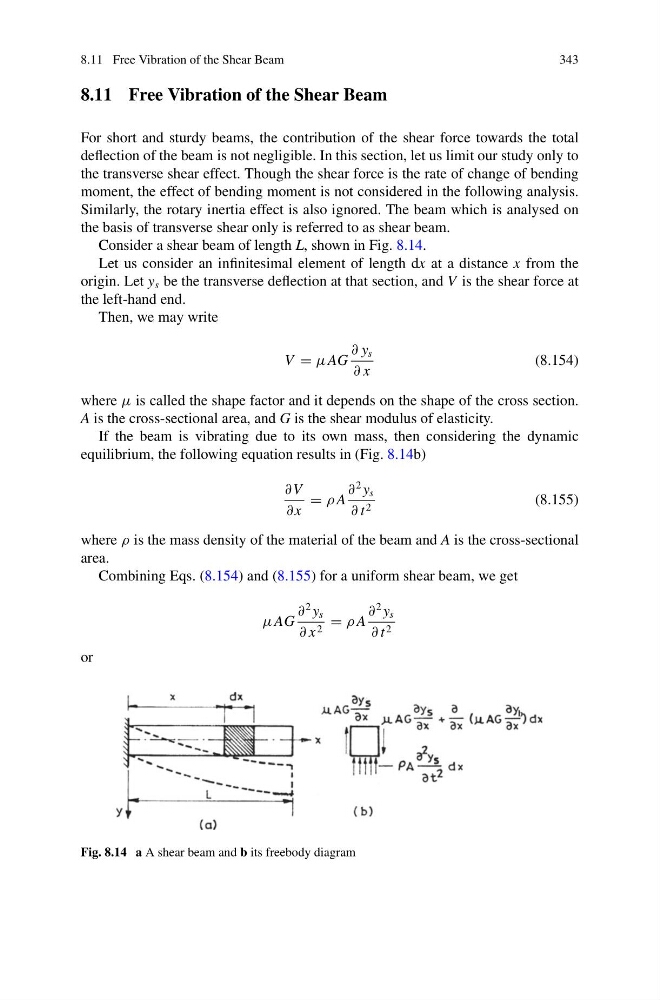
Consider a shear beam of length L, shown in Fig. 8.14.
Let us consider an infinitesimal element of length dx at a distance x from the
origin. Let y s be the transverse deflection at that section, and V is the shear force at
the left-hand end.
Then, we may write
V = μAG
∂ y s
∂ x
(8.154)
where μ is called the shape factor and it depends on the shape of the cross section.
A is the cross-sectional area, and G is the shear modulus of elasticity.
If the beam is vibrating due to its own mass, then considering the dynamic
equilibrium, the following equation results in (Fig. 8.14b)
∂ V
∂ x
= ρ A
∂
2 y s
∂ t 2
(8.155)
where ρ is the mass density of the material of the beam and A is the cross-sectional
area.
Combining Eqs. (8.154) and (8.155) for a uniform shear beam, we get
μAG
∂
2 y s
∂ x 2 = ρ A
∂
2 y s
∂ t 2
or
Fig. 8.14 a A shear beam and b its freebody diagram
343
8.11 Free Vibration of the Shear Beam
For short and sturdy beams, the contribution of the shear force towards the total
deflection of the beam is not negligible. In this section, let us limit our study only to
the transverse shear effect. Though the shear force is the rate of change of bending
moment, the effect of bending moment is not considered in the following analysis.
Similarly, the rotary inertia effect is also ignored. The beam which is analysed on
the basis of transverse shear only is referred to as shear beam.
Consider a shear beam of length L, shown in Fig. 8.14.
Let us consider an infinitesimal element of length dx at a distance x from the
origin. Let y s be the transverse deflection at that section, and V is the shear force at
the left-hand end.
Then, we may write
V = μAG
∂ y s
∂ x
(8.154)
where μ is called the shape factor and it depends on the shape of the cross section.
A is the cross-sectional area, and G is the shear modulus of elasticity.
If the beam is vibrating due to its own mass, then considering the dynamic
equilibrium, the following equation results in (Fig. 8.14b)
∂ V
∂ x
= ρ A
∂
2 y s
∂ t 2
(8.155)
where ρ is the mass density of the material of the beam and A is the cross-sectional
area.
Combining Eqs. (8.154) and (8.155) for a uniform shear beam, we get
μAG
∂
2 y s
∂ x 2 = ρ A
∂
2 y s
∂ t 2
or
Fig. 8.14 a A shear beam and b its freebody diagram