

8.4 Free Torsional Vibration of the Shaft
319
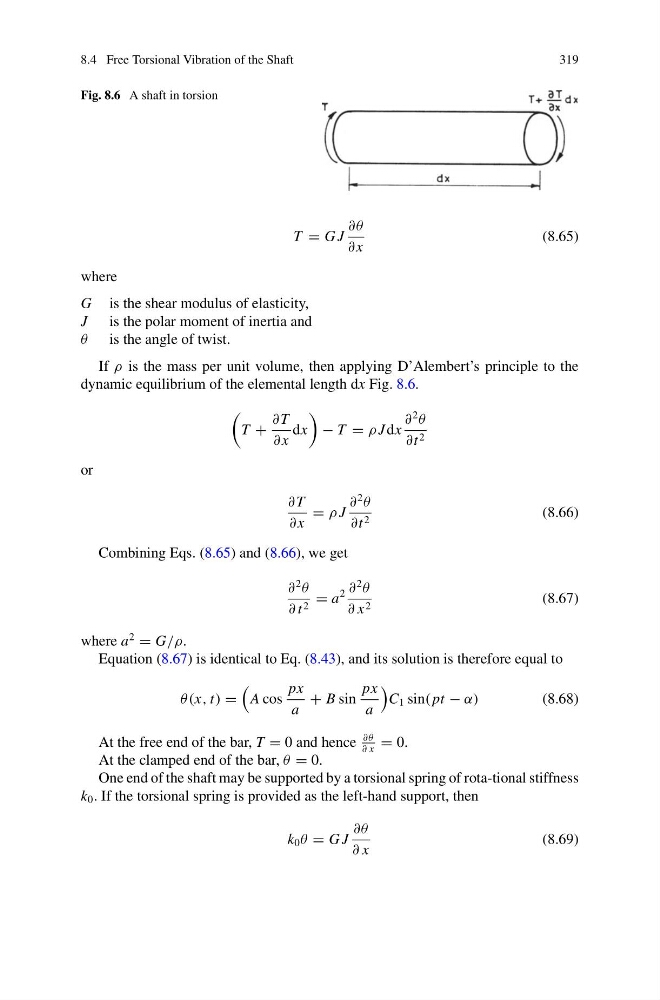
Fig. 8.6 A shaft in torsion
T = G J
∂θ
∂ x
(8.65)
where
G is the shear modulus of elasticity,
J is the polar moment of inertia and
θ is the angle of twist.
If ρ is the mass per unit volume, then applying D’Alembert’s principle to the
dynamic equilibrium of the elemental length dx Fig. 8.6.
T +
∂ T
∂ x
dx
− T = ρ J dx
∂
2
θ
∂t 2
or
∂ T
∂ x
= ρ J
∂
2
θ
∂t 2
(8.66)
Combining Eqs. (8.65) and (8.66), we get
∂
2
θ
∂ t 2 = a
2 ∂
2
θ
∂ x 2
(8.67)
where a
2
= G/ρ.
Equation (8.67) is identical to Eq. (8.43), and its solution is therefore equal to
θ(x, t) =
A cos
px
a
+ B sin
px
a
C 1 sin( pt − α)
(8.68)
At the free end of the bar, T = 0 and hence
∂θ
∂ x
= 0.
At the clamped end of the bar, θ = 0.
One end of the shaft may be supported by a torsional spring of rota-tional stiffness
k 0 . If the torsional spring is provided as the left-hand support, then
k 0 θ = G J
∂θ
∂ x
(8.69)
319
Fig. 8.6 A shaft in torsion
T = G J
∂θ
∂ x
(8.65)
where
G is the shear modulus of elasticity,
J is the polar moment of inertia and
θ is the angle of twist.
If ρ is the mass per unit volume, then applying D’Alembert’s principle to the
dynamic equilibrium of the elemental length dx Fig. 8.6.
T +
∂ T
∂ x
dx
− T = ρ J dx
∂
2
θ
∂t 2
or
∂ T
∂ x
= ρ J
∂
2
θ
∂t 2
(8.66)
Combining Eqs. (8.65) and (8.66), we get
∂
2
θ
∂ t 2 = a
2 ∂
2
θ
∂ x 2
(8.67)
where a
2
= G/ρ.
Equation (8.67) is identical to Eq. (8.43), and its solution is therefore equal to
θ(x, t) =
A cos
px
a
+ B sin
px
a
C 1 sin( pt − α)
(8.68)
At the free end of the bar, T = 0 and hence
∂θ
∂ x
= 0.
At the clamped end of the bar, θ = 0.
One end of the shaft may be supported by a torsional spring of rota-tional stiffness
k 0 . If the torsional spring is provided as the left-hand support, then
k 0 θ = G J
∂θ
∂ x
(8.69)