

318
8 Free Vibration Analysis of Continuous Systems
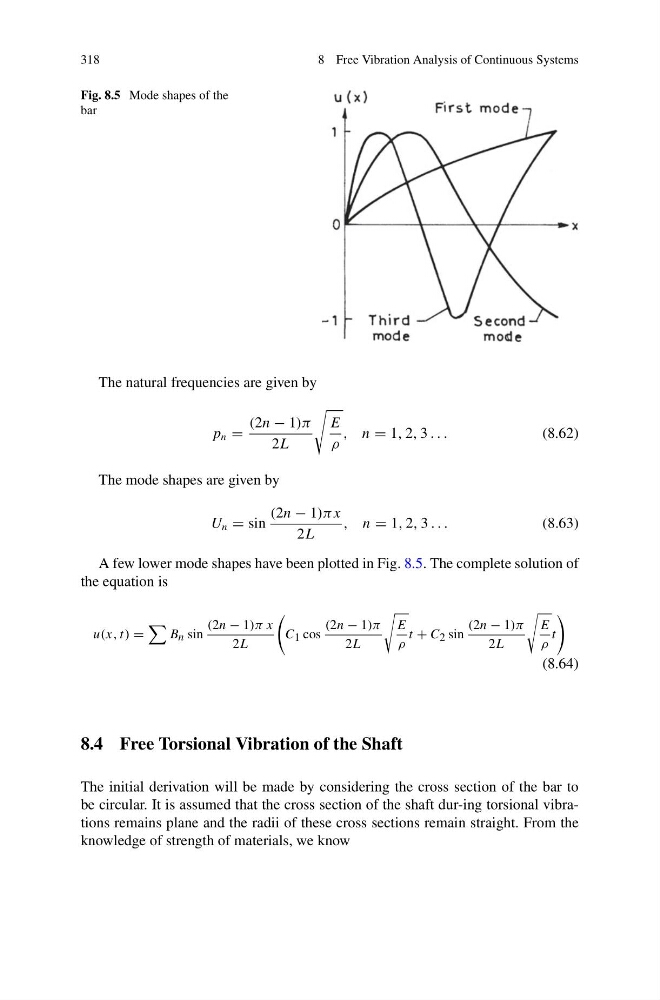
Fig. 8.5 Mode shapes of the
bar
The natural frequencies are given by
p n =
(2n − 1)π
2L
E
ρ
, n = 1, 2, 3 . . .
(8.62)
The mode shapes are given by
U n = sin
(2n − 1)π x
2L
, n = 1, 2, 3 . . .
(8.63)
A few lower mode shapes have been plotted in Fig. 8.5. The complete solution of
the equation is
u(x, t) =
B n sin
(2n − 1)π x
2L
C 1 cos
(2n − 1)π
2L
E
ρ
t + C 2 sin
(2n − 1)π
2L
E
ρ
t
(8.64)
8.4 Free Torsional Vibration of the Shaft
The initial derivation will be made by considering the cross section of the bar to
be circular. It is assumed that the cross section of the shaft dur-ing torsional vibrations remains plane and the radii of these cross sections remain straight. From the
knowledge of strength of materials, we know
8 Free Vibration Analysis of Continuous Systems
Fig. 8.5 Mode shapes of the
bar
The natural frequencies are given by
p n =
(2n − 1)π
2L
E
ρ
, n = 1, 2, 3 . . .
(8.62)
The mode shapes are given by
U n = sin
(2n − 1)π x
2L
, n = 1, 2, 3 . . .
(8.63)
A few lower mode shapes have been plotted in Fig. 8.5. The complete solution of
the equation is
u(x, t) =
B n sin
(2n − 1)π x
2L
C 1 cos
(2n − 1)π
2L
E
ρ
t + C 2 sin
(2n − 1)π
2L
E
ρ
t
(8.64)
8.4 Free Torsional Vibration of the Shaft
The initial derivation will be made by considering the cross section of the bar to
be circular. It is assumed that the cross section of the shaft dur-ing torsional vibrations remains plane and the radii of these cross sections remain straight. From the
knowledge of strength of materials, we know