

8.3 Free Longitudinal Vibration of a Bar
317
N = 0
(8.54)
Using the relation of N from Eq. (8.39), we can write
dU
dx
= 0
(8.55)
8.3.1 Free Longitudinal Vibration of a Bar Clamped at X = 0
and Free at X = L
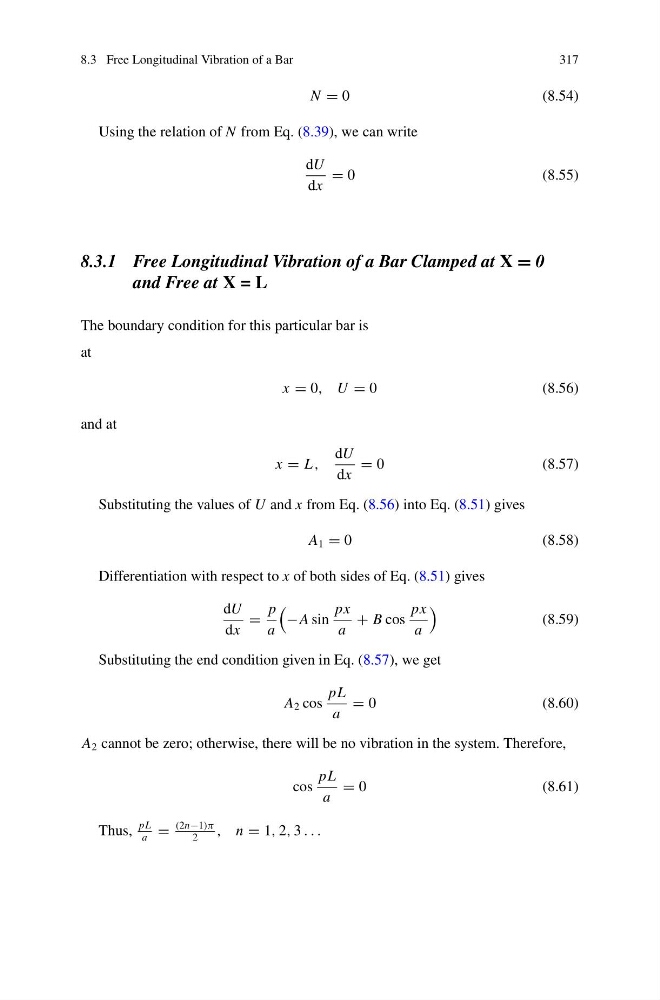
The boundary condition for this particular bar is
at
x = 0, U = 0
(8.56)
and at
x = L ,
dU
dx
= 0
(8.57)
Substituting the values of U and x from Eq. (8.56) into Eq. (8.51) gives
A 1 = 0
(8.58)
Differentiation with respect to x of both sides of Eq. (8.51) gives
dU
dx
=
p
a
−A sin
px
a
+ B cos
px
a
(8.59)
Substituting the end condition given in Eq. (8.57), we get
A 2 cos
pL
a
= 0
(8.60)
A 2 cannot be zero; otherwise, there will be no vibration in the system. Therefore,
cos
pL
a
= 0
(8.61)
Thus,
pL
a
=
(2n−1)π
2
, n = 1, 2, 3 . . .
317
N = 0
(8.54)
Using the relation of N from Eq. (8.39), we can write
dU
dx
= 0
(8.55)
8.3.1 Free Longitudinal Vibration of a Bar Clamped at X = 0
and Free at X = L
The boundary condition for this particular bar is
at
x = 0, U = 0
(8.56)
and at
x = L ,
dU
dx
= 0
(8.57)
Substituting the values of U and x from Eq. (8.56) into Eq. (8.51) gives
A 1 = 0
(8.58)
Differentiation with respect to x of both sides of Eq. (8.51) gives
dU
dx
=
p
a
−A sin
px
a
+ B cos
px
a
(8.59)
Substituting the end condition given in Eq. (8.57), we get
A 2 cos
pL
a
= 0
(8.60)
A 2 cannot be zero; otherwise, there will be no vibration in the system. Therefore,
cos
pL
a
= 0
(8.61)
Thus,
pL
a
=
(2n−1)π
2
, n = 1, 2, 3 . . .