

316
8 Free Vibration Analysis of Continuous Systems
d
2 q
dt 2
q
= −p
2
(8.46)
or
d
2 q
dt 2 + p
2 q = 0
(8.47)
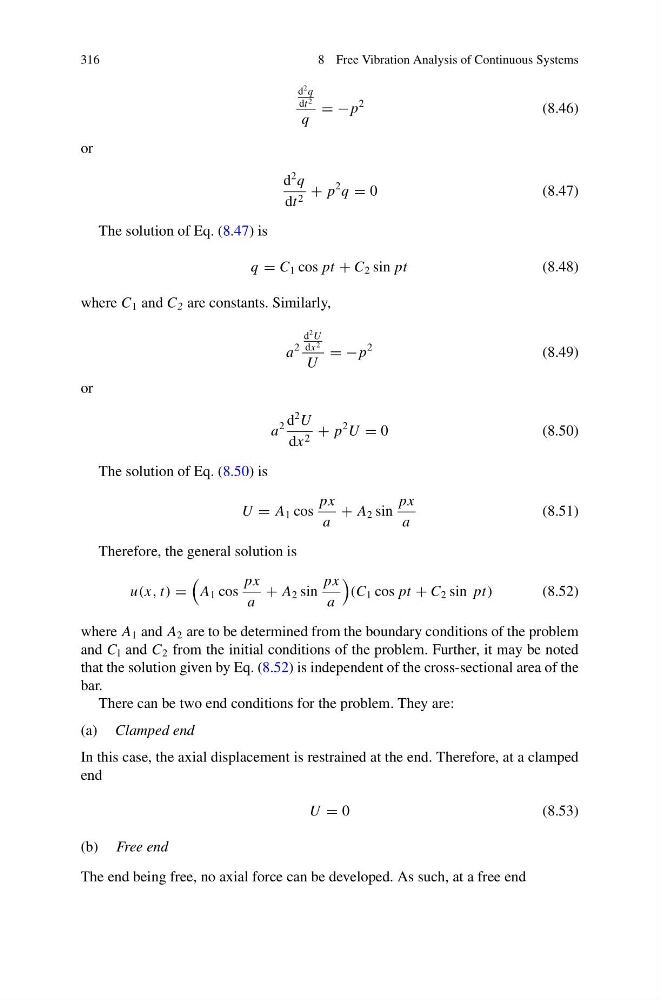
The solution of Eq. (8.47) is
q = C 1 cos pt + C 2 sin pt
(8.48)
where C 1 and C 2 are constants. Similarly,
a
2
d
2 U
dx 2
U
= −p
2
(8.49)
or
a
2 d
2 U
dx 2 + p
2 U = 0
(8.50)
The solution of Eq. (8.50) is
U = A 1 cos
px
a
+ A 2 sin
px
a
(8.51)
Therefore, the general solution is
u(x, t) =
A 1 cos
px
a
+ A 2 sin
px
a
(C 1 cos pt + C 2 sin pt)
(8.52)
where A 1 and A 2 are to be determined from the boundary conditions of the problem
and C l and C 2 from the initial conditions of the problem. Further, it may be noted
that the solution given by Eq. (8.52) is independent of the cross-sectional area of the
bar.
There can be two end conditions for the problem. They are:
(a) Clamped end
In this case, the axial displacement is restrained at the end. Therefore, at a clamped
end
U = 0
(8.53)
(b) Free end
The end being free, no axial force can be developed. As such, at a free end
8 Free Vibration Analysis of Continuous Systems
d
2 q
dt 2
q
= −p
2
(8.46)
or
d
2 q
dt 2 + p
2 q = 0
(8.47)
The solution of Eq. (8.47) is
q = C 1 cos pt + C 2 sin pt
(8.48)
where C 1 and C 2 are constants. Similarly,
a
2
d
2 U
dx 2
U
= −p
2
(8.49)
or
a
2 d
2 U
dx 2 + p
2 U = 0
(8.50)
The solution of Eq. (8.50) is
U = A 1 cos
px
a
+ A 2 sin
px
a
(8.51)
Therefore, the general solution is
u(x, t) =
A 1 cos
px
a
+ A 2 sin
px
a
(C 1 cos pt + C 2 sin pt)
(8.52)
where A 1 and A 2 are to be determined from the boundary conditions of the problem
and C l and C 2 from the initial conditions of the problem. Further, it may be noted
that the solution given by Eq. (8.52) is independent of the cross-sectional area of the
bar.
There can be two end conditions for the problem. They are:
(a) Clamped end
In this case, the axial displacement is restrained at the end. Therefore, at a clamped
end
U = 0
(8.53)
(b) Free end
The end being free, no axial force can be developed. As such, at a free end