

8.3 Free Longitudinal Vibration of a Bar
315
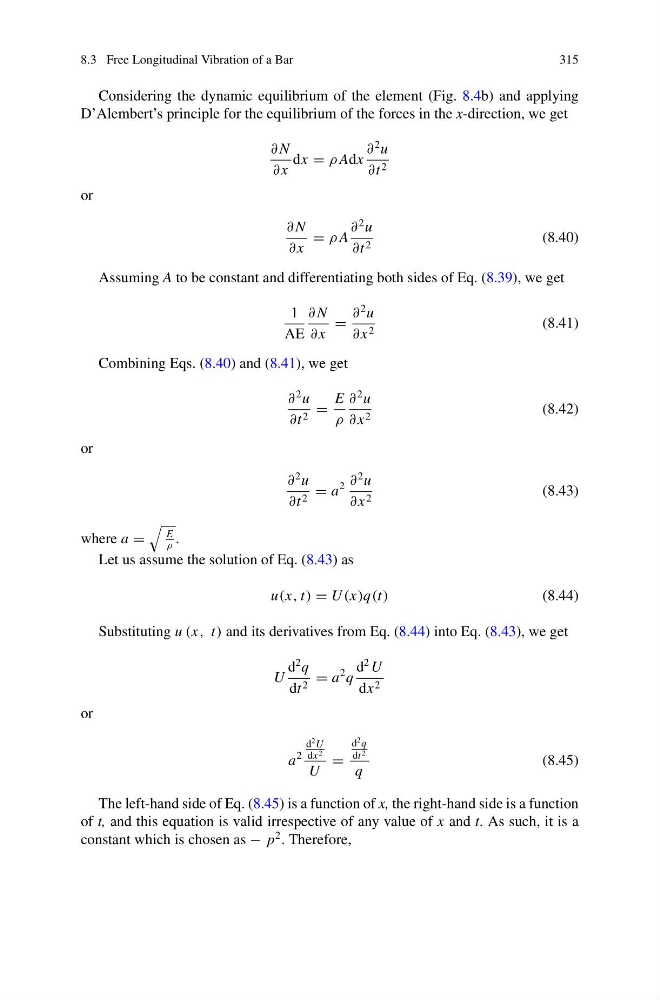
Considering the dynamic equilibrium of the element (Fig. 8.4b) and applying
D’Alembert’s principle for the equilibrium of the forces in the x-direction, we get
∂ N
∂ x
dx = ρ Adx
∂
2 u
∂t 2
or
∂ N
∂ x
= ρ A
∂
2 u
∂t 2
(8.40)
Assuming A to be constant and differentiating both sides of Eq. (8.39), we get
1
AE
∂ N
∂ x
=
∂
2 u
∂ x 2
(8.41)
Combining Eqs. (8.40) and (8.41), we get
∂
2 u
∂t 2 =
E
ρ
∂
2 u
∂ x 2
(8.42)
or
∂
2 u
∂t 2 = a
2 ∂
2 u
∂ x 2
(8.43)
where a =
E
ρ
.
Let us assume the solution of Eq. (8.43) as
u(x, t) = U (x)q(t)
(8.44)
Substituting u (x, t) and its derivatives from Eq. (8.44) into Eq. (8.43), we get
U
d
2 q
dt 2 = a
2 q
d
2 U
dx 2
or
a
2
d
2 U
dx 2
U
=
d
2 q
dt 2
q
(8.45)
The left-hand side of Eq. (8.45) is a function of x, the right-hand side is a function
of t, and this equation is valid irrespective of any value of x and t. As such, it is a
constant which is chosen as − p
2 . Therefore,
315
Considering the dynamic equilibrium of the element (Fig. 8.4b) and applying
D’Alembert’s principle for the equilibrium of the forces in the x-direction, we get
∂ N
∂ x
dx = ρ Adx
∂
2 u
∂t 2
or
∂ N
∂ x
= ρ A
∂
2 u
∂t 2
(8.40)
Assuming A to be constant and differentiating both sides of Eq. (8.39), we get
1
AE
∂ N
∂ x
=
∂
2 u
∂ x 2
(8.41)
Combining Eqs. (8.40) and (8.41), we get
∂
2 u
∂t 2 =
E
ρ
∂
2 u
∂ x 2
(8.42)
or
∂
2 u
∂t 2 = a
2 ∂
2 u
∂ x 2
(8.43)
where a =
E
ρ
.
Let us assume the solution of Eq. (8.43) as
u(x, t) = U (x)q(t)
(8.44)
Substituting u (x, t) and its derivatives from Eq. (8.44) into Eq. (8.43), we get
U
d
2 q
dt 2 = a
2 q
d
2 U
dx 2
or
a
2
d
2 U
dx 2
U
=
d
2 q
dt 2
q
(8.45)
The left-hand side of Eq. (8.45) is a function of x, the right-hand side is a function
of t, and this equation is valid irrespective of any value of x and t. As such, it is a
constant which is chosen as − p
2 . Therefore,