

314
8 Free Vibration Analysis of Continuous Systems
From Eqs. (8.35) and (8.36), we get
p n =
nπ c
L
=
nπ
L
T
m
n = 1, 2 . . .
(8.37)
Values of p n given by Eq. (8.37) are the allowable vibration frequencies of the
string, for the given boundary conditions.
The purpose of this section is to show alternative approaches of solution which
can sometimes prove to be useful.
8.3 Free Longitudinal Vibration of a Bar
Let us consider the longitudinal vibration of a slender, straight elastic bar. It is
assumed that the cross sections, which are initially plane and per-pendicular to the
axis of the bar, remain plane and perpendicular to the axis at all stages of the vibratory
motion.
Let the bar be uniform and has a cross-sectional area A. E is the modulus of
elasticity of the material of the bar, L is its length, and ρ is the mass of the material
per unit volume.
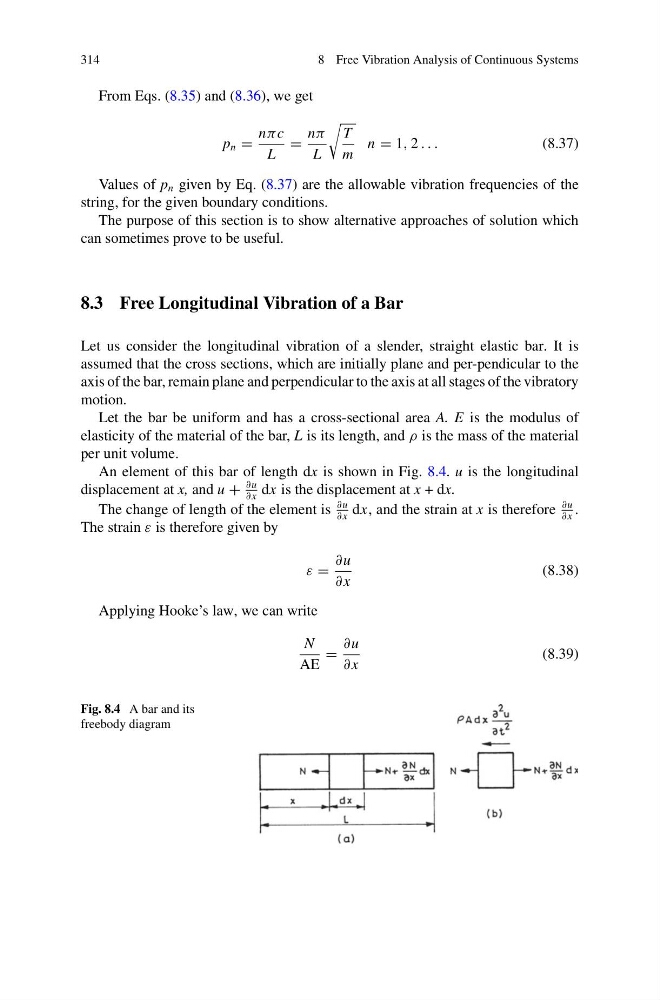
An element of this bar of length dx is shown in Fig. 8.4. u is the longitudinal
displacement at x, and u +
∂u
∂ x
dx is the displacement at x + dx.
The change of length of the element is
∂u
∂ x
dx, and the strain at x is therefore
∂u
∂ x
.
The strain ε is therefore given by
ε =
∂u
∂ x
(8.38)
Applying Hooke’s law, we can write
N
AE
=
∂u
∂ x
(8.39)
Fig. 8.4 A bar and its
freebody diagram
8 Free Vibration Analysis of Continuous Systems
From Eqs. (8.35) and (8.36), we get
p n =
nπ c
L
=
nπ
L
T
m
n = 1, 2 . . .
(8.37)
Values of p n given by Eq. (8.37) are the allowable vibration frequencies of the
string, for the given boundary conditions.
The purpose of this section is to show alternative approaches of solution which
can sometimes prove to be useful.
8.3 Free Longitudinal Vibration of a Bar
Let us consider the longitudinal vibration of a slender, straight elastic bar. It is
assumed that the cross sections, which are initially plane and per-pendicular to the
axis of the bar, remain plane and perpendicular to the axis at all stages of the vibratory
motion.
Let the bar be uniform and has a cross-sectional area A. E is the modulus of
elasticity of the material of the bar, L is its length, and ρ is the mass of the material
per unit volume.
An element of this bar of length dx is shown in Fig. 8.4. u is the longitudinal
displacement at x, and u +
∂u
∂ x
dx is the displacement at x + dx.
The change of length of the element is
∂u
∂ x
dx, and the strain at x is therefore
∂u
∂ x
.
The strain ε is therefore given by
ε =
∂u
∂ x
(8.38)
Applying Hooke’s law, we can write
N
AE
=
∂u
∂ x
(8.39)
Fig. 8.4 A bar and its
freebody diagram