

8.2 Vibration of Strings
313
For the right-going wave,
p =
2π c
λ
(8.28)
or,
τ =
λ
c
(8.29)
or,
λ = τ c
(8.30)
The number of waves per unit length, known as wave number d, equals the inverse
of the wavelength, α = 1/λ. With these new definitions, the right-going wave can
be written as
y(x, t) = A sin(2παx − pt)
(8.31)
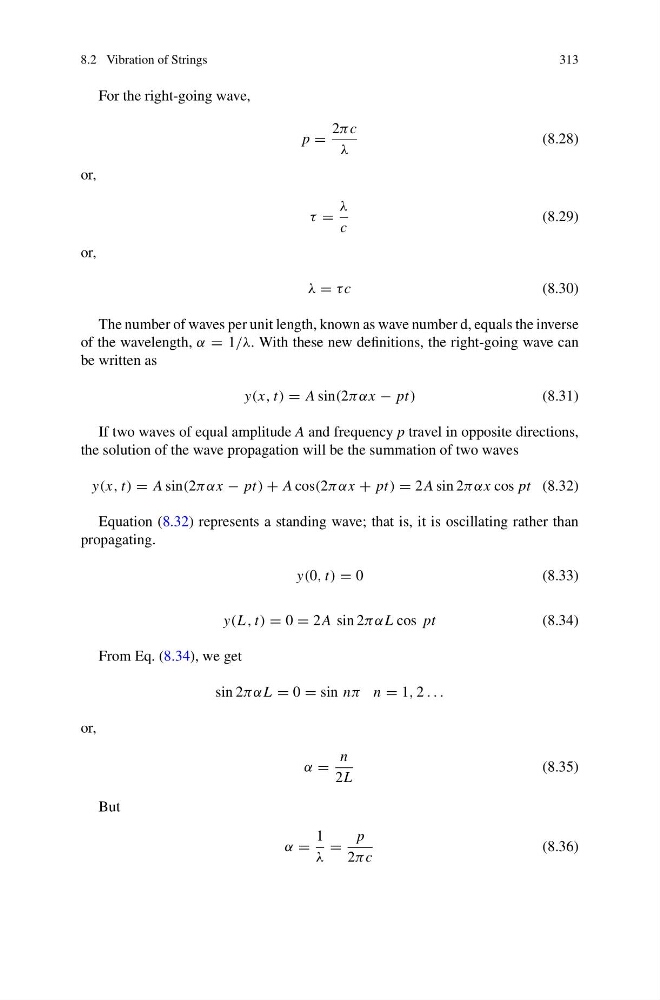
If two waves of equal amplitude A and frequency p travel in opposite directions,
the solution of the wave propagation will be the summation of two waves
y(x, t) = A sin(2παx − pt) + A cos(2παx + pt) = 2 A sin 2παx cos pt (8.32)
Equation (8.32) represents a standing wave; that is, it is oscillating rather than
propagating.
y(0, t) = 0
(8.33)
y(L , t) = 0 = 2 A sin 2παL cos pt
(8.34)
From Eq. (8.34), we get
sin 2παL = 0 = sin nπ n = 1, 2 . . .
or,
α =
n
2L
(8.35)
But
α =
1
λ
=
p
2π c
(8.36)
313
For the right-going wave,
p =
2π c
λ
(8.28)
or,
τ =
λ
c
(8.29)
or,
λ = τ c
(8.30)
The number of waves per unit length, known as wave number d, equals the inverse
of the wavelength, α = 1/λ. With these new definitions, the right-going wave can
be written as
y(x, t) = A sin(2παx − pt)
(8.31)
If two waves of equal amplitude A and frequency p travel in opposite directions,
the solution of the wave propagation will be the summation of two waves
y(x, t) = A sin(2παx − pt) + A cos(2παx + pt) = 2 A sin 2παx cos pt (8.32)
Equation (8.32) represents a standing wave; that is, it is oscillating rather than
propagating.
y(0, t) = 0
(8.33)
y(L , t) = 0 = 2 A sin 2παL cos pt
(8.34)
From Eq. (8.34), we get
sin 2παL = 0 = sin nπ n = 1, 2 . . .
or,
α =
n
2L
(8.35)
But
α =
1
λ
=
p
2π c
(8.36)