

312
8 Free Vibration Analysis of Continuous Systems
The following derivatives are obtained
∂
2 y
∂t 2 = c
2 ∂ F 1
∂t 2 + c
2 ∂
2 F 2
∂t 2
(8.23)
∂
2 y
∂ x 2 =
∂
2 F 1
∂ x 2 +
∂
2 F 2
∂ x 2
(8.24)
Substituting the above values in Eq. (8.21) yields
∂
2 F 1
∂ x 2 +
∂
2 F 2
∂ x 2 =
1
c 2
c
2 ∂
2 F 1
∂t 2 + c
2 ∂
2 F 2
∂t 2
(8.25)
to find that it is satisfied for any two different functions of x ∓ ct.
In order to demonstrate this, a harmonic solution is assumed
y(x, t) = A sin
2π
λ
(x − ct) + B cos
2π
λ
(x + ct)
(8.26)
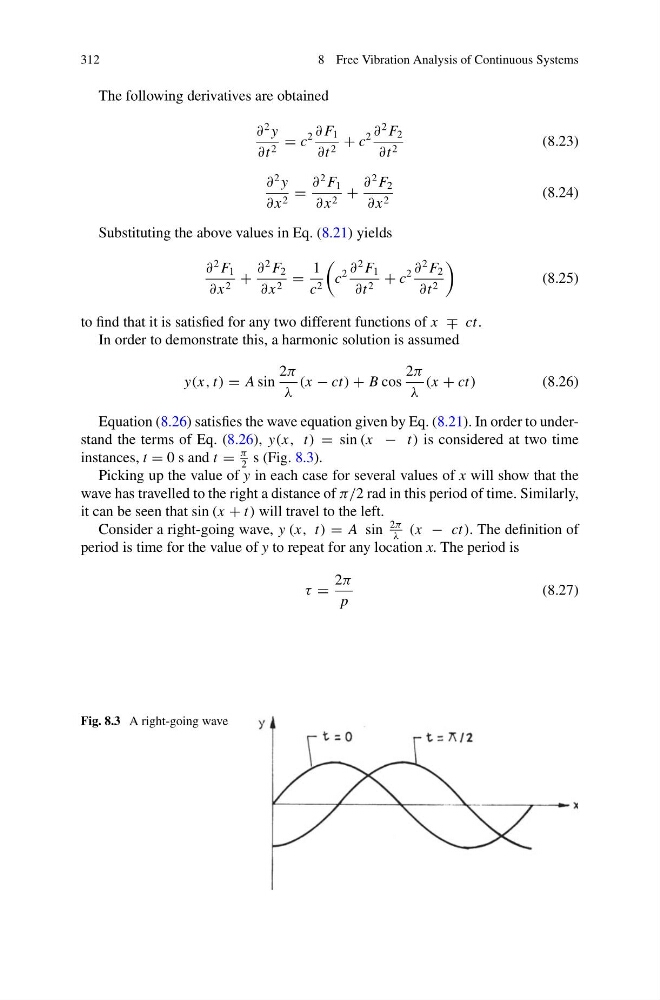
Equation (8.26) satisfies the wave equation given by Eq. (8.21). In order to understand the terms of Eq. (8.26), y(x, t) = sin (x − t) is considered at two time
instances, t = 0 s and t =
π
2
s (Fig. 8.3).
Picking up the value of y in each case for several values of x will show that the
wave has travelled to the right a distance of π/2 rad in this period of time. Similarly,
it can be seen that sin (x + t) will travel to the left.
Consider a right-going wave, y (x, t) = A sin
2π
λ
(x − ct). The definition of
period is time for the value of y to repeat for any location x. The period is
τ =
2π
p
(8.27)
Fig. 8.3 A right-going wave
8 Free Vibration Analysis of Continuous Systems
The following derivatives are obtained
∂
2 y
∂t 2 = c
2 ∂ F 1
∂t 2 + c
2 ∂
2 F 2
∂t 2
(8.23)
∂
2 y
∂ x 2 =
∂
2 F 1
∂ x 2 +
∂
2 F 2
∂ x 2
(8.24)
Substituting the above values in Eq. (8.21) yields
∂
2 F 1
∂ x 2 +
∂
2 F 2
∂ x 2 =
1
c 2
c
2 ∂
2 F 1
∂t 2 + c
2 ∂
2 F 2
∂t 2
(8.25)
to find that it is satisfied for any two different functions of x ∓ ct.
In order to demonstrate this, a harmonic solution is assumed
y(x, t) = A sin
2π
λ
(x − ct) + B cos
2π
λ
(x + ct)
(8.26)
Equation (8.26) satisfies the wave equation given by Eq. (8.21). In order to understand the terms of Eq. (8.26), y(x, t) = sin (x − t) is considered at two time
instances, t = 0 s and t =
π
2
s (Fig. 8.3).
Picking up the value of y in each case for several values of x will show that the
wave has travelled to the right a distance of π/2 rad in this period of time. Similarly,
it can be seen that sin (x + t) will travel to the left.
Consider a right-going wave, y (x, t) = A sin
2π
λ
(x − ct). The definition of
period is time for the value of y to repeat for any location x. The period is
τ =
2π
p
(8.27)
Fig. 8.3 A right-going wave