

8.2 Vibration of Strings
309
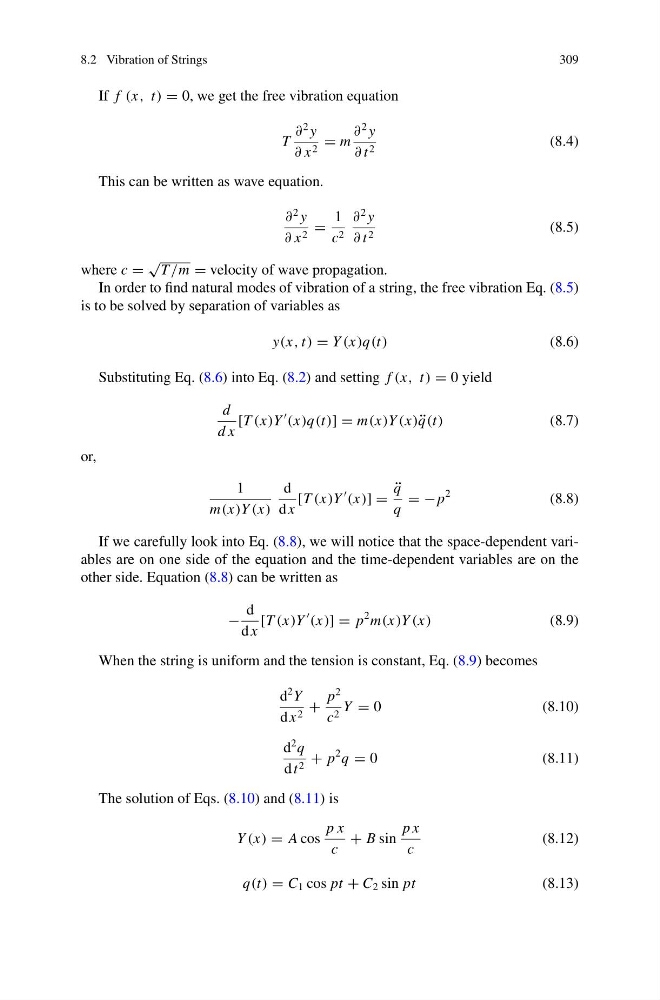
If f (x, t) = 0, we get the free vibration equation
T
∂
2 y
∂ x 2 = m
∂
2 y
∂ t 2
(8.4)
This can be written as wave equation.
∂
2 y
∂ x 2 =
1
c 2
∂
2 y
∂ t 2
(8.5)
where c =
√
T /m = velocity of wave propagation.
In order to find natural modes of vibration of a string, the free vibration Eq. (8.5)
is to be solved by separation of variables as
y(x, t) = Y (x)q(t)
(8.6)
Substituting Eq. (8.6) into Eq. (8.2) and setting f (x, t) = 0 yield
d
d x
[T (x)Y
(x)q(t)] = m(x)Y (x) ¨
q(t)
(8.7)
or,
1
m(x)Y (x)
d
d x
[T (x)Y
(x)] =
¨
q
q
= −p
2
(8.8)
If we carefully look into Eq. (8.8), we will notice that the space-dependent variables are on one side of the equation and the time-dependent variables are on the
other side. Equation (8.8) can be written as
−
d
d x
[T (x)Y
(x)] = p
2 m(x)Y (x)
(8.9)
When the string is uniform and the tension is constant, Eq. (8.9) becomes
d
2 Y
d x 2 +
p
2
c 2 Y = 0
(8.10)
d
2 q
d t 2 + p
2 q = 0
(8.11)
The solution of Eqs. (8.10) and (8.11) is
Y (x) = A cos
p x
c
+ B sin
p x
c
(8.12)
q(t) = C 1 cos pt + C 2 sin pt
(8.13)
309
If f (x, t) = 0, we get the free vibration equation
T
∂
2 y
∂ x 2 = m
∂
2 y
∂ t 2
(8.4)
This can be written as wave equation.
∂
2 y
∂ x 2 =
1
c 2
∂
2 y
∂ t 2
(8.5)
where c =
√
T /m = velocity of wave propagation.
In order to find natural modes of vibration of a string, the free vibration Eq. (8.5)
is to be solved by separation of variables as
y(x, t) = Y (x)q(t)
(8.6)
Substituting Eq. (8.6) into Eq. (8.2) and setting f (x, t) = 0 yield
d
d x
[T (x)Y
(x)q(t)] = m(x)Y (x) ¨
q(t)
(8.7)
or,
1
m(x)Y (x)
d
d x
[T (x)Y
(x)] =
¨
q
q
= −p
2
(8.8)
If we carefully look into Eq. (8.8), we will notice that the space-dependent variables are on one side of the equation and the time-dependent variables are on the
other side. Equation (8.8) can be written as
−
d
d x
[T (x)Y
(x)] = p
2 m(x)Y (x)
(8.9)
When the string is uniform and the tension is constant, Eq. (8.9) becomes
d
2 Y
d x 2 +
p
2
c 2 Y = 0
(8.10)
d
2 q
d t 2 + p
2 q = 0
(8.11)
The solution of Eqs. (8.10) and (8.11) is
Y (x) = A cos
p x
c
+ B sin
p x
c
(8.12)
q(t) = C 1 cos pt + C 2 sin pt
(8.13)