

308
8 Free Vibration Analysis of Continuous Systems
8.2 Vibration of Strings
Study of vibration of strings will be helpful in understanding the dynamic behaviour
of strings.
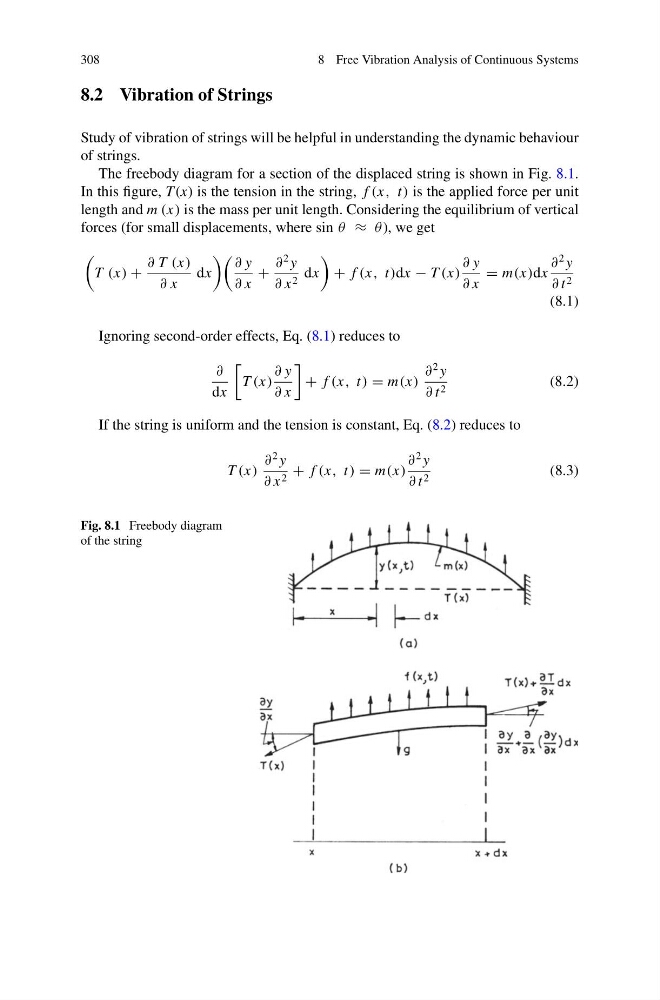
The freebody diagram for a section of the displaced string is shown in Fig. 8.1.
In this figure, T (x) is the tension in the string, f (x, t) is the applied force per unit
length and m (x) is the mass per unit length. Considering the equilibrium of vertical
forces (for small displacements, where sin θ ≈ θ ), we get
T (x) +
∂ T (x)
∂ x
dx
∂ y
∂ x
+
∂
2 y
∂ x 2 dx
+ f (x, t)dx − T (x)
∂ y
∂ x
= m(x)dx
∂
2 y
∂ t 2
(8.1)
Ignoring second-order effects, Eq. (8.1) reduces to
∂
dx
T (x)
∂ y
∂ x
+ f (x, t) = m(x)
∂
2 y
∂ t 2
(8.2)
If the string is uniform and the tension is constant, Eq. (8.2) reduces to
T (x)
∂
2 y
∂ x 2 + f (x, t) = m(x)
∂
2 y
∂ t 2
(8.3)
Fig. 8.1 Freebody diagram
of the string
8 Free Vibration Analysis of Continuous Systems
8.2 Vibration of Strings
Study of vibration of strings will be helpful in understanding the dynamic behaviour
of strings.
The freebody diagram for a section of the displaced string is shown in Fig. 8.1.
In this figure, T (x) is the tension in the string, f (x, t) is the applied force per unit
length and m (x) is the mass per unit length. Considering the equilibrium of vertical
forces (for small displacements, where sin θ ≈ θ ), we get
T (x) +
∂ T (x)
∂ x
dx
∂ y
∂ x
+
∂
2 y
∂ x 2 dx
+ f (x, t)dx − T (x)
∂ y
∂ x
= m(x)dx
∂
2 y
∂ t 2
(8.1)
Ignoring second-order effects, Eq. (8.1) reduces to
∂
dx
T (x)
∂ y
∂ x
+ f (x, t) = m(x)
∂
2 y
∂ t 2
(8.2)
If the string is uniform and the tension is constant, Eq. (8.2) reduces to
T (x)
∂
2 y
∂ x 2 + f (x, t) = m(x)
∂
2 y
∂ t 2
(8.3)
Fig. 8.1 Freebody diagram
of the string