

310
8 Free Vibration Analysis of Continuous Systems
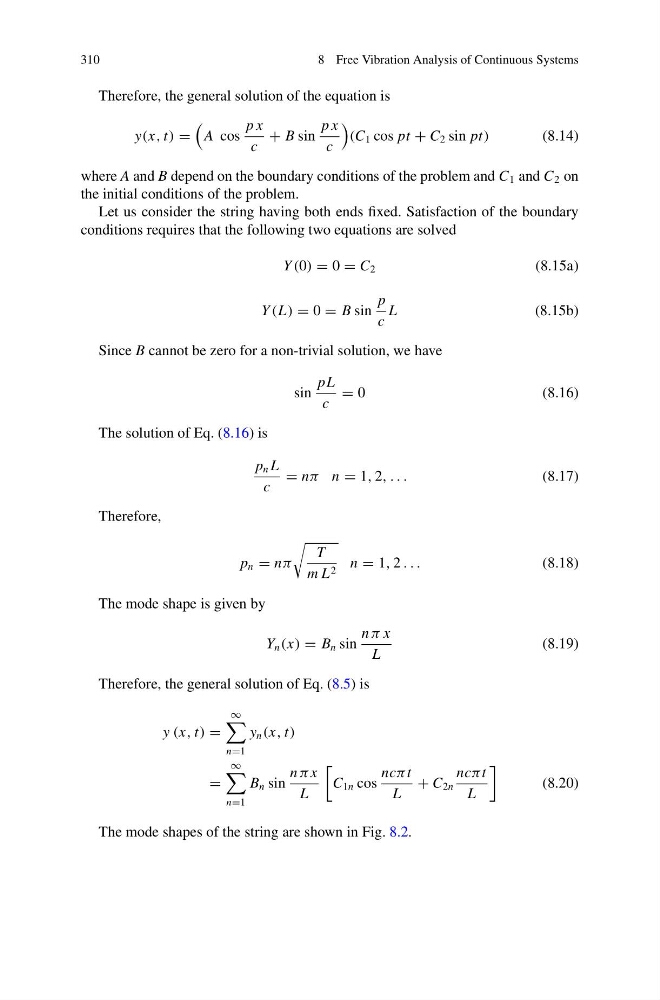
Therefore, the general solution of the equation is
y(x, t) =
A cos
p x
c
+ B sin
p x
c
(C 1 cos pt + C 2 sin pt)
(8.14)
where A and B depend on the boundary conditions of the problem and C 1 and C 2 on
the initial conditions of the problem.
Let us consider the string having both ends fixed. Satisfaction of the boundary
conditions requires that the following two equations are solved
Y (0) = 0 = C 2
(8.15a)
Y (L) = 0 = B sin
p
c
L
(8.15b)
Since B cannot be zero for a non-trivial solution, we have
sin
pL
c
= 0
(8.16)
The solution of Eq. (8.16) is
p n L
c
= nπ n = 1, 2, . . .
(8.17)
Therefore,
p n = nπ
T
m L 2 n = 1, 2 . . .
(8.18)
The mode shape is given by
Y n (x) = B n sin
n π x
L
(8.19)
Therefore, the general solution of Eq. (8.5) is
y (x, t) =
∞
n=1
y n (x, t)
=
∞
n=1
B n sin
n π x
L
C 1n cos
ncπ t
L
+ C 2n
ncπ t
L
(8.20)
The mode shapes of the string are shown in Fig. 8.2.
8 Free Vibration Analysis of Continuous Systems
Therefore, the general solution of the equation is
y(x, t) =
A cos
p x
c
+ B sin
p x
c
(C 1 cos pt + C 2 sin pt)
(8.14)
where A and B depend on the boundary conditions of the problem and C 1 and C 2 on
the initial conditions of the problem.
Let us consider the string having both ends fixed. Satisfaction of the boundary
conditions requires that the following two equations are solved
Y (0) = 0 = C 2
(8.15a)
Y (L) = 0 = B sin
p
c
L
(8.15b)
Since B cannot be zero for a non-trivial solution, we have
sin
pL
c
= 0
(8.16)
The solution of Eq. (8.16) is
p n L
c
= nπ n = 1, 2, . . .
(8.17)
Therefore,
p n = nπ
T
m L 2 n = 1, 2 . . .
(8.18)
The mode shape is given by
Y n (x) = B n sin
n π x
L
(8.19)
Therefore, the general solution of Eq. (8.5) is
y (x, t) =
∞
n=1
y n (x, t)
=
∞
n=1
B n sin
n π x
L
C 1n cos
ncπ t
L
+ C 2n
ncπ t
L
(8.20)
The mode shapes of the string are shown in Fig. 8.2.