

302
7 Forced Vibration Analysis of Multiple Degrees of Freedom System
Splitting the load into real and imaginary parts gives (Eq. 7.109)
x
∗
= [H ]
−1
F
(r )
R
+ i[H ]
−1
F
(r )
I
(7.117)
If we assume that the real part of the load vector has the solution, then
x
∗(r )
R
R + i
x
∗(r )
I
R = [H ]
−1
F
(r )
R
(7.118)
and imaginary part of the load vector has the solution,
x
∗(r )
R
I + i
x
∗(r )
I
I = [H ]
−1
F
(r )
I
(7.119)
Combining Eqs. (7.117), (7.118) and (7.119) indicates that the solution for a
complex load vector may be found from a combination of two separate solutions of
the complex equation with the real part and imaginary part of the load vector as real
right-hand sides of the complex equation
x
∗
=
x
(r )
R
R + i
x
(r )
I
R + i
x
(r )
R
I +
x
(r )
I
I
=
x
(r )
R
R −
x
(r )
I
I +
i
x
(r )
R
I +
x
(r )
I
R
(7.120)
Exercise 7
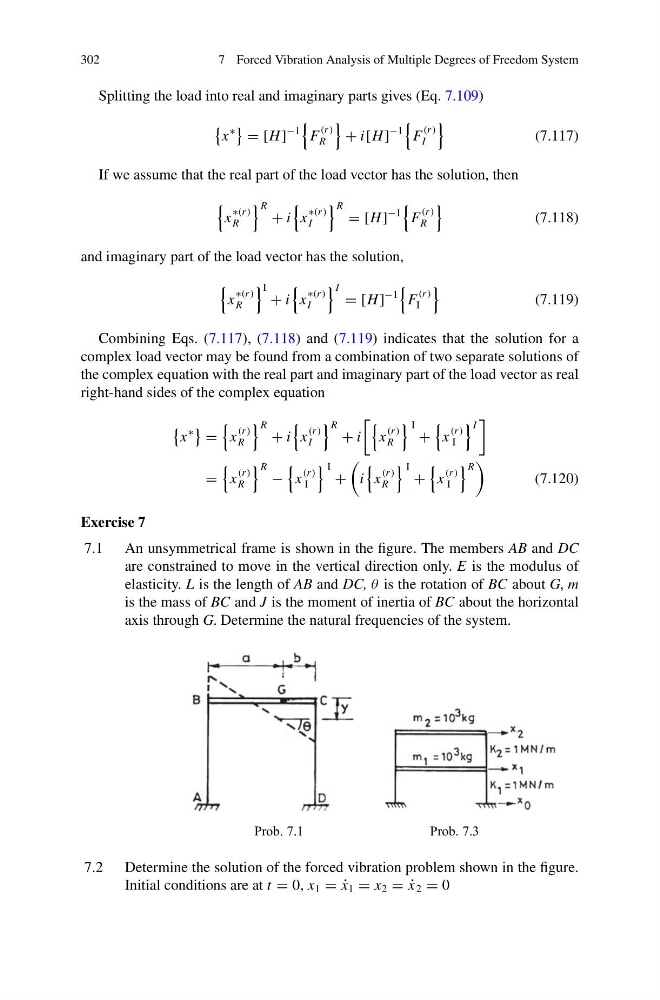
7.1 An unsymmetrical frame is shown in the figure. The members AB and DC
are constrained to move in the vertical direction only. E is the modulus of
elasticity. L is the length of AB and DC, θ is the rotation of BC about G, m
is the mass of BC and J is the moment of inertia of BC about the horizontal
axis through G. Determine the natural frequencies of the system.
Prob. 7.1
Prob. 7.3
7.2 Determine the solution of the forced vibration problem shown in the figure.
Initial conditions are at t = 0, x 1 = ˙
x 1 = x 2 = ˙
x 2 = 0
7 Forced Vibration Analysis of Multiple Degrees of Freedom System
Splitting the load into real and imaginary parts gives (Eq. 7.109)
x
∗
= [H ]
−1
F
(r )
R
+ i[H ]
−1
F
(r )
I
(7.117)
If we assume that the real part of the load vector has the solution, then
x
∗(r )
R
R + i
x
∗(r )
I
R = [H ]
−1
F
(r )
R
(7.118)
and imaginary part of the load vector has the solution,
x
∗(r )
R
I + i
x
∗(r )
I
I = [H ]
−1
F
(r )
I
(7.119)
Combining Eqs. (7.117), (7.118) and (7.119) indicates that the solution for a
complex load vector may be found from a combination of two separate solutions of
the complex equation with the real part and imaginary part of the load vector as real
right-hand sides of the complex equation
x
∗
=
x
(r )
R
R + i
x
(r )
I
R + i
x
(r )
R
I +
x
(r )
I
I
=
x
(r )
R
R −
x
(r )
I
I +
i
x
(r )
R
I +
x
(r )
I
R
(7.120)
Exercise 7
7.1 An unsymmetrical frame is shown in the figure. The members AB and DC
are constrained to move in the vertical direction only. E is the modulus of
elasticity. L is the length of AB and DC, θ is the rotation of BC about G, m
is the mass of BC and J is the moment of inertia of BC about the horizontal
axis through G. Determine the natural frequencies of the system.
Prob. 7.1
Prob. 7.3
7.2 Determine the solution of the forced vibration problem shown in the figure.
Initial conditions are at t = 0, x 1 = ˙
x 1 = x 2 = ˙
x 2 = 0