

7.12 Frequency Domain Analysis of Direct Frequency Response Method
303
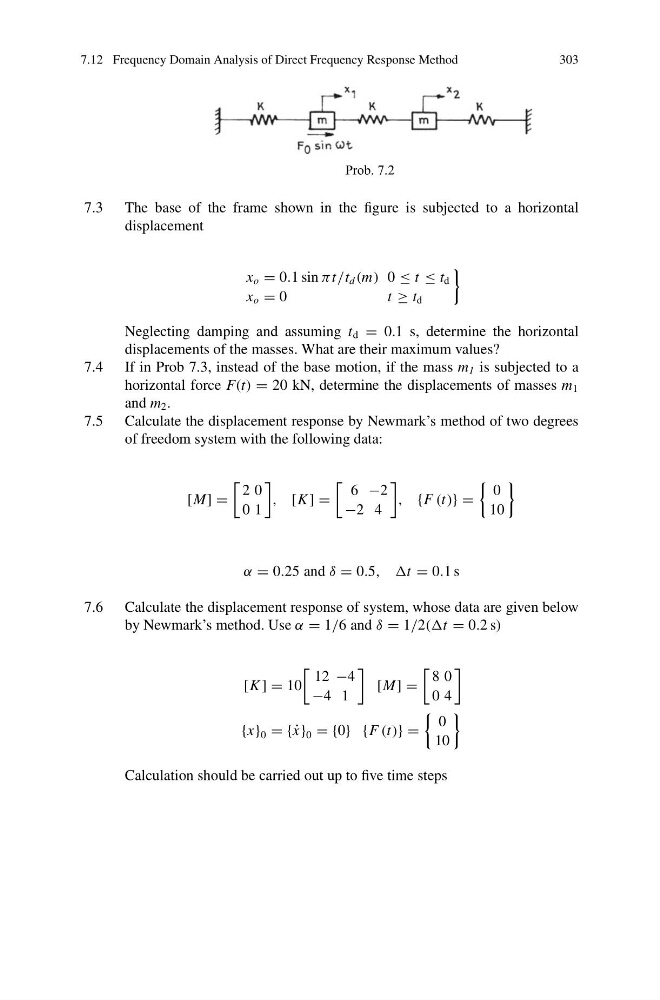
Prob. 7.2
7.3 The base of the frame shown in the figure is subjected to a horizontal
displacement
x o = 0.1 sin π t/t d (m)
x o = 0
0 ≤ t ≤ t d
t ≥ t d
Neglecting damping and assuming t d = 0.1 s, determine the horizontal
displacements of the masses. What are their maximum values?
7.4 If in Prob 7.3, instead of the base motion, if the mass m 1 is subjected to a
horizontal force F(t) = 20 kN, determine the displacements of masses m 1
and m 2 .
7.5 Calculate the displacement response by Newmark’s method of two degrees
of freedom system with the following data:
[M] =
2 0
0 1
, [K ] =
6 −2
−2 4
, {F (t)} =
0
10
α = 0.25 and δ = 0.5, ,t = 0.1 s
7.6 Calculate the displacement response of system, whose data are given below
by Newmark’s method. Use α = 1/6 and δ = 1/2( = 0.2 s)
[K ] = 10
12 −4
−4 1
[M] =
8 0
0 4
{x} 0 = { ˙
x} 0 = {0} {F (t)} =
0
10
Calculation should be carried out up to five time steps
303
Prob. 7.2
7.3 The base of the frame shown in the figure is subjected to a horizontal
displacement
x o = 0.1 sin π t/t d (m)
x o = 0
0 ≤ t ≤ t d
t ≥ t d
Neglecting damping and assuming t d = 0.1 s, determine the horizontal
displacements of the masses. What are their maximum values?
7.4 If in Prob 7.3, instead of the base motion, if the mass m 1 is subjected to a
horizontal force F(t) = 20 kN, determine the displacements of masses m 1
and m 2 .
7.5 Calculate the displacement response by Newmark’s method of two degrees
of freedom system with the following data:
[M] =
2 0
0 1
, [K ] =
6 −2
−2 4
, {F (t)} =
0
10
α = 0.25 and δ = 0.5, ,t = 0.1 s
7.6 Calculate the displacement response of system, whose data are given below
by Newmark’s method. Use α = 1/6 and δ = 1/2( = 0.2 s)
[K ] = 10
12 −4
−4 1
[M] =
8 0
0 4
{x} 0 = { ˙
x} 0 = {0} {F (t)} =
0
10
Calculation should be carried out up to five time steps