

278
7 Forced Vibration Analysis of Multiple Degrees of Freedom System
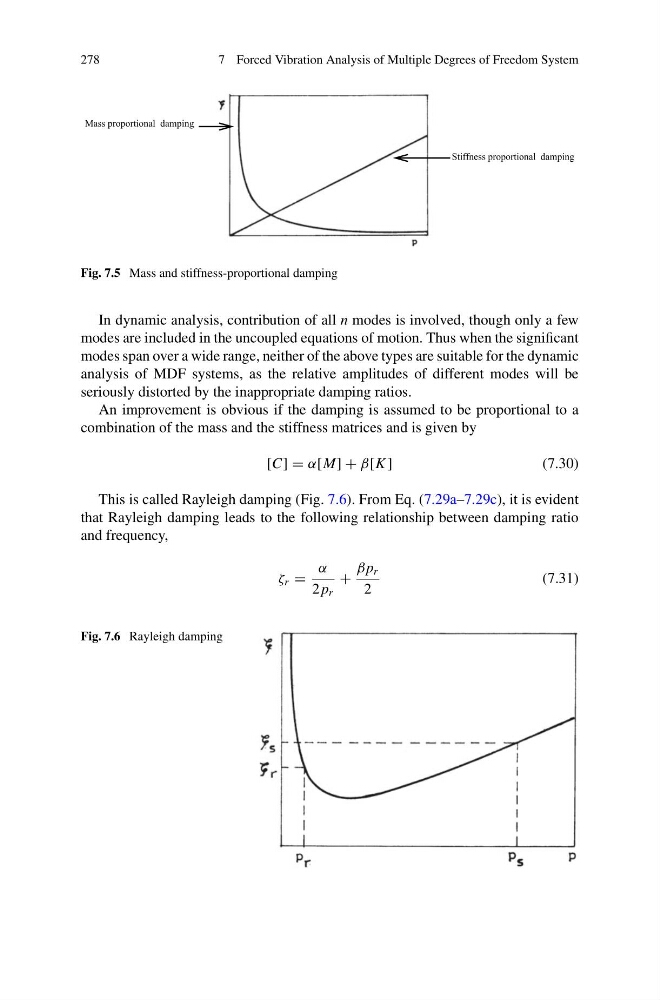
Mass proportional damping
Stiffness proportional damping
Fig. 7.5 Mass and stiffness-proportional damping
In dynamic analysis, contribution of all n modes is involved, though only a few
modes are included in the uncoupled equations of motion. Thus when the significant
modes span over a wide range, neither of the above types are suitable for the dynamic
analysis of MDF systems, as the relative amplitudes of different modes will be
seriously distorted by the inappropriate damping ratios.
An improvement is obvious if the damping is assumed to be proportional to a
combination of the mass and the stiffness matrices and is given by
[C] = α[M] + β[K ]
(7.30)
This is called Rayleigh damping (Fig. 7.6). From Eq. (7.29a–7.29c), it is evident
that Rayleigh damping leads to the following relationship between damping ratio
and frequency,
ζ r =
α
2 p r
+
βp r
2
(7.31)
Fig. 7.6 Rayleigh damping
7 Forced Vibration Analysis of Multiple Degrees of Freedom System
Mass proportional damping
Stiffness proportional damping
Fig. 7.5 Mass and stiffness-proportional damping
In dynamic analysis, contribution of all n modes is involved, though only a few
modes are included in the uncoupled equations of motion. Thus when the significant
modes span over a wide range, neither of the above types are suitable for the dynamic
analysis of MDF systems, as the relative amplitudes of different modes will be
seriously distorted by the inappropriate damping ratios.
An improvement is obvious if the damping is assumed to be proportional to a
combination of the mass and the stiffness matrices and is given by
[C] = α[M] + β[K ]
(7.30)
This is called Rayleigh damping (Fig. 7.6). From Eq. (7.29a–7.29c), it is evident
that Rayleigh damping leads to the following relationship between damping ratio
and frequency,
ζ r =
α
2 p r
+
βp r
2
(7.31)
Fig. 7.6 Rayleigh damping